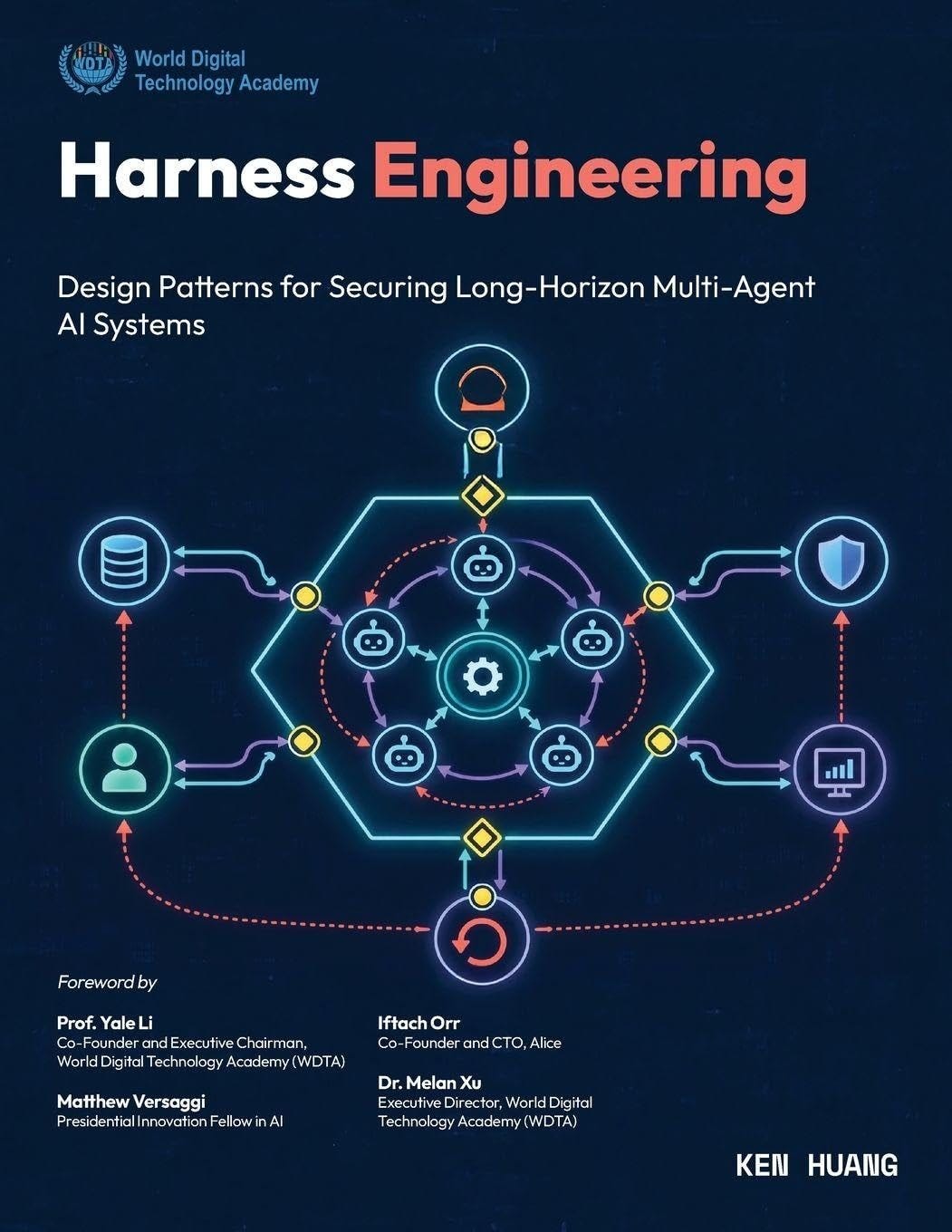
Harness engineering defines the most significant engineering discipline of the agentic era. Software teams encounter countless blog posts and social media discussions about this same topic. Yet the engineering community lacks a systematic technical treatment of harnesses. This book provides that systematic treatment.
One thing is clear: computing is undergoing a foundational transition; engineering teams are moving from traditional software engineering for deterministic execution to harness engineering for non-deterministic computing. This architectural evolution carries broader operational reach than pure code generation. It governs all agentic applications across enterprise infrastructure, autonomous business processes, security operations, and physical AI deployments. This volume provides practical architecture and implementation patterns for teams building any agentic application.
The author thanks four distinguished technology leaders for reviewing the book and contributing forewords:
Prof. Yale Li(Co-Founder and Executive Chairman, World Digital Technology Academy; Chairman, Cloud Security Alliance Greater China Region; Foreign Academician, Ukrainian Academy of Engineering Sciences; Former Global Chief Security Architect, Microsoft): “Build the harness first, and grant autonomy within the boundaries that the harness can enforce, observe, and reverse.“Matthew Versaggi(Presidential Innovation Fellow in AI; Founder, College of Artificial Intelligence): “The durable unit of design is the harness: autonomy bounds, identity delegation, intent contracts, governed memory, observability, runtime steering, fleet coordination, and evidence-based improvement.“Iftach Orr(Co-Founder and CTO, Alice; Co-Lead, OWASP Agentic Skills Top 10 and OWASP AIVSS): “Malicious skills, over-privileged tools, weak isolation, and untrusted external instructions are harness failures before they are model failures.“Dr. Melan Xu(Executive Director, World Digital Technology Academy; Secretary-General, Cloud Security Alliance Greater China Region): “Emerging technology fails in production when control, identity, observation, and accountability are incomplete, and secure harness patterns give engineering communities a shared language for reliable deployment.“
🛒 Buy Harness Engineering on Amazon
The harness coordinates ten foundational pattern families that transform probabilistic foundation models into dependable enterprise infrastructure:
1. Autonomy Boundaries: Engineers configure capability envelopes, permission tiers, human-in-the-loop authorization gates, and operational circuit breakers for every autonomous action. The harness intercepts tool calls exceeding pre-allocated quotas, preventing runaway execution loops and unauthorized infrastructure modifications.
2. Scoped Identity: Security teams bind distinct cryptographic identities to agents, delegating least-privilege tokens and validating session certificates. The harness authenticates inter-agent requests, monitors cryptographic signatures, and prevents unauthorized privilege escalation across cluster boundaries.
3. Intent Contracts: Developers formalize pre-execution schema contracts, validate tool arguments, detect semantic drift, and verify post-condition invariants. Before executing destructive operations, the harness requires cryptographic approval tokens and matches payload checksums against approved task specifications.
4. Context Isolation: Architects separate untrusted external inputs from trusted system instructions, eliminating prompt injection vulnerabilities and context poisoning. The harness partitions working context across isolated subagent scratchpads, sanitizing third-party responses before ingestion.
5. Memory Governance: Platform operators regulate episodic, semantic, and working memory writes through tamper-resistant audit trails and explicit time-to-live policies. The harness enforces strict read-write access control lists, preventing poisoned or unverified data from contaminating long-term vector stores.
6. Structured Observability: Telemetry pipelines record structured spans, OpenTelemetry traces, causal execution graphs, token consumption metrics, and deterministic replay logs. Operations teams inspect step-level causal linkages to diagnose non-deterministic deviations and reconstruct execution paths.
7. Runtime Steering: Control planes provide mid-execution interrupts, policy injection, state rollback to verified checkpoints, and human intervention points during multi-step runs. Engineers pause running workflows, inspect intermediate state payloads, and resume execution without invalidating security guarantees.
8. Fleet Scalability: Orchestration engines coordinate multi-agent swarms, supervise task handoffs, route peer messages, prevent deadlock cycles, and partition distributed state across worker clusters. The harness enforces consensus protocols and mutual exclusion locks across concurrent operations.
9. Data Governance: Governance controllers enforce data egress boundaries, mask confidential credentials, enforce tenancy partitions, and verify regulatory compliance across external API calls. The harness prevents exfiltration by validating outbound payloads against cryptographic schema policies.
10. Empirical Evaluation: Testing teams measure agent performance with deterministic execution harnesses, regression suites, adversarial perturbation benchmarks, and evidence-based improvement cycles. Platform architects require reproducible benchmark scores before promoting updated models or harness configurations to production environments.
Ken Huang, Adjunct Professor at the University of San Francisco (USF) and Co-Chair of the AI Safety, Trust, and Responsibility (AI STR) Working Group at the World Digital Technology Academy (WDTA), authored this work. Packt and WDTA co-publish this volume to establish a shared engineering vocabulary and architectural foundation for the industry.