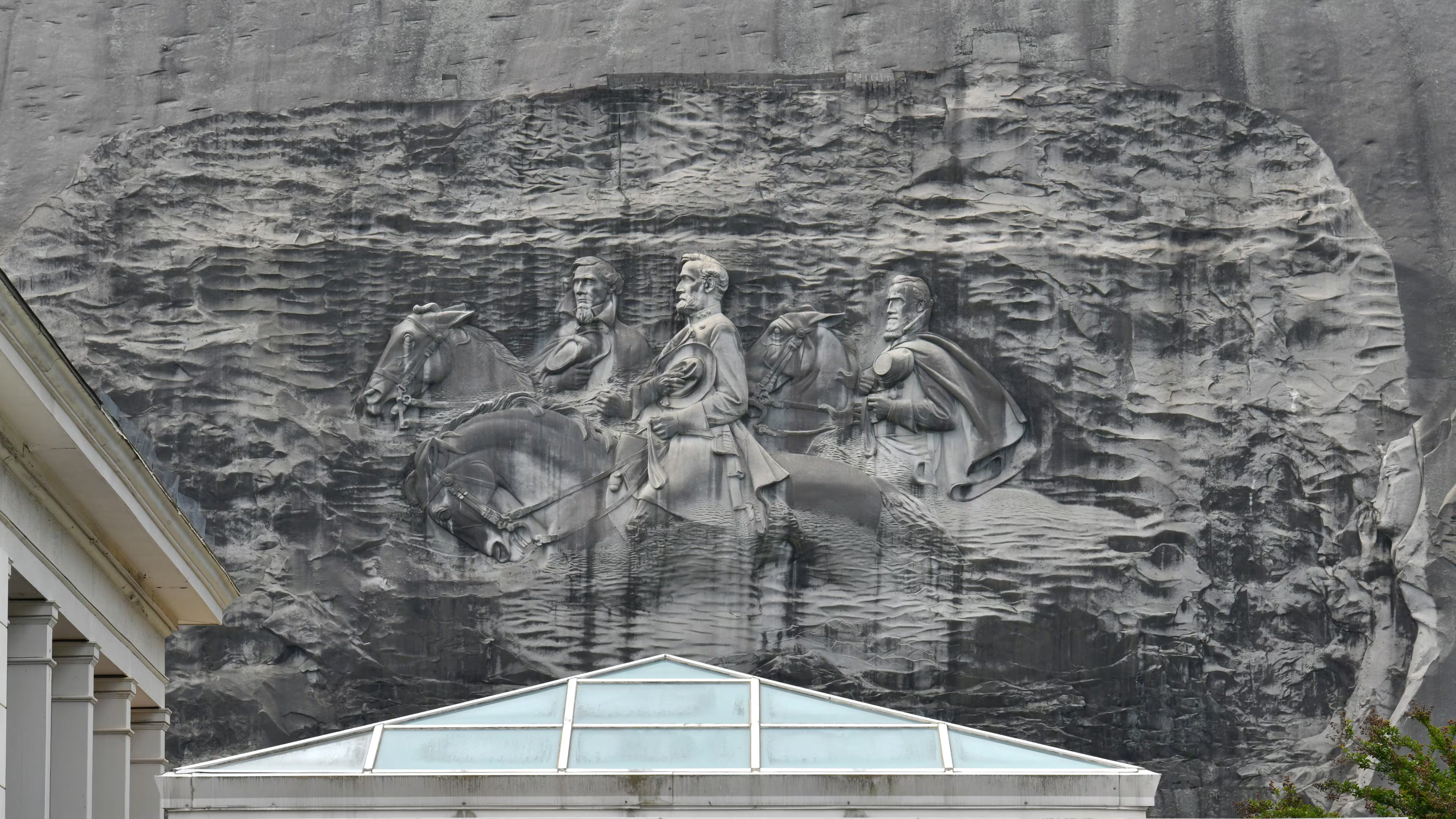
After numerous delays, including a burst pipe, the new museum at Stone Mountain, Georgia has finally opened to the public. To suggest that the challenges are daunting would be an understatement.
The Confederate monument at Stone Mountain isn’t just the largest in the world, it is located on the site of the rebirth of the Ku Klux Klan in 1915. Its construction, over the course of much of the twentieth century, was part of the resistance movement against civil rights in the 1950s and 60s in Georgia.
There have long been calls for its removal and those calls are justified, but a new museum offers, for the first time in its history, the opportunity to use the monument to teach this history and educate the public.
The new Interpretive Center occupies two floors inside Memorial Hall, located on the north side of the park directly across from the Confederate carving. One half of the bottom floor is a theater, where visitors can watch a 15-minute short film about the park’s history….
The new Interpretive Center occupies two floors inside Memorial Hall, located on the north side of the park directly across from the Confederate carving. One half of the bottom floor is a theater, where visitors can watch a 15-minute short film about the park’s history.
Upstairs, the walkthrough exhibition showcases the history of the mountain from how it was formed through the present day, with breakout sessions explaining its role in the Civil War and the inception of the infamous relief sculpture.
One section is dedicated to explaining the “Lost Cause,” the term created after the Civil War in an attempt to recast the Confederacy as noble rather than treasonous. A miniature model partway through the museum depicts what the original plan for the mountainside carving looked like.
Nearly every section of the museum contains interactive elements, including click-through maps, story slides and short videos. On one wall, a still photo of a former slave is brought to life with AI, and an audio track plays in sync with the AI video, allowing him to tell his story in his own words.
Martin O’Toole, spokesman for the the Georgia Division of the Sons of Confederate Veterans disapproves: “As far as I could see, nothing in the plaques was anything but an attack on the Confederacy and through it the Southern people who supported it. This is not a memorial but a one-sided political and historical screed.”
This is certainly a sign that the museum is on track, but it hasn’t precluded pushback.
Some have argued that the interpretation doesn’t go far enough. Others remain focused on removing the monument and have zero interest in using public funds to interpret it.
I understand and appreciate these views. Reasonable people can disagree about the best way forward.
Regardless, the monument will remain in place for the foreseeable future and we need to take every opportunity to tell the truth about it. The museum will remain a work in progress. A good friend of mine in Georgia reminded me that, “Government owned assets are going to be subject to whatever the government officials want them to be. It’s not a private museum which can do what it wants to do.”
It’s anybody’s guess as to the direction of the public debate given the recent election of the state’s first Black governor.
But let’s put this new museum in context. Over the last year and a half we’ve seen nothing but pushback at the federal level against the Smithsonian Institution, National Park Service and other institutions that are committed to telling the same stories and interpreting the same history as the museum at Stone Mountain.
From this perspective, the museum may help to lead the way against this reactionary and racist effort on the part of the Trump administration to censor and distort our history.
Whoever thought it would be the state of Georgia leading the charge?
Even with all the challenges it faces, I am willing to give this new museum a chance. I wish its staff all the best and look forward to visiting soon.