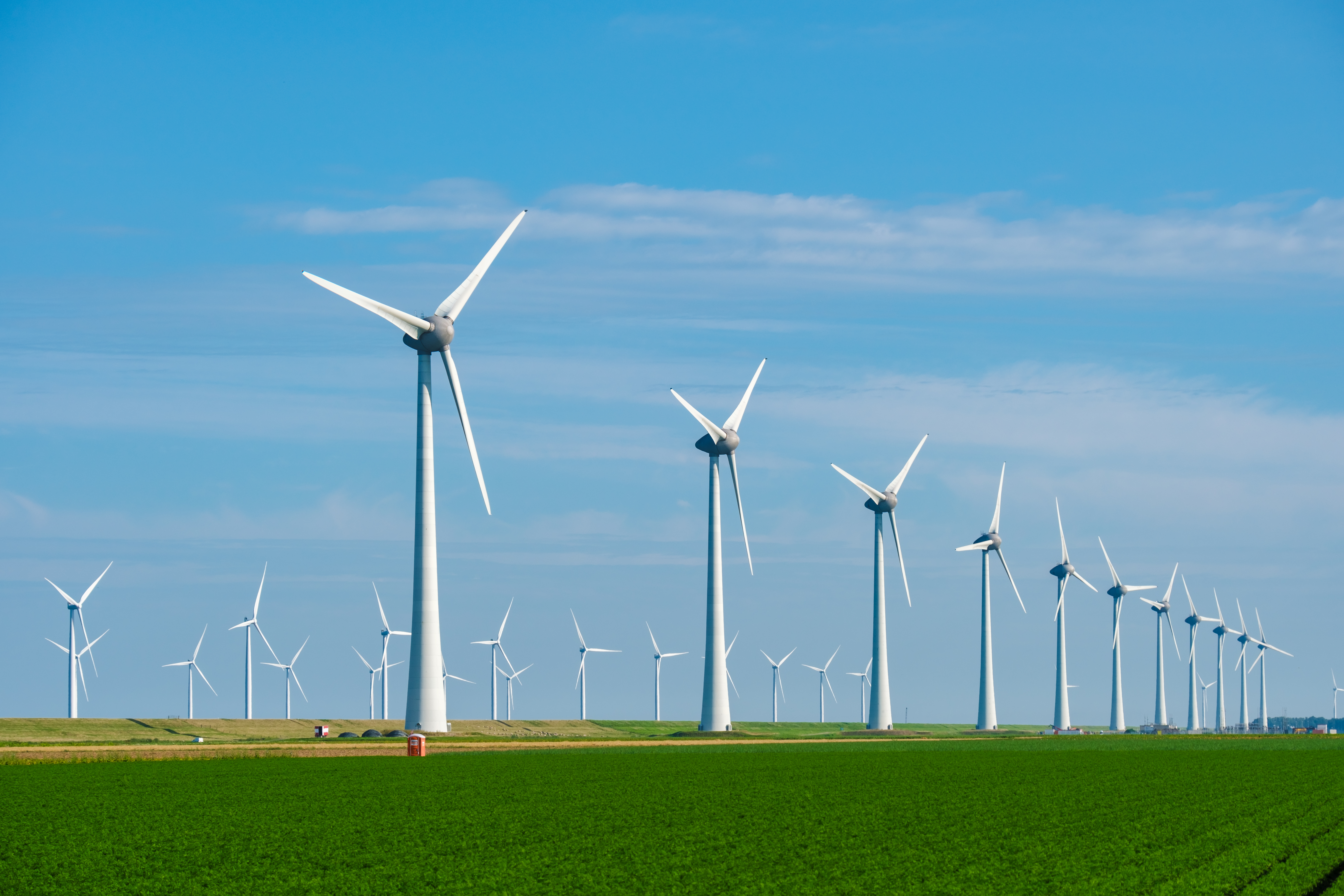
Just as Michigan voters overwhelmingly approved a ballot proposal intended to restrict the political influence of the state’s largest utilities, DTE and Consumers Energy responded by taking the state to federal court. Meanwhile, residents in Williams and Beaver townships are facing the possibility of a massive wind-energy development, one that could reshape portions of the rural landscape they call home, despite years of local debate over whether such projects belong there in the first place.
Click here to sign up to Landen Taylor’s Substack.
On November 3, Michigan voters approved Proposal 2, a measure designed to restrict certain political contributions from regulated utility companies, government contractors, and people or organizations connected to them. The results were hardly close. In Bay County alone, 37,408 people voted in favor of the proposal, compared with just 8,958 who opposed it, according to unofficial election results. That amounts to approximately 81% of participating voters supporting additional restrictions on the political activities of companies whose financial interests are closely tied to decisions made by elected officials.
Two days later, DTE Energy and Consumers Energy filed a federal lawsuit challenging portions of the newly approved restrictions. Around the same time, DTE publicly confirmed that it was exploring a 254-megawatt wind-energy development in Williams and Beaver townships, although the company had not yet finalized or publicly disclosed the precise locations where turbines might eventually stand.
The lawsuit and the wind-farm proposal are separate matters, and the election was certainly not a referendum on renewable energy. Nevertheless, their convergence raises an interesting question about the relationship between Michigan’s utility companies, the government responsible for regulating them, and the communities expected to accommodate their infrastructure.
For residents of Williams Township, the possibility of industrial-scale renewable-energy development is hardly a new concern. In February 2025, the township’s Planning Commission held a public hearing regarding proposed zoning regulations for wind turbines, solar installations, battery-storage facilities, and a renewable-energy overlay district. The meeting attracted a substantial crowd, with residents gathering to express their concerns about what these developments could mean for their properties, their neighbors, and the future of the township.
According to contemporary reporting from the Midland Daily News, several hundred people attended the hearing, with 27 residents speaking during the public-comment period. The township’s official meeting minutes confirm that the hearing lasted more than an hour, beginning at 7:10 p.m. and concluding at 8:15 p.m. The turnout was remarkable for a local planning meeting, particularly one concerning regulations for projects that had not yet been formally approved.
Among those addressing the crowd was Planning Commissioner Steve VanTol, who offered a particularly revealing assessment of the community’s concerns.
“Nobody here wants a (wind turbine), or a battery plant, or a solar farm,” VanTol told those gathered, according to the Midland Daily News.
His statement was an expression of the frustration evident at the meeting, rather than a scientific measurement of public opinion. Not every property owner necessarily shares that position, and some may welcome the opportunity to lease land for renewable-energy development. Nevertheless, the intensity of the discussion demonstrated that township officials were confronting a genuine controversy, one that existed well before DTE publicly identified Williams and Beaver townships as potential locations for its latest project.
The township’s proposed response was to establish a renewable-energy overlay district, identifying specific areas where certain developments could potentially be permitted. The proposed district included Sections 6 and 7, along with the northern half of Section 30, near Williams Township’s western boundary with Midland County. By concentrating potential development within designated areas, officials hoped to exercise some influence over where future projects might be constructed, rather than leaving the entire township exposed to applications for large renewable-energy facilities.
The Planning Commission ultimately voted unanimously to recommend amendments to the township’s zoning ordinance, reflecting an effort to prepare for development pressures that were already becoming apparent. Contemporary reporting also indicated that some local landowners had signed leases anticipating future renewable-energy projects, including agreements involving property outside the proposed overlay district. Those agreements have not been established as contracts with DTE, and there is currently no verified connection between those earlier leases and the company’s newly announced wind project. Their existence does, however, illustrate that renewable-energy development was already being contemplated in the area.
The township’s concerns were shaped in large part by legislation passed in Lansing several years earlier. In November 2023, Governor Gretchen Whitmer signed a package of energy laws intended to accelerate Michigan’s transition toward cleaner electricity generation, including Public Act 233, which established a new state-level permitting process for qualifying renewable-energy developments.
Before the legislation, local governments generally exercised zoning authority over proposed wind and solar developments within their boundaries. Public Act 233, which took effect in November 2024, introduced a process through which developers of sufficiently large projects could seek approval from the Michigan Public Service Commission under certain circumstances. For wind-energy developments, the threshold is 100 megawatts, meaning DTE’s proposed 254-megawatt project would be large enough to qualify for consideration under the state siting framework.
That does not mean DTE can simply ignore every local ordinance or begin construction without obtaining the necessary approvals. The law establishes requirements concerning land agreements, permitting, public participation, and other matters, while preserving local approval processes in circumstances defined by the statute. However, it also creates a potential route for state authorization when specified conditions are met, including situations involving local ordinances that do not satisfy the state’s compatibility requirements.
Supporters of the state’s renewable-energy legislation argue that Michigan needs a consistent process for developing infrastructure capable of meeting its long-term electricity goals. Large wind and solar facilities require substantial land, access to transmission infrastructure, and coordination across multiple jurisdictions, while restrictive local ordinances can make otherwise feasible projects difficult or impossible to construct. From that perspective, state-level review provides a mechanism for evaluating projects under consistent standards rather than allowing individual municipalities to effectively determine the pace of Michigan’s energy transition.
Opponents raise a different concern, arguing that decisions affecting the character of a community should remain meaningfully accountable to the people who live there. A wind turbine might contribute electricity to the broader grid, but its physical presence is experienced most directly by nearby residents, whose concerns may include noise, shadow flicker, wildlife, agricultural operations, and changes to the surrounding landscape.
Those competing interests are not easily resolved, particularly when participating landowners and neighboring property owners may have very different opinions about the same development. A farmer who signs a voluntary lease may see a valuable opportunity to supplement agricultural income, while a neighbor who receives no lease payments may view the proposed infrastructure as an unwelcome change to the area. Both have legitimate interests, and neither perspective can be dismissed simply because Michigan has established statewide energy targets.
The difficulty is determining how those interests should be weighed, and who ultimately has the authority to make that decision.
That question becomes particularly interesting when considered alongside Michigan’s recent vote on utility political contributions. Although Proposal 2 concerned campaign finance rather than land use, the overwhelming support it received demonstrates that voters were willing to place additional restrictions on the political activities of companies operating within heavily regulated industries.
The proposal amended Michigan’s campaign-finance laws by restricting certain contributions associated with regulated electric and gas utilities, major government contractors, and individuals or organizations connected to those entities. It also expanded disclosure requirements for certain political communications, including advertisements identifying candidates or ballot questions without expressly advocating a particular vote.
The plaintiffs are challenging Section 30a of the Michigan Campaign Finance Act, arguing that the restrictions violate constitutional protections involving political expression and equal treatment under the law. Their complaint contends that the measure extends beyond regulating corporate political spending by restricting the participation of certain employees, executives, family members, and associated political organizations.
DTE has emphasized that its approximately 10,000 Michigan employees should retain the same rights to participate in political campaigns as other residents, while Consumers Energy has raised similar objections concerning restrictions connected to employment and organizational affiliation.
Michigan voters approved additional restrictions on utility-connected campaign contributions by an overwhelming margin, and within two days, two of the state’s largest utility companies were seeking judicial intervention against a central part of the new law.
The companies are entitled to pursue that challenge, just as voters were entitled to support the proposal. What makes the dispute particularly relevant is the substantial amount of money utility-connected political committees have contributed to Michigan candidates, including officials whose positions involve decisions affecting the energy industry.
According to campaign-finance records compiled by Planet Detroit, political action committees associated with DTE Energy and Consumers Energy contributed a combined $446,360 directly to candidates appearing on Michigan’s November 2026 ballot during the 2025–2026 election cycle. DTE Energy’s PAC contributed $193,850 to 73 candidates, while Consumers Energy’s PAC contributed $252,510 to 89 candidates.
Democratic Congresswoman Debbie Dingell received a combined $26,000 from the two PACs during the election cycle, while Republican Congresswoman Lisa McClain received $20,000. Republican Congressman Tim Walberg also received $20,000, and Democratic Congresswoman Hillary Scholten received $22,000.
Closer to Bay County, Congresswoman Kristen McDonald Rivet received $13,000 from DTE’s PAC and another $10,000 from Consumers Energy’s PAC, bringing her combined total to $23,000. At the state level, Republican House Speaker Matt Hall received a combined $13,000, while Democratic State Senator John Cherry received $11,000.
None of those contributions, by themselves, establish that an elected official acted improperly, changed a position, or provided favorable treatment in exchange for financial support. Political contributions are disclosed precisely so the public can examine them, and their existence should not be confused with evidence of corruption.
But the relationships remain relevant because regulated utilities operate within an industry where government decisions carry enormous financial consequences. State lawmakers establish energy policy, determine the legal framework governing infrastructure development, and shape the authority of regulatory agencies. The Michigan Public Service Commission oversees significant aspects of utility operations, including rates, investments, and certain infrastructure approvals.
The companies therefore have substantial interests in decisions made by the very government whose elected officials receive support from utility-connected political committees.
That is not necessarily evidence of wrongdoing, but it helps explain why campaign-finance restrictions involving regulated utilities became an issue significant enough to attract overwhelming voter support.
It also raises questions about the longer political history of Michigan’s renewable-energy legislation. Public Act 233 was enacted in 2023, three years before the election cycle examined in Planet Detroit’s contribution database. The recent contributions cannot establish which lawmakers received utility-connected money before voting on the legislation, nor can they demonstrate that any contribution influenced its passage.
Answering those questions would require a separate examination of earlier campaign-finance disclosures, legislative voting records, and the utilities’ documented positions on the legislation. For now, the available records establish a narrower point: the same utility companies challenging Michigan’s newly approved campaign-finance restrictions maintain political action committees that contributed substantial sums to candidates from both major parties during the most recent election cycle.
Meanwhile, back in Bay County, residents still have remarkably little confirmed information about the wind-energy development DTE is considering.
The company has identified Williams and Beaver townships as the general area for a proposed 254-megawatt project, but the precise locations of the turbines have not been publicly finalized. Without a confirmed project boundary or preliminary layout, it remains difficult to determine which properties could be involved, how close turbines might stand to existing homes, or what portions of the surrounding landscape could be affected.
There are also unanswered questions about the project’s economics. A development of this scale could generate additional property-tax revenue, provide lease payments to participating landowners, and create temporary construction employment. It could also contribute to Michigan’s renewable-electricity supply and broader energy-planning objectives.
But the extent of those benefits depends on details that have not yet been established publicly, including the project’s actual design, financing, land agreements, construction schedule, and anticipated operating arrangements.
Likewise, concerns about turbine noise, shadow flicker, wildlife, and other potential impacts cannot be meaningfully evaluated without knowing what equipment would be installed and where it would be located. The consequences of a wind farm are not determined by its nameplate capacity alone, and a responsible assessment requires more than simply assuming every potential benefit or concern will materialize.
One potentially interesting clue appears in the regional electricity-grid records. A publicly accessible compilation of the Midcontinent Independent System Operator’s interconnection queue identifies a 254-megawatt wind project in Bay County, listed under project number J3361, with an entry date of April 12, 2024.
The record identifies ITC Transmission as the associated transmission owner, and the project’s listed capacity matches DTE’s proposed development exactly. That makes the entry worth examining, particularly because its queue date predates the company’s November 2026 public announcement by more than two years.
However, the publicly available summary does not identify DTE as the develope…