In my prime, I would read perhaps 150 serious books a year.
I would skim over parts that did not resonate, but would still absorb a good deal as I skimmed. I would focus on the themes and passages that resonated. I would think about them. I would then go off and argue with the author, or at least with a spun-up sub-turing instantiation of the author in my imagination. Figure 5 hours per book. 750 hours per year building my own cognitive capacity out of a total budget of 24 × 365 = 8760 hours per year, it was time worth spent.
Well, now, we are not such as once moved heaven and earth, but what we are, we are.
I am down to perhaps, half of that: 75 books a year, 1.5 a week, of which 40% are re-readings to remind me and refresh my parasocial acquaintance with my intellectual magisters and adversaries. Half of this gap comes from lower energy. Half of the gap comes from time being absorbed by reading and watching other things. Of those, perhaps half of which are things that are worthwhile.
There is a definite loss. There is a great sense in which deep reading and substantial continued engagement builds one own cognitive knowledge structures in an important way. Thus this feels like a gap in my personal information processing life that I should try to repair. The natural way to repair it, of course, is to see whether MAMLM technologies might be useful. Could they create a document, a document that I could then spend an hour with, that will present to me summary points and then focus my attention on passage in the book that I would have focused my attention on had I read it? And might I then be able, by having that document thereafter, quickly refresh my recollection? Thus I will not have the memories I would have had had I spent five hours with the book. But I would have the ability to rapidly simulate and, when asked questions about or thinking about issues relevant to the book, have me and my IT systems rapidly come up with the words I would have said or written if I did have the memories?
In short, could I turn myself and my machines into a Chinese Room? (With the benefits not only of communicating to others, but then actually building memories as my self watches the Chinese Room output.)
Were this to work, my 75 serious books a year could then effectively grow to 375. I, or rather the Chinese Room of which I was a component, would then know more useful stuff, or at least communicate to others (and back to myself) as if it knew more useful stuff.
The answer to the question is, almost surely: No.
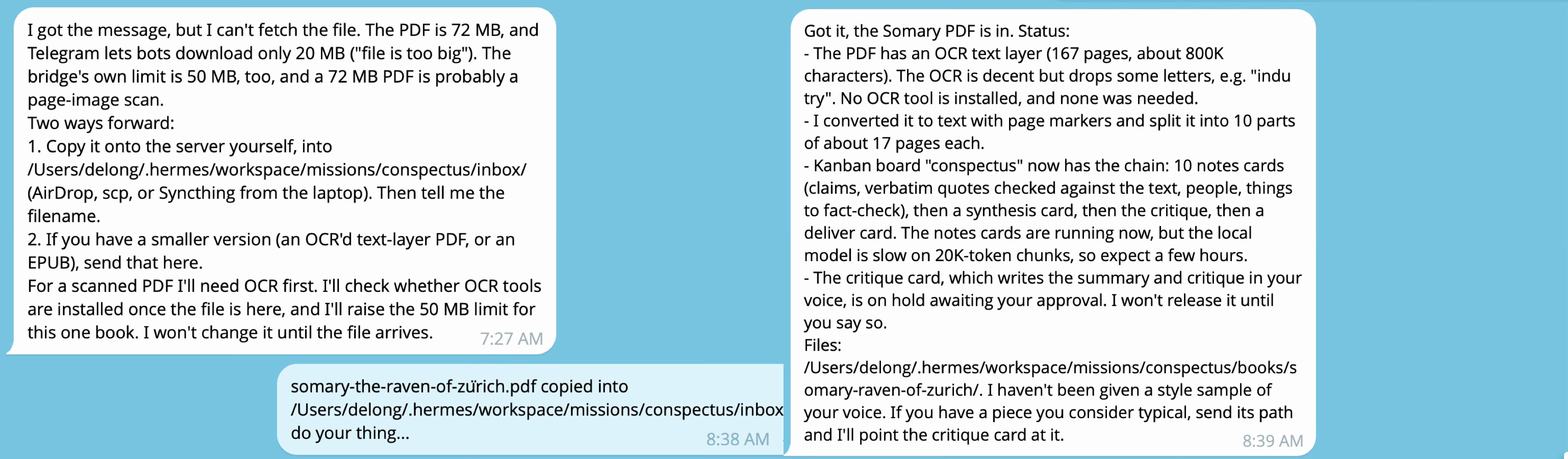
But is it worth trying, because (a) it might work—the horse might learn to sing—(b) it might half-work and still thus be useful as a note-system, and (c) it will teach me a lot about the limits of MAMLM technology when one asks it to do more than stochastic parrotage outside the realm of the extraordinary use case that it MAMLM-as-coding-assistant, or rather MAMLM-as-coding-master. Hence I now have:
~/.hermes/workspace/missions/conspectus/
A conspectus is a short, organized overview of a larger text, giving you the main points and how they fit together, from conspicere, “to look at attentively.” You rarely see the word even in rarified academic English, except in translations from Slavic where *konspect *is an everyday word for structured study notes.
A summary condenses. A synopsis is a summary that follows the sequence of topics. An overview is casual and broad. A survey covers the range, rather than compresses. The word conspectus combines summary and survey: a compact map of the territory that is comprehensive and structured yet as brief as possible. the content. For me, my conspectus is book-by-book folders for books that I wish I had read (or re-read): notes, briefing, and synthesis documents that I review, flipping back to the text to read the book passages it direct me to as I do, and then afterwards either refer to myself or have it brought to my attention by my systems when it seems relevant to what I am thinking about.
Thus I will not have my memories of having read the book. I will not have read the book. But will the Chinese Room I and my systems construct be a good enough substitute for my memories of having read the book? Will I or my intelligence, for some definition of “I” or of “my intelligence”, have the knowledge that I would have had I read the book of Felix Somary, Menger’s student and classmate of Schumpeter and Mises, who spent fifty years watching Europe come apart and saying so? My machines built me a conspectus: a briefing, a critique, and pointers to the key scenes, including Weber storming out of a Vienna café and Ludendorff interrogating Somary at Kreuznach.
My bottom line: I think so. Give me five minutes’ notice, and I can now construct the memories, the brain states, that I would have had I in fact read the book. Or at least I can construct a very close approximation of them. I have run enough spot-checks against the text to be confident that the hallucination level her is very low. So I can now talk about the book as convincingly as if I had read it. Is that knowledge, or only a good performance of it?
Now let me switch gears and talk about Felix Somary 1889-1956 called by some “the Raven of Zürich” and his autobiography The Raven of Zürich. In 1899 (aged seventeen), he enrolled in the Faculty of Law and Political Science of the University of Vienna, where he studied under Carl Menger (to whom he also served as an assistant) and Eugen von Philippovich. I am told by Wikipedia that his classmates included Joseph Schumpeter, Rudolf Hilferding, Otto Bauer, Emil Lederer, and Ludwig von Mises.
Somary foresaw the 1929 crash, preferred state bankruptcy to inflation, and warned against unconditional surrender. I’ve wanted to read his memoir for a decade and never will.
Here we have yet another of the Vienna figures, like Hayek, Schumpeter, Polanyi, and so forth, who kept trying to grasp and understand the problems of 1900 to 1950—the problems rooted in the replacement of the steampower by the applied-science, and then the mass-production economy, along with the parallel and associated transformations of mass communication and of the social network with the rise of nationalism and ethnicism. I know the book because of its account of Max Weber and Joseph Schumpeter discussing the Russian Revolution:
On my return journey I stopped briefly in Vienna to report to the Rothschild bank on the Bucharest negotiations. Apart from that, Max Weber had asked me to be present at the discussion he was to have with Schumpeter about the succession to his chair at the University of Vienna. Weber wanted to return to Germany and he was thinking of Schumpeter as his successor, but the two men knew each other only superficially, although Schumpeter had written an outstanding history of ideas to accompany Weber’s handbook on social sciences.
I was worried about the meeting, because a greater contrast between two personalities was hard to imagine. Max Weber was a restless, nervous type, full of ‘drive’, a Huguenot with deeply-held convictions, for which he strove with every atom of his energy. He battled on without letting up, even when only minor issues were at stake. He was explosive in temperament, verging on intolerance; those who did not know him well could easily have been put off or even frightened at first meeting him.
Hugo von Hofmannsthal tried to explain him by saying: ‘He has the gifts of a Caesar who is unable to find a field large enough for his energies.’ There was much truth in that observation: Weber was never in his life able to give his tremendous intellectual and spiritual powers full expression. He took nothing lightly.
Schumpeter, on the other hand, took nothing hard. He had been educated at the Vienna Theresianum, where the pupils were taught to stick to subjects, and not get personally involved. The rules of the game in every party and ideology were to be learned thoroughly, but nobody should join a party or subscribe to a dogma. And Schumpeter was a virtuoso at playing any political game, from the extreme left to the extreme right. He had worked briefly on the Socialisation Commission in Berlin, which met under the leadership of our Vienna University colleague Hilferding, who at the time led the German independent socialists, for whom the official Social Democrats were too moderate.
Hilferding often told me of his astonishment at Schumpeter’s radicalism; but Schumpeter was not radical at all, he merely followed through to the appropriate conclusions, given the premises. He felt that if socialism were to be introduced at the end of the war, it should be in a consistent way.
We met in the Café Landtmann opposite the University. Ludo Hartmann, a historian of the Classical world and son-in-law of Mommsen, accompanied Weber, and I came with Schumpeter. I took no notes of our conversation, but can recall the elements of it that impressed me most strongly.
The talk turned to the Russian Revolution, and Schumpeter expressed satisfaction that socialism was no longer an abstract theoretical notion, but would now be tested in the real world. Weber said with some heat that communism at the Russian stage of development was a crime—he knew the language and followed Russian affairs closely. He added that developments in Russia would lead to unheard-of human misery and end in a terrible catastrophe.
‘That may well be,’ said Schumpeter, ‘but it would be a good laboratory to test our theories’.
‘A laboratory heaped with human corpses!’ Weber rejoined.
‘Every anatomy classroom is the same thing’, Schumpeter shot back.
To change the subject, I commented that the war had altered the direction of social developments that would otherwise have gone quite differently. Weber agreed, but unfortunately chose Great Britain as his example, referring to its swing away from Liberalism. But Schumpeter disputed this view. Weber became more vehement and raised his voice, as Schumpeter for his part became more sarcastic and lowered his.
All around us the café customers stopped their card games and listened eagerly, until the point when Weber sprang to his feet and rushed out into the Ringstrasse, crying ‘This is intolerable!’ Hartmann followed with Weber’s hat, and vainly tried to calm him down.
Schumpeter, who had remained behind with me, only smiled and said ‘How can someone carry on like that in a coffee house!’…
I felt unhappy about the incident. Here were two individuals of rare gifts, who were not far apart in their fundamental views on the economy, and in their deep intellectual seriousness. But it was the curse of the German and Austrian haute bourgeoisie that its all too few original personalities, if they ever met at all, immediately became deadly enemies. They all had too much temperament to compromise on issues.
Both Weber and Schumpeter were failures in their native land, Austria; they only found success abroad. Yet they had something in common: outside their own country they felt themselves in exile…
Conspectus introduces this set-piece as follows:
The Café Landtmann Clash: Weber vs. Schumpeter (p. 70):
The Scene:A high-society confrontation at the Café Landtmann in Vienna, the epicenter of the city’s intellectual milieu, where two of the 20th century’s greatest social scientists collide over the fate of the Russian Empire.
The Substance:A fundamental rift in the intellectual response to the Russian Revolution. While Max Weber reacts with visceral horror, viewing the event as an absolute crime and a catastrophe, Joseph Schumpeter maintains a clinical, almost detached curiosity, viewing the revolution as a “laboratory” to test the viability of socialist theories.
Why it’s striking:The juxtaposition of the setting—the leisurely, refined atmosphere of Viennese café culture—with the subject of the debate: the blood-soaked birth of the Soviet Union. It captures a pivotal moment where the old world’s intellectual giants attempted to rationalize the arrival of a new, terrifying era of systemic collapse.
Great story, even if it is too good to be true in its details. So that put Felix Somary’s The Raven of Zürich on my to-read list. But today it is further from the top of the list than it was a decade ago. It is clear that I am never going to read it. But a properly-harnessed ollama/gemma4:31b-mlx, overseen and guided by a harness constructed by anthropic/claude-opus (itself harnessed by claude-code), can:
Plus I fed it Max Weber’s Economy & Society (which I have read, but long ago), and Slouching Towards Utopia (which, of course, I know very well.
What do I think of the job that it is doing?
To summarize: I am quite pleased. After spending an hour on the conspectus folder (and then half an hour, checking random pieces of the conspectus folder against the actual book itself), I definitely feel like the Chinese Room of which I am a component could definitely fake it. It can respond as if I have actually read the book, in the way I would. Thus I have hopes that my leafing to the passages it points me to, consulting it when it comes to mind, and having my systems bring it in when they think it is relevant will together be as if I actually have the memories of having read, at least for people looking at me in my Chinese Room from the outside. And from the inside? That is a hard question that I do not yet have an answer to.
But the proof of the pudding is in the eating: What do my systems think is worth noting from Somary? Here is the introductory briefing that it wants to give me:
Briefing: Felix Somary, The Raven of ZürichFelix Somary was the ultimate high-society canary in the coal mine. Trained in the Vienna school—which meant he spent his youth learning that the world is a fragile place and that economic depressions are inevitable (p. 17)—he spent the next fifty years watching the 20th century dismantle itself in real time. He calls the government the “fence that separates the zoo of wild animals from the outside world” (p. 15), and he spent his career observing exactly when and how those fences broke.
The arc of his life is a map of European collapse. In the pre-1914 years, he was playing the great game of international finance, trying to use the Baghdad Railway as a colonial compromise to stop the Anglo-German naval race from turning into a world war (p. 35-38). He failed, of course. During the war, he became a critic of the military’s delusional confidence, specifically General Ludendorff, who thought he could just seize Caucasian oilfields without considering how to actually get the oil out (pp. 66-67). Somary saw the rouble collapsing in 1917 while the diplomats were still pretending the Russian Empire was a going concern (p. 64).
Then came the Zürich years. This is where he earned the name “The Raven.” He played the role of the professional gloom-monger, correctly predicting the 1929 crash (p. 7) and managing client assets by restricting them to the only three places he trusted: Switzerland, Britain, and Holland (p. 77). He had a visceral hatred for inflation, calling it a “permanent poisoning of the very bloodstream of a society” (p. 78), and argued that a clean state default—a “one-time surgical intervention”—would have been far less damaging than the slow-motion arson of the interwar inflation (p. 78-79).
He ended up in Washington during WWII, where he looked at American technical mastery and saw a total lack of forward planning for the war economy (p. 106). He had a particular disdain for the “cult of mediocrity” in US education (p. 129) and the “unreality” of the Washington bubble, which he believes led to the failure to support the German resistance and a total misreading of the Soviet Union (p. 129). Even in the postwar era, he remained a skeptic of the Marshall Plan’s “frenetic speed” (p. 138), arguing that reciprocal free trade and free immigration would have been the real cure for the dollar shortage.
Somary died c…