Good morning and welcome back to Vittles. Today’s newsletter is a vital conversation about the state of British agriculture and its reliance on low-paid, seasonal migrant labour, between Claire Ratinon,** Emiliano Mellino and Sybil Msezane**.** **
You can now buy a bundle of our third magazine, ** The Influencers**, and our second magazine,
When we talk about our broken food system, we often speak about the unsustainable relationship big agriculture has to the soil, but we rarely talk about the most exploited actor in this system: the farm worker. Across the British agriculture sector, the use of precarious and short-term labour, particularly from migrant farm workers, is commonplace. In 2023,[at a hearing in the House of Lords], Sybil Msezane, a migrant who was a seasonal worker on UK farms in 2022, said of British soft fruit and vegetable farms:‘I do not think the farmers even knew we existed outside the weight of fruit or vegetables that we picked on a daily basis. From my experience, we were not viewed as humans.’
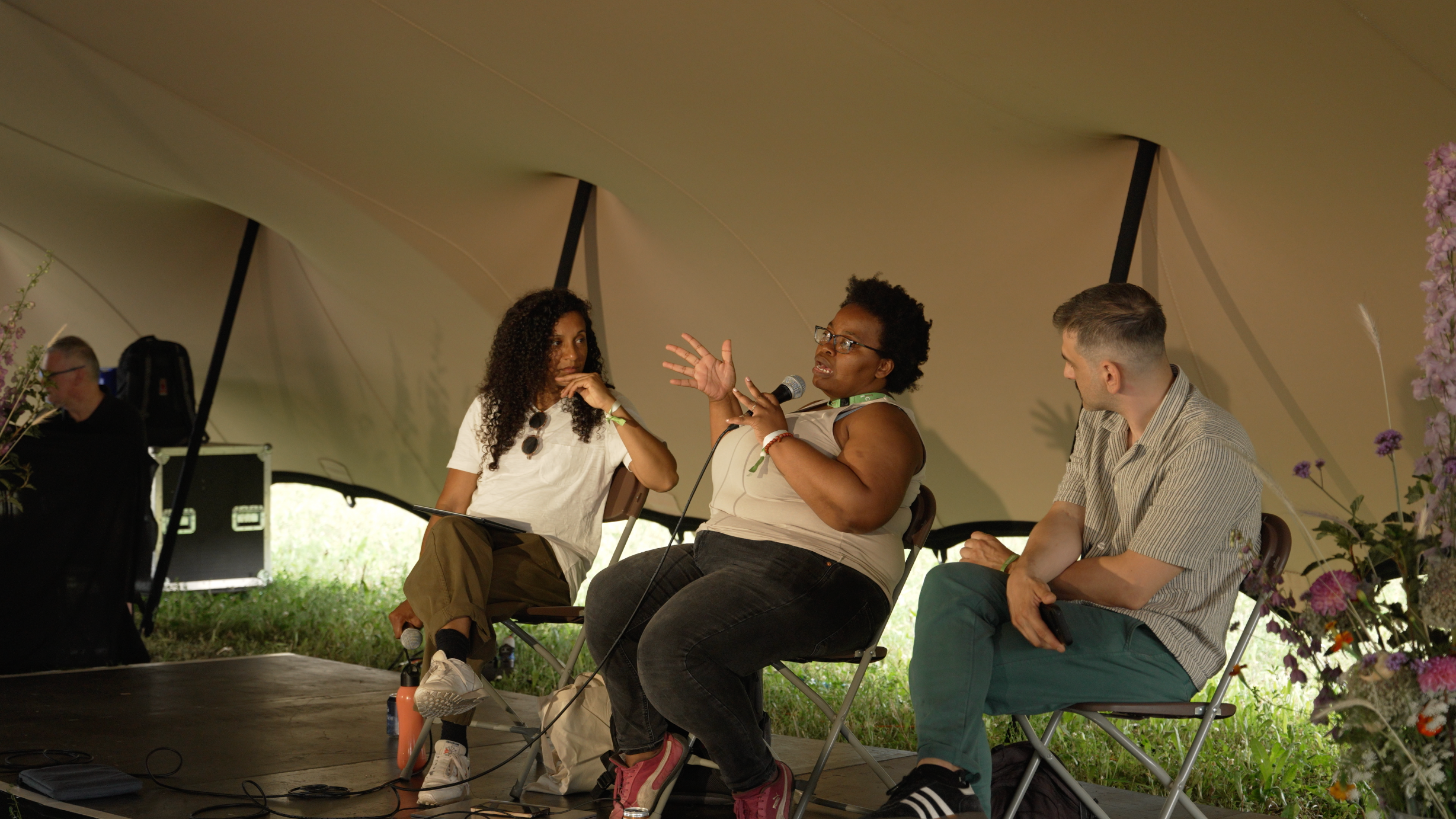
So, whenVittleswas asked to put on a panel discussion this summer at the annual regenerative agriculture festivalThe Bureau of Investigative Journalism[Groundswell], we knew that this was the topic we wanted to discuss. Sybil, who now works in social care, was joined on the panel by Emiliano Mellino, an award-winning journalist withwhose work has uncovered the widespread exploitation of gig economy, care and seasonal agricultural workers. The discussion was chaired by food grower and writer Claire Ratinon, an organiser with Solidarity Across Land Trades (SALT), a grassroots trade union of workers organising for fairer conditions, solidarity, care and justice.
Sybil, Emiliano and Claire’s wide-ranging discussion explored the working conditions on British farms, the issues with the Seasonal Migrant Worker Visa Scheme that enable worker exploitation, and how narratives around land work enable, justify and normalise these conditions. What follows is an edited transcript of their discussion, which offers some vital perspectives on the current state of British agricultural labour.Jonathan Nunn
Claire Ratinon: I was recently reminded of Article 23 of the UN’s Universal Declaration of Human Rights, which states that everyone has the right to work, to free choice of employment, and to just and favourable conditions of work, and that everyone has the right to form and join trade unions for the protection of their interests. But to put that in the UK context, the International Trade Union Confederation, which ranks every country in terms of its violations against its workforce and its workers’ rights, had recently ranked the UK at four (the lowest is five), although the recent passing of the Employment Rights Bill, has dragged it up to a three.
Still, what that translates to is regular violation of workers’ rights, particularly in agriculture, where farm workers are routinely exposed to working conditions that those in other workplaces would consider unacceptable. And this is exponentially worse for those who are brought in through the Seasonal Worker visa scheme. Even if you have had no interaction with migrant workers working on farms, any citizen who is invested in the food system and who cares about agriculture ought to care about those who pick the food that feeds the vast majority of this country.
Sybil, to start, could you tell the story of how you came from South Africa to the UK to work on a farm?
**Sybil Msezane: **So, I came in 2022, which was the first year South Africans [were allowed to], even though the agricultural visa scheme had been open for a while. Up until that point it was predominantly open to Eastern European countries. I came across the opportunity on a Facebook posts, made by CVPlacements, when I was helping young, unemployed people looking for work, and I thought, Working on farms in the UK cannot be worse than working on farms in South Africa. Prior to 1994, you couldn’t organise on farms in South Africa – there weren’t trade unions. I’m not saying that the conditions have exponentially improved, but in many ways, workers now have day-one rights. So, I thought, it can’t be worse in the UK. But I also thought, ‘I need to experience what I’m encouraging other people to do.’
Nothing could have prepared me for what I encountered. I worked on three farms in that season, even though I didn’t complete the full six months – I went back to South Africa after three months.
The first farm I worked on, I thought was bad. But retrospectively, having worked on other farms, having heard stories of other people, scarily I have to say that, from all the stories I’ve heard, it holds up as one of the better farms. When we arrived, six of us (both male and female) were put into a three-bedroom caravan, which we had to share. We’d never met, we didn’t know each other and it was really cramped. Two or three weeks in, an additional person was put into our caravan and was told that they would sleep on the couch in the living room.
We started work at the first farm, a soft fruit farm, at about 6am. When I moved to a vegetable farm, we started work as early as 4.30am. But the caravans were up to an hour or two away from some of the fields, and you didn’t get paid for that time, even though in South Africa that would be considered working time – as soon as you get onto your employer’s vehicle, that is working time there, because through no fault of your own, you have to travel from where you are to where the fields are. But this is not the case here in the UK.
We were told it would be £10.50 an hour. Once we started working on a lot of the farms, you were told, yes, £10.50, but you also needed to meet the weight – like how many crates you picked – which could reduce how much you were making. Often people were making way below the minimum wage. I and a lot of the South Africans were fortunate that CVPlacements, the agency that was contracted by Concordia (the UK agency) did not charge us fees. But people from countries like Nepal and Tajikistan had often not just paid for their visa, but also paid agencies to get them in touch with the company on the scheme that they came through. Currently there are five or six ‘scheme operators’ that the farms are contracted to. You need to be in contact with whatever agency in your country runs the scheme here in the UK – you can only go through them. You can’t get in touch with a farmer and have them employ you directly.
[Editor’s note:These ‘scheme operators’ are the only companies that can sponsor seasonal farm worker visas and they have been given the power to effectively run the visa scheme. The farm is the employer but the scheme operator is responsible for bringing the workers into the country and for their welfare while here. However, these recruitment companies often get subcontractors in other countries to do the work for them. So for example, in South Africa it was a company called CVPlacements. In Nepal, it was a company called Poseidon, which in turn[hired another subcontractor]called My Careers HR]
Claire: So, a lot of people got into debt to come?
Sybil: Yeah. A lot of people had paid a lot of money. You also need to come with subsistence because even though you’re paid weekly, you’re paid in arrears. Usually for the first two weeks, you’re not paid, but you still need to pay rent for the caravan that you’re sharing with either five or six other people, and you have to get your own food. You need to get yourself from whatever airport to the farm wherever you will be in the UK … and that’s another thing: you don’t get to choose. You get allocated a farm. You could be sent to Scotland or to Surrey – you just don’t know until your Certificate of Sponsorship is issued.
One of the big challenges with the UK, not just in the agricultural sector, is how the Certificate of Sponsorship ties you to a particular employer. It means, if that employer is exploitative or abusive, you have very little recourse, because if that Certificate of Sponsorship is withdrawn, you either have to return home or you become an undocumented migrant. So, employers hold all the power because they know that you left your country to come and work for the season. They can also determine whether you actually even get hours. Your supervisor can decide whether you can go on the field or not on that day, or how long you stay on the field. If they feel you’re picking too slowly, at the first break you could be told you need to go back to the caravan. Some people ended up not making any money in a week because they were only making maybe £100–200 pounds, most of which would just go to food and rent. It didn’t matter how much you made that week, you still had to pay rent for the caravan.
Claire: Emiliano, can you speak a little bit about the wider context of what the employment landscape looks like for workers in this scenario?
Emiliano Mellino: As Sybil summarised, workers are tied to the recruiter, who decides where you work, when you work, and also if you have a visa to stay in the UK. That’s a fundamental issue that facilitates exploitation, and it’s something that the government knew was an issue before the visa was created. Several human rights and workers’ rights organisations warned that tied visas create conditions of exploitation.
And there were other issues. The fact that workers are only here for six months means they don’t really have time to build links with people who might help them from an employment point of view. The fact that they largely don’t speak English, so again, it’s harder to enforce their rights. The fact that the farms tend to be isolated and far from organisations that might offer support.
Over the years, I’ve interviewed more than 100 workers, but I’ve also managed to get hold, after a long Freedom-of-Information battle, of around twenty Home Office reports from their farm inspections, which covered interviews with about 145 workers. Nearly half of those workers interviewed raised some kind of welfare issue: racism, wage theft, mistreatment in the fields, threats of being sent back home, and so on. And I just want to be clear, these aren’t rogue farms; these are farms that supply the major supermarkets in the UK with the food most people eat on a day-to-day basis.
When workers made complaints, they would often be told that they could leave and just go back to their home countries: if you don’t like it, go home. One Moldovan worker started to cry in the middle of the interview with the Home Office inspector when she was explaining that she only got one fifteen-minute break, and was prevented from taking others – even if it was to go to the toilet, to drink water, or to eat – until she hit all her targets. At the end of the interview, she said, ‘All that is missing is a whip to beat people.’
Another farm worker reported that a manager shouted, ‘I’m a pure-blooded English woman. I will stay here, and you will go back to your poor countries.’ People also told Home Office inspectors that they had to work twelve-hour days back to back for up to two weeks. When they told managers they needed a day off, the response often was, ‘You’ve come here to work, so you have to work.’ Many workers report mice, cockroaches, bedbugs and other pests in the caravans, and sometimes the caravans don’t have showers or toilets, so you have to go to a communal room. Many workers reported not having any privacy, as managers or admin staff would just come into the caravans whenever they wanted.
These caravans are effectively old British holiday camp caravans set up for a family, and often have a double room, with small beds for children in the other rooms. I’ve seen very large men having to sleep in very tiny beds that they certainly did not fit in. In the Home Office reports, there are people who had to share a double bed with strangers or women who had to share caravans with men they didn’t know. And there are health and safety issues: in one of these Home Office reports there was a report of somebody who had to pull out their own tooth because they weren’t given access to dental or medical care. During the pandemic, a Ukrainian woman who got COVID was confined to her caravan. She said she was not given food or any other kind of assistance and told that if she left her caravan, she would be disciplined.
Sybil also mentioned the illegal recruitment fees that some workers are being made to pay by recruiters that are licensed by the Home Office. The Home Office inspection reports I accessed cited fees as high as £7,500 that workers paid to come and work in the UK. As you can imagine, many of these workers never made back anywhere near as much.
I could talk to you about Nepali workers who, after having paid thousands of pounds, were told after six weeks they had to go back home. They had not even put a dent on their debts. And when they refused, they were told, ‘If you don’t go back, you will be blacklisted, and you will never work in the UK again.’ The recruiter’s so blatant they put this in an email, showing how aware they are that they will face no consequences.
I could talk to you about Vadim, who also came when Sibyl and I went to give evidence to the House of Lords. His caravan got so cold – it was 8°C at night – that some nights when he went to bed, he didn’t know if he’d wake up in the morning.
I want to reaffirm that these are all things that the Home Office knows about – they’re in the inspection reports. They’ve known for years about this. So, there’s really no excuse on the part of the government for continuing to allow this to go on.
Claire: Other than that the fruit and veg economy relies upon it.
As a trade union case rep, I hear similar things in the alternative agriculture sector, with people who have no choice but to accept appalling living conditions. I know somebody who was given a hose as a shower and no other facilities for bathing. In terms of wage theft, the amount of unpaid overtime, low-paid or unpaid labour that completely upholds the alternative and regenerative sectors ... if those workers knew that they had the right to actually take their employers to tribunal to claim for those wages, the sector would fall.
I would really love to hear from both of you about what workers are doing. I don’t want to talk about migrant workers as though they have no agency. Obviously there are many structural reasons why migrant workers find it hard to push back against the conditions they experience – and yet there are workers who are doing exactly that.
Emiliano: There is often very little media coverage about what is happening on farms, including what we call wildcat strikes – ‘unofficial’ strikes not backed by a trade union, which don’t follow normal procedures that the very cumbersome union legislation we have in the UK requires. There are lots of spontaneous acts of rebellion by workers – they will suddenly down tools and not work, and will put demands onto the employer.
I reported on one case at one of the biggest farms in the UK – Haygrove Farm in Herefordshire. It was a strike led by around 100 Latin American workers, and it was kicked off by a number of things. They were given no work for weeks – this was to do with climate change and the instability of seasons – even though many of them were indebted. In this case, the farm had paid for the workers’ flights upfront, and they were told that they would cost a certain amount, but then many of them realised that the farm was asking them for more money than what they said the flights were worth. There was also bullying and other issues.
And so they held a wildcat strike…