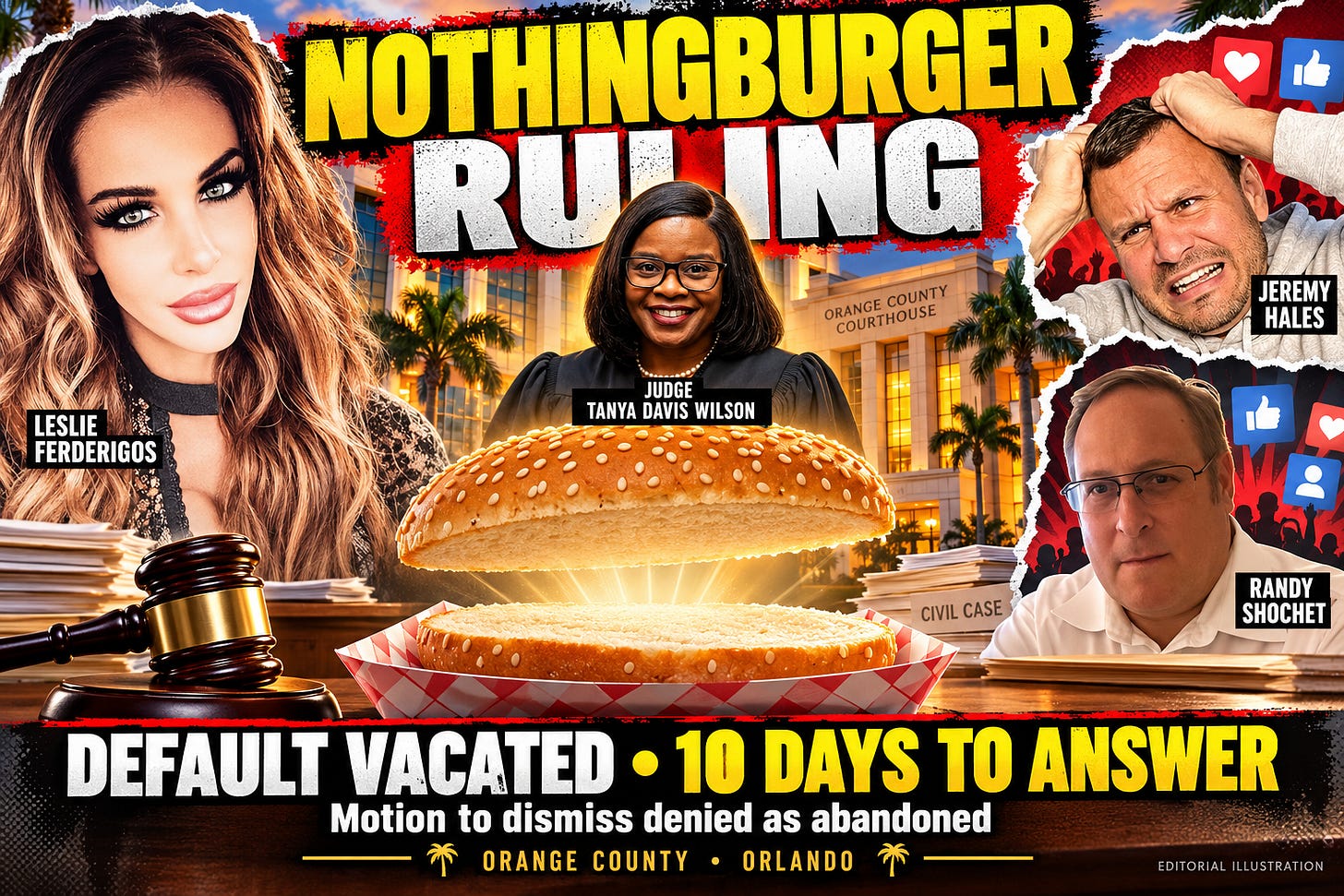
LUTHMANN NOTE: I have no objection to Jeremy Hales celebrating something he actually won. I object to selling a procedural development as vindication and leaving the audience with a story the written order contradicts. Judge Wilson corrected her mistake. Everyone reporting it owes viewers the correction with comparable prominence. Shochet’s default argument failed, while the defendants’ dismissal motion was denied. Both facts belong in the account. My criticism of POLAMOP is that the spectacle rewards escalation while the paperwork becomes an inconvenience. Courts exercise power over real people. When their decisions become props for a victory show, the audience loses the ability to distinguish justice from promotion.
Jeremy Hales had a victory video. Judge Tanya Davis Wilson had a written correction. On September 28, the Orange County judge vacated her oral ruling granting a judicial default against Leslie and Michael Ferderigos, explaining that their answer deadline had never started. The court denied their motion to dismiss as abandoned, and the lawsuit continued. The Ferderigoses have a chance to refile the motion to dismiss within ten days.
Joining Lisa Lee and Robbie Keszey on Two Lees in a Pod, Richard Luthmann examines how that procedural dispute became another Halesverse celebration, then asks the larger question: What happens to public confidence in courts when litigation commentary sells a result the written order does not support?
00:00 The victory claim and the same-day correction01:56 Luthmann introduces the hearing and procedural dispute12:17 Shochet’s argument for a judicial default19:17 The defendants’ response25:50 Where was the written denial?30:52 Reading Judge Wilson’s signed order37:50 The defendants’ challenge to the default44:50 Lisa discusses the Halesverse reaction56:09 POLAMOP and the loss Hales may not recognize58:06 Chief Justice Roberts and public confidence in courts
Jeremy Hales’s victory lap ran into Judge Tanya Davis Wilson’s written order.
In this episode of Two Lees in a Pod, Richard Luthmann joins Lisa Lee and Robbie Keszey to examine the September 28 developments in Orlando’s Orange County Circuit Court, Case No. 2025-CA-006868-O. The discussion follows the hearing, the defendants’ challenge, the judge’s correction, and the online celebration that Luthmann argues exposes the danger of POLAMOP.
Hales’s celebratory presentation supplies the public-facing side of the story. But Hales’s narrative and reality collide: the celebrated courtroom victory and the written ruling that followed bear little resemblance.
The court initially granted a judicial default orally. That happened. But the signed September 28 order, filed at 6:10 p.m., expressly corrected that result:
“The 10 days never began to run. Defendants were not in default.”
Judge Wilson also wrote: “The oral ruling granting default was error.”
Her operative order vacated the oral default ruling and denied the plaintiffs’ default motion. It also denied Leslie and Michael Ferderigos’s motion to dismiss as abandoned and directed each defendant to serve an answer within ten days after the order was filed. The lawsuit survived. The default did not. The order awarded no damages and did not decide the merits of the underlying claims.
There is a procedural fight behind the premature Halesverse celebration. Attorney Randall “Randy” Shochet argued that the case-management deadline had already disposed of the dismissal motion and that answers were overdue. The defendants disputed that position and described their continuing participation in the case. Their verified motion provides their written arguments.
Judge Wilson ultimately distinguished the abandoned dismissal motion from the unanswered complaint. Her order explained that the case-management language had not started the answer clock; the required written denial had never been filed. That distinction defeated the default request.
Luthmann reads through the actual court order and explains why viewers must separate a ruling announced during a hearing from the written disposition entered afterward. The defendants also filed an objection to the proposed order, disputing language they said exceeded the oral ruling. Those objections are their allegations, not findings of misconduct by Judge Wilson.
The episode’s broader argument comes into focus when Luthmann argues that the day supplies a compact demonstration of the problem: a judicial mistake becomes material for immediate celebration, while the correction has to fight for attention afterward. Lisa discusses reactions she attributes to Megan Fox, That Umbrella Guy, and Mr. Coop. Her accounts of those reactions are part of the panel’s commentary; the signed order remains the measure of what the court actually did.
POLAMOP means “Protraction of Litigation and Multiplication of Proceedings,” the term discussed in ** “Florida Courtroom or Studio?”**. Luthmann’s criticism is that litigation can become a continuing source of content, pressure, and audience engagement, with accuracy subordinated to the next supposed knockout.
That matters beyond the people fighting this lawsuit. In his ** 2024 Year-End Report on the Federal Judiciary, page 7**, Chief Justice John Roberts warned that
The danger identified here is a public taught to mistake procedural developments for conclusive findings. A corrected ruling can then look inexplicable to viewers who were sold an overstated version of the first result. That damages understanding of judicial decision-making and burdens the administration of justice with a public narrative detached from the record.
Reporting the initial oral ruling was legitimate. Presenting it as a final resolution of the lawsuit was not supported by what happened. After the written correction, the responsibility to update the audience became unavoidable. Whether a particular false statement was an error or deliberate disinformation requires evidence of what its speaker knew; Judge Wilson did not decide that question.
Watch the videos, follow the hearing discussion, and read the order. Hales’s default request was denied. The Ferderigos defendants must answer. The case continues. That is the result the audience deserves to hear.
Disclosure: Richard Luthmann is a defendant in separate litigation brought by Hales. This episode contains opinion, disputed allegations, and strong language.
Thank you , , and many others for tuning into my live video! Join me for my next live video in the app.