Danielle with today’s Democracy-ish write-up!
There is a specific kind of exhaustion that sets in when the machinery of political and corporate corruption stops bothering to hide behind closed doors. For decades, the unwritten rule of American oligarchy was at least to maintain the theater of legitimacy—to let regulatory bodies, corporate boards, and elected officials perform a polite dance of checks and balances while wealth quietly consolidated at the top.
That theater is officially over.
Consider the recent whiplash in the artificial intelligence sector. After reaching a staggering peak in October, NVIDIA—the company responsible for roughly 90% of the chips powering the global AI ecosystem—watched its stock plummet by 47% in a matter of weeks. The slide wasn’t occurring in a vacuum. Following Anthropic’s high-profile public debut, where initial enthusiasm quickly gave way to investor skepticism and a broader NASDAQ dip, the cracks in the AI economy began to show. When a single chipmaker forms the load-bearing wall for an entire circular economy of cross-investments, cloud partnerships, and speculative valuations, a 47% drop isn’t just a market correction. It is an existential threat to the entire edifice.
Enter the political rescue mission.
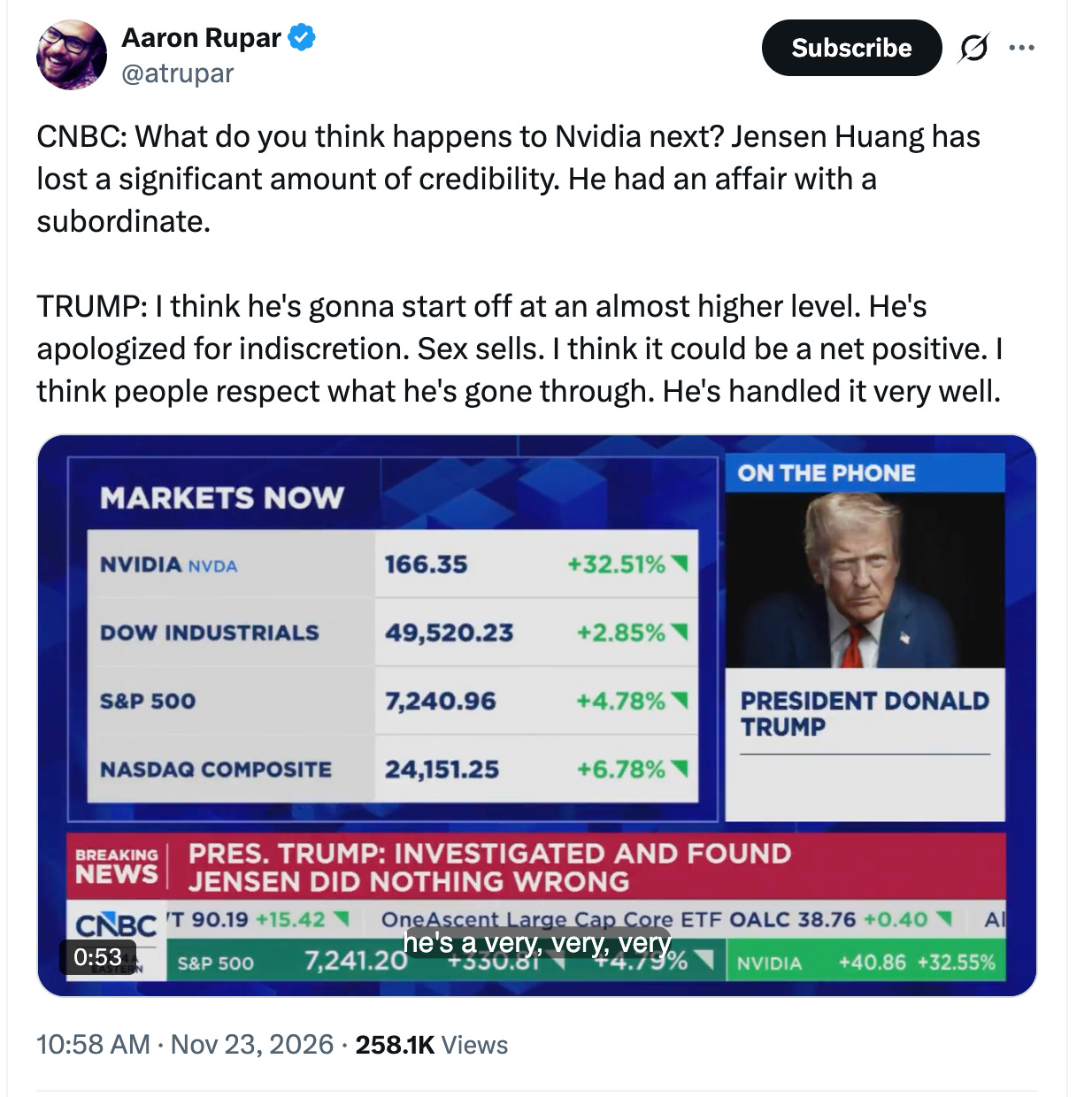
Rather than letting the market correct itself, the response to a deflating bubble was an aggressive, top-down intervention. When Donald Trump personally worked the phones to pressure NVIDIA’s board into reinstating former CEO Jensen Huang right before the opening bell, the market reacted with predictable, Pavlovian obedience. Within hours of the announcement, NVIDIA’s stock surged back by over 30%, pulling adjacent players like Oracle and CoreWeave up with it.
The mechanics of this rebound raise urgent questions about who knew what, and when. In a market where fortunes are made in the margins between private phone calls and public press releases, sudden reversals of this magnitude inevitably invite scrutiny over insider timing—especially when political leaders hold direct financial stakes in the very companies they are publicly boosting, and when major tech firms have already poured tens of millions of dollars into White House-adjacent projects.
Even more troubling is what gets swept under the rug in the name of keeping the stock ticker green. Huang’s return came despite serious national security red flags—including intelligence warnings regarding Chinese espionage networks targeting the semiconductor supply chain and prior rollbacks of export restrictions that had been designed to keep advanced AI hardware out of Beijing’s hands. In an era where geopolitical rivalry is routinely invoked to justify everything from land seizures for data centers to massive federal subsidies, national security suddenly becomes negotiable the moment a balance sheet is in danger.
To cement the message, the reinstatement was accompanied by a surreal piece of political iconography: a doctored image posted to Truth Social swapping out the American flag for the NVIDIA banner, and replacing a raised fist with a red bra—a nod to the tabloid scandal surrounding Huang’s ouster. It was a remarkably honest piece of visual storytelling. The national flag replaced by a corporate logo; public duty replaced by private indulgence; the machinery of the state repurposed as a personal PR firm for billionaire allies.
If this were merely a story about one party’s transactional politics, it would be predictable enough. What makes the current moment so disorienting is the bipartisan complicity propping up the same fragile system.
While voters delivered a clear mandate against corporate capture, the Democratic establishment has largely responded with business as usual. From Senate leadership backing late-night legislative packages like the Bipartisan American Affordability and Jobs Act—a boon for data center expansion and fossil fuel infrastructure—to key lawmakers skipping symbolic accountability votes to attend defense-contractor-heavy fundraisers, the message to the public is unmistakable. Whether through direct presidential intervention or quiet legislative favors, both sides of the aisle are deeply invested in ensuring the AI bubble does not burst on their watch.
We have seen this movie before. In 2008, a handful of financial institutions built an unsustainable house of cards, pocketed the profits while the music played, and handed the bill to the American taxpayer when the floor gave out. Today, the names have changed from mortgage-backed securities to hyperscale data centers and speculative AI valuations, yet the underlying moral hazard remains identical. The executives and politicians inflating the bubble take none of the real risk. Their wealth is insulated by tax breaks, lobbying networks, and golden parachutes.
Meanwhile, the average citizen—95% of whom hold no meaningful stake in these soaring tech stocks—is told to accept higher energy costs, encroaching data centers, and an increasingly automated, impersonal economy as the price of “winning the future.” Distracted by an endless stream of digital entertainment and numbed by the sheer scale of the grift, the public is expected to sit quietly in the audience while the house is mortgaged yet again.
The tragedy isn’t just that the bubble will eventually burst. The tragedy is that by the time it does, the people who engineered it will have already walked away with the safe, leaving everyone else to sift through the ashes.
***Because I’m a terrible capitalist, here’s a great 25% off discount for new paid subscribers. It’ll only be about $3.75/month or $38/year.
There are no paywalls, and The Left Hook continues depending on the kindness of our readers
Thank you , , , , , and many others for tuning into my live video with ! Join me for my next live video in the app.