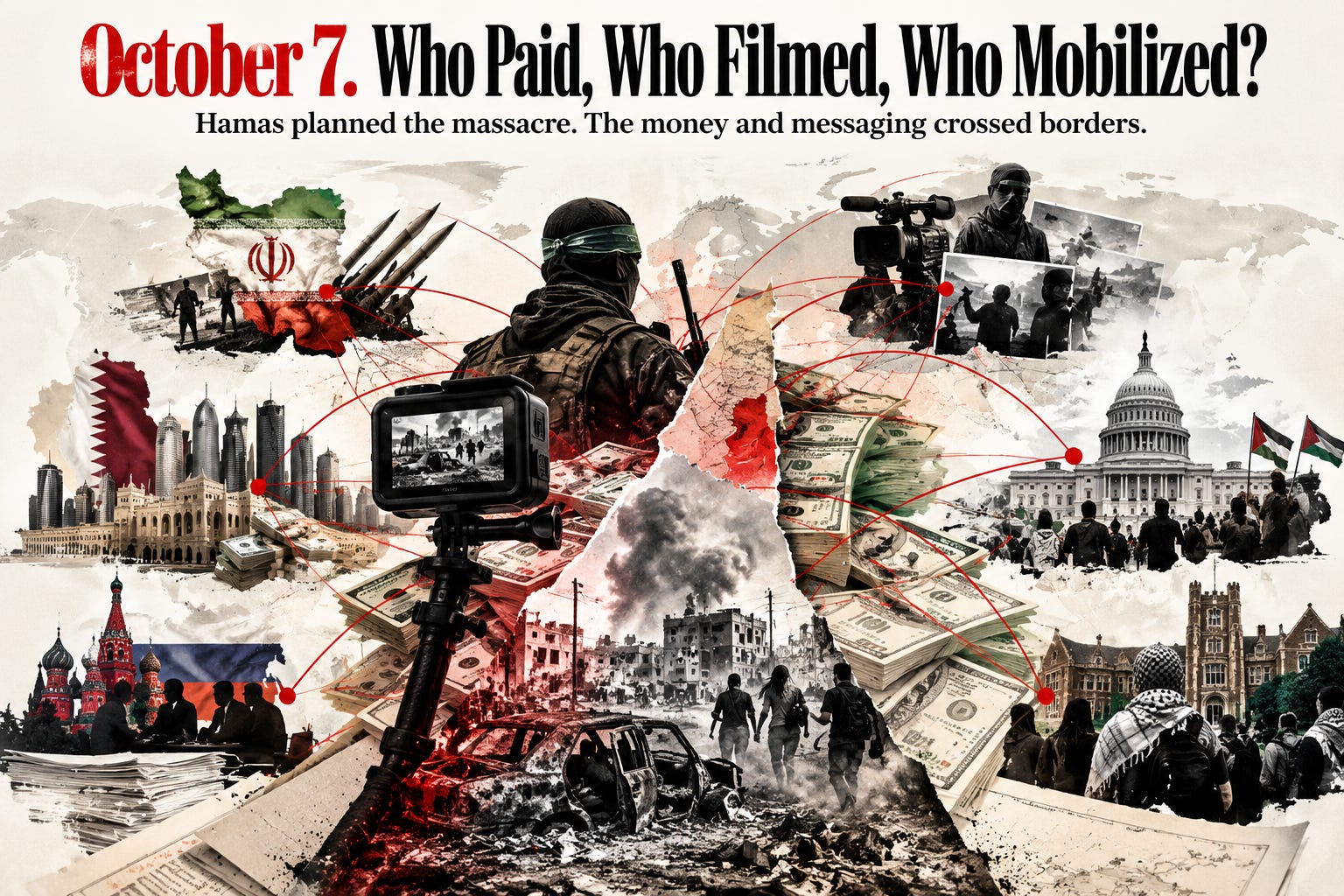
Hamas’s captured records reveal plans to film the October 7 massacre, a funded media department, and news agencies operating under its supervision. U.S. Treasury documents identify an international investment portfolio worth more than $500 million, while other records trace Iranian military support, Qatari financial assistance to Gaza, and Russian diplomatic contacts with Hamas. In the United States, established advocacy organizations began mobilizing while Israeli families were still being hunted and abducted. The names, dates, money, and organizational relationships appear in government records, court filings, financial audits, and the organizations’ public statements.
A personal note: Some of this information may already be familiar. But seeing the names, money, documents, and relationships together is shocking. I’ve spent hours following these connections, and the more I uncover, the more disturbing the picture becomes. And I know there’s more information out there. We have government investigations, convictions, sanctions, and years of documented warnings. Yet so many of these networks have continued operating. How much more do we need to know before there is real accountability?
On October 7, 2023, Hamas terrorists crossed into Israel carrying rifles, explosives, and cameras. They murdered families in their homes, attacked the Nova music festival, burned buildings, and dragged hostages back into Gaza. Some recorded the violence on phones and body cameras, and Hamas began releasing footage while Israeli civilians were still hiding from the gunmen.
That same day, American Muslims for Palestine and Americans for Justice in Palestine Action issued a statement blaming Israeli policies for the violence. National Students for Justice in Palestine circulated a toolkit celebrating the assault as Palestinian resistance and organizing campus demonstrations. By October 9, the Council on American-Islamic Relations was urging Americans to contact Congress and demand an immediate ceasefire.
Hamas had spent years preparing its assault. It also maintained a funded media department, news agencies, international investments, and relationships with foreign governments and financial facilitators. Some of the American organizations responding to October 7 had spent years building political coalitions, campus chapters, fundraising arrangements, and congressional advocacy programs.
The documents stretch from an FBI-recorded meeting in Philadelphia in 1993 to handwritten instructions attributed to Yahya Sinwar in 2022, U.S. terrorism-financing sanctions, internal Hamas audits, original organizational statements, and federal lawsuits brought by survivors of the massacre.
On August 24, 2022, Yahya Sinwar prepared two handwritten documents describing an invasion of Israel. Israeli forces later recovered them in Gaza. One addressed operational preparations, including breaching the border and recording violence against Israeli civilians and soldiers. The other described a larger invasion plan involving 25 junctions and more than 220 Israeli communities, cities, and military positions.
Sinwar estimated that the operation would need approximately 10,000 trained fighters. The plans addressed hostage-taking, the removal of civilians from Israeli communities, and how Hamas would present the invasion internationally. The filming instructions were included before the attack, when Hamas was still preparing its fighters and deciding how the operation would unfold.
Planning continued through 2023. Minutes from Hamas leadership meetings recovered in Gaza describe discussions involving Sinwar, Mohammed Deif, Marwan Issa, and other senior figures. The documents also describe efforts to obtain assistance from Iran and Hezbollah, including reported discussions between Khalil al-Hayya and Iranian commander Mohammed Said Izadi in July 2023. Hamas leaders considered approaching Hezbollah leader Hassan Nasrallah, while Ismail Haniyeh, who headed Hamas’s overseas political bureau, was reportedly briefed on the project.
The records establish reported consultations and requests for assistance, although they do not establish that Iran or Hezbollah controlled the operation or knew its final date. Hamas also worked to conceal its military preparations. A September 2022 deception plan described maintaining apparently routine activity near the border while preparing for an assault, and Sinwar’s instructions contemplated contacting other Palestinian armed factions shortly after the invasion began.
On October 7, Hamas’s al-Qassam Brigades began distributing announcements and footage through official channels. Researchers at the Atlantic Council later documented thousands of posts from Hamas and affiliated groups during the first 72 hours. The attackers had entered Israel with cameras because Hamas had planned to record and publicize the violence.
Ali al-Amoudi had served as director of Yahya Sinwar’s office, was elected to Hamas’s political bureau in 2021, and headed its information department. His relationship with Sinwar dated back to their imprisonment in Israel.
In February 2026, the Meir Amit Intelligence and Terrorism Information Center published an investigation based on internal Hamas documents recovered in Gaza. The material included financial audits, media plans, budgets, staffing records, and administrative correspondence.
The documents described a multiyear media program called Sword of Jerusalem 2022–2025. It contained 25 projects with production targets, schedules, and financial allocations. Hamas planned messaging for Palestinian audiences, psychological operations aimed at Israelis, and English-language campaigns intended to influence Western audiences. Its proposals included social-media advertising, video production, and campaigns designed to weaken Israeli public confidence.
Financial audits addressed to al-Amoudi showed his department supervising media outlets that presented themselves publicly as independent news organizations. Their internal records identified budgets, employees, management decisions, and relationships with the Hamas-controlled al-Aqsa media network.
Shehab News Agency, وكالة شهاب للأنباء, operated from Gaza and concentrated on news updates, video, and social-media content. A Hamas finance department audit examined its 2021 operations, including staffing, revenue, expenses, debts, management, and the agency’s relationship with the al-Aqsa network.
The audit recorded $349,562 in revenue and $361,417 in expenses, leaving an annual deficit of $11,855. Employee salaries accounted for $275,576. Of the reported revenue, $269,407 came from budget allocations, $70,640 from media and advertising income, and $9,515 from other sources.
Shehab employed 37 workers across news, production, operations, and administration. Its offices occupied two apartments in Gaza City’s Palestine Tower, in property attributed to Hamas’s media department. The records identify Shadi Abu Sabha as a director appointed in late 2021 and describe the creation of an associated production company called Event.
Shehab’s separation from the al-Aqsa network began in October 2021. Its operations and administrative authority were separated in January 2022, and the agency completed independent registration in May 2022. The audit nevertheless documented continuing financial relationships, including employees receiving salaries through al-Aqsa.
The financial records also identified $46,937 held in local banks and a cash balance of $16,606 in Turkey. The Turkey entry did not identify Anadolu Agency, Reuters, or another international news company as a recipient.
Safa News Agency, وكالة صفا, published news reports, interviews, and longer articles. Its financial and administrative audit was also submitted to al-Amoudi. According to researchers examining the captured documents, Safa followed the strategic program of Hamas’s information department rather than an independent media strategy.
The wider structure included the al-Aqsa network and Al-Risalah. Ghazi Hamad, a senior Hamas political figure and spokesperson, had previously served as an editor of Al-Risalah. The February 2026 investigation also identified Shehab as a distributor of Hamas military media material during the war that followed October 7.
Hamas’s information department had employees, budgets, production facilities, and news outlets operating beyond its official military accounts. The captured audits describe the financial and administrative relationships behind those operations.