Thank you to Ridge Security for sponsoring this article.
Disclaimer: Author Ken Huang is an advisor to Ridge Security
Annual penetration testing fails for a simple reason: teams change systems every day and test them once a year. A report describes test day. After test day, teams deploy code, change settings, change privileges, and new disclosures appear. Each one can open a path the report never covered. So teams test after each change, not once a year.
We can decide which tool to use based on two facts. First, a penetration test produces the most sensitive description of a system outside production itself, so where test data goes is an architecture decision, not a contract clause. Second, validation counts as continuous only when teams repeat five stages after each change: scope, discovery, prioritisation, validation, and mobilisation, with every fix retested and proved closed. A test with no revalidation after a fix is not continuous validation.
RidgeOne is the example this article uses for that loop inside the customer’s own environment. It pairs RidgeGen with an open-weight model on NVIDIA DGX Spark, with 128 GB of unified memory, and it runs four concurrent assessments in five deployment steps, with no external AI calls. Ridge uses the NVIDIA DGX Spark as a reference example; any server with a compatible architecture and comparable specifications is expected to work similarly. In a test run by Ridge against OWASP Juice Shop, it produced 32 verified findings, including 19 critical- and high-severity findings, over approximately 10 hours. RidgeOne is the software package and follows RidgeGen pricing, based on the number of IT assets in scope; a third-party DGX Spark hardware price is not a RidgeOne software price. Questions remain about the model-update mechanism and the exact physical-versus-virtual deployment model.
Security teams have treated one test date as one year of coverage: one test, one report. That no longer matches how systems change. Teams release code daily, change settings weekly, change access with every hire and departure, and new disclosures appear without a schedule. Teams cannot describe a system that changes daily with a test dated once a year.
A penetration test report tells you what the testers found on test day. It does not tell you what your system looks like after that day. The next day, your team can release new code, change a setting, or give someone new access. A new flaw can also be published that affects software you already run. After any of those events, the report no longer describes the system you have.
Third-party guides put a typical manual test at one to four weeks, $10,000 to $50,000 or more per engagement, and one to four engagements per year for a given application. A focused web application test is usually between $10,000 and $20,000.
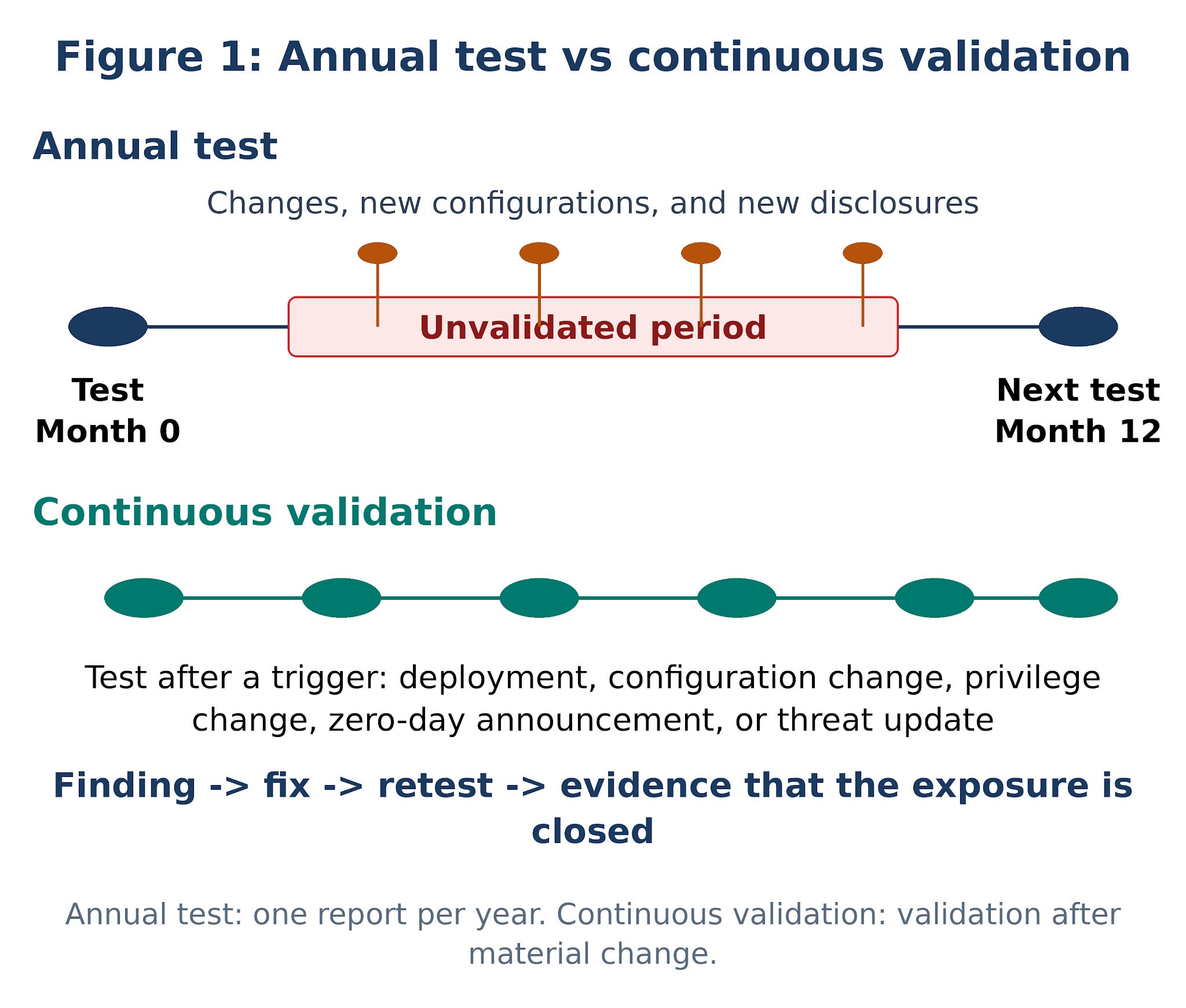
Figure 1 shows the difference between an annual test and a system that changes every day: a report that is accurate on test day, then becomes incomplete after each deployment, configuration change, and disclosure that follows.
Figure 1: Annual test against continuous validation
The Zero Day Clock tracker, cited in Help Net Security’s coverage of Gartner’s COST work, puts the time from disclosure to a weaponised exploit at under 10 hours on average for 2026, down from roughly 53 days two years earlier. Those summaries also put new CVE publications in 2025 at 49,183, about 135 per day.
The question is whether an attacker can reach and use it in this system now, after the latest change. A scanner cannot always show whether an attacker can reach a weakness, whether a control blocks the path, or whether two lower-severity weaknesses together give full access. Teams test the path in a controlled way and record evidence.
Continuous validation does not remove the manual test. The continuous system checks known paths, new changes, and repeated exposures at a frequency a manual team cannot sustain. The manual team then works on novel risk, complex business logic, and independent assurance.
A team that tests once a year does not have one year of assurance. It has one day of evidence, followed by months of untested change. Teams fix it by testing after each change, not by adding more effort to the same calendar.
Where test data goes is not a contract detail. A penetration test produces the most sensitive description of a system outside production itself, and the recipient of that description holds it under the terms that cover that destination.
Some teams cannot use a cloud-delivered test, even when it is cheaper or easier to start. Finance, government, and telecom customers appear repeatedly in Ridge’s own description of its customer base. Teams in those sectors face data residency rules, customer contracts, and audit requirements that restrict where test data and target details can go. That description covers reachable services, credential paths, misconfigurations, and confirmed weaknesses.
Dradis, in an analysis of data sovereignty in penetration testing, warns that pasting findings into a public AI tool sends a client’s findings to infrastructure under terms the client never agreed to, and that this can breach a penetration test non-disclosure agreement. The same analysis cites the Samsung case from 2023, in which engineers leaked proprietary source code through ChatGPT prompts and the company followed with an internal ban. For government clients, defence work, or strict data residency requirements, the analysis concludes that the hosting model causes the risk, not only the contract terms.
A local model keeps test data, target responses, and AI reasoning on hardware the customer controls. For some teams, the first question is not price or speed, but whether test data leaves their premises. If the answer must be no, a cloud model cannot be used, regardless of price or speed.
Mid-sized teams have a second constraint: they may have no AI team, no AI infrastructure project, and no appetite for building one. George Duo, Ridge’s vice president of product management, said in that release that organisations should not need a larger AI team or a complicated infrastructure project to use agentic testing, while keeping control of their data, infrastructure, and testing process. Ridge president Lydia Zhang added in the same release that autonomy has to come with control. Ridge built RidgeOne for that buyer: a team that needs continuous validation, cannot send test data out, and cannot staff an AI project.
That is why the hosting question comes before price or speed for these teams. A cheaper test that sends test data out is not a cheaper version of the same test. It exposes test data to a system outside the customer’s control. And a team with no AI team and no AI infrastructure project does not need a larger programme to use agentic testing. It needs agentic testing that arrives complete, with no AI infrastructure to build.
Continuous validation is not a faster test. It repeats five stages. A team that skips one stage has not done continuous validation. Scoping decides what matters. Discovery finds what is exposed. Prioritisation ranks by exploitability and business impact, not by score alone. Validation proves exploitability and plausible attack paths. Mobilisation fixes, assigns, and revalidates. A programme that tests without revalidating after a fix has not finished the five stages. It has only run another test.
Gartner introduced Continuous Threat Exposure Management, or CTEM, in 2022 as a programme for continually evaluating the accessibility, exposure, and exploitability of an enterprise’s digital and physical assets. It runs as a five-stage loop. Scoping defines the business area and attack surface to protect, including the most important assets and threat scenarios. Discovery enumerates assets and exposures within that scope, including hidden assets, misconfigurations, and risks beyond CVEs. Prioritisation ranks exposures by exploitability, business impact, and compensating controls, not by CVSS score alone. Validation confirms exploitability and plausible attack paths, and whether controls respond. Mobilisation sends fixes to the owning teams, with ownership, deadlines, and revalidation proving the exposure is closed.
RidgeBot is listed by Gartner in the Adversarial Exposure Validation category, which supports the Validation stage through active testing that simulates attacker behaviour. RidgeGen and RidgeOne supply detailed, evidence-backed validation and fix guidance that support Mobilisation. The customer still handles Scoping, Prioritisation, and Mobilisation.
Figure 2 shows the CTEM loop: scope, discovery, prioritisation, validation, and mobilisation, with validation triggered by change and revalidation proving a fix, rather than a single test that ends with a report.
Figure 2: CTEM loop from scope to mobilisation
Gartner’s Continuous Offensive Security Testing model, or COST, described in a March 2026 report by Dhivya Poole, Carlos De Sola Caraballo, and Mitchell Schneider, gives the operating model for the Validation stage. Novee and Skyhawk describe COST as trigger-driven, intelligence-led validation that unifies penetration testing, red teaming, bug bounty, and control validation into a single capability, blending automation, AI, and human expertise. It activates when something material changes: a new deployment, a configuration change, a privilege change, a zero-day announcement, or a sharp rise in threat intelligence.
Skyhawk, Help Net Security, and Novee repeatedly state that, by 2028, over 60 percent of enterprise penetration test programmes will operate as continuous validation executed within DevSecOps pipelines and governed by CTEM, replacing annual assessments as the primary proof of resilience. The forecast is about programmes, not about the disappearance of annual tests for compliance purposes.
A trigger-driven process works only if every finding is retested after it is fixed. A finding that enters a ticket and is never retested is not continuous validation. Ridge’s model supports that process by sending validated findings into patch and ticketing workflows, per Ridge’s own site, and by revalidating after a change, deployment, or integration. An Omdia survey of 400 cybersecurity professionals found that 94 percent of organisations see the importance of keeping humans in the loop for offensive security programmes.
On 26 October 2026 Ridge announced it is the only company listed across four categories in three Gartner cybersecurity reports. A Gartner listing is not a Gartner endorsement, as Ridge’s own release states. Ridge joined NVIDIA Inception in September 2026. Inception is a startup-support programme, not a product certification or an endorsement of RidgeOne’s test quality. That explains RidgeOne’s DGX Spark and Nemotron choices, both NVIDIA technologies.
Agentic testing is strong at breadth, speed, and repetition. Autonomous pentesting produces high-confidence, evidence-backed findings through a find-prove-fix loop. A human reviewer still confirms what those findings mean as business risk for the organisation. That division of labour applies inside a private appliance as well as in other deployments.
First, agentic testing cannot yet deliver independent assurance on its own. HackerNoon, in an analysis of agentic penetration testing, states that high- and critical-severity findings still need a human to confirm them, and explain what they mean as business risk, and that a tool validating its own findings is not independent assurance, however good the evidence pack. RidgeOne evidence alone may not satisfy an auditor looking for manual testing evidence under PCI DSS, SOC 2, HIPAA, or ISO 27001, per third-party guidance reviewed for this article. Autonomous pentesting reports are widely accepted in compliance testing programmes, and they still require an auditor’s review and sign-off.
Second, A box that tests only what approved tools and interfaces allow it to test does not test social engineering, physical access, or deep insider threats, per Spartech’s analysis.
Third, model risks persist inside the box. Spartech lists misinterpretation of target responses, overconfident conclusions, and missed areas that result from following unproductive investigative paths. The Intruder practitioner account adds false positives, inflated severity ratings, and incomplete coverage. Ridge’s answer is evidence-backed verification, separation of reasoning from execution, and SafeBox credential handling. Fourth, scope and authorisation remain the customer’s responsibility, and guardrails work only within the scope the customer defines. Industry practitioner guidance lists the requirements: test only targets the customer owns or is authorised to assess, with scope documented in writing; rate-limit and avoid denial-of-service behaviour; minimise sensitive production data in prompts; validate in staging before production; log prompts, agent decisions, and network actions; and require human approval before high-risk actions. Ridge’s frozen launch package, three-zone architecture, and boundaries set before a run support those practices, per Ridge’s own material.
Fifth, the model-update question is largely unpublished for RidgeOne. Ridge’s datasheet states only that each release states its exact model build, and that the model can be updated as open-weight models improve without changing platform or safety controls. That leaves unanswered: who pushes updates, on what schedule, whether updating needs an outbound connection, and how new versions are regression-tested.
Ridge Security announced RidgeOne on 13 October 2026 as a self-contained solution for autonomous AI penetration testing and agentic red teaming for mid-sized organisations: the teams that need continuous validation, cannot send test data out, and cannot staff an AI project. Ridge describes it as RidgeGen, its agentic security validation platform, combined with an open-weight AI model running on NVIDIA DGX Spark. Ridge’s datasheet states that RidgeOne requires no AI infrastructure to build, no AI team to hire, and no per-token costs.
The launch release says only “an open-weight AI model.” The datasheet names the models. RidgeOne includes the NVIDIA Nemotron 3 family: Nemotron 3 Nano, a 30-billion-parameter model, as the default for efficient, fast turnaround, and Nemotron 3 Super, a 120-billion-parameter mixture-of-experts model, for deeper reasoning on complex, multi-step targets. GPT-OSS is also supported, and RidgeGen is model-agnostic. Neither model runs in an external provider’s cloud in the RidgeOne package.
Figure 3 is the separation inside RidgeOne between deciding what to test and executing the test: the model on the GPU decides what to test next and interprets what comes back, RidgeGen on the CPU executes the tests, applies safety rules, and writes the report, with the platform enforcing the boundaries the customer sets.
Figure 3: RidgeOne inside the box
Ridge’s datasheet hardware is the NVIDIA DGX Spark, based on the GB10 Grace Blackwell system, with 128 GB of unified memory shared between the AI model and RidgeGen, a 20-core Arm CPU with an integrated Blackwell GPU, and 4 TB of NVMe self-encrypting storage. Ridge states the system runs Ubuntu 24.04 LTS Server hardened to CIS Benchmark Level 1, is administered through a web interface and a restricted management console, and is delivered as a signed image with published checksums. Ridge uses the NVIDIA DGX Spark as a reference example. Any server model with a compatible architecture and comparable hardware specifications is expected to work similarly.
Inside the box, the model runs on the GPU and RidgeGen runs on the CPU. Ridge states that no request leaves the appliance for the AI to do its work, and that the platform, not the model, enforces the boundaries the cus…