OpenAI ships the most capable agent framework in this series, and OpenAI ships no central place that enforces tool policy for that framework. Article 1, AWS Agentic Security Tooling, Mapped to MAESTRO, established a central Cedar gateway and one rule: routing decides coverage. Article 2, Microsoft Agentic Security Tooling, Mapped to MAESTRO: Policy Lives in Four Places, established the split alternative: policy lives in identity, content, connector, and framework controls. Article 3, Google Agentic Security Tooling, Mapped to MAESTRO: The Gateway Is Real, the Semantics Are Not, established a gateway that enforces identity, destination, and tool name, and still needs a custom engine for argument semantics. OpenAI sits outside all three conclusions. OpenAI gives a developer a small set of primitives, input and output guardrails, per-tool approval, tracing, and an instruction hierarchy, and OpenAI leaves every enforcement decision to developer code, key scope, and human approval. That combination is the thesis of this article. OpenAI gives a team the strongest SDK primitives for an agent, and OpenAI gives a team no gateway, no per-agent identity principal, and no native retrieval or memory provenance control. A team that buys the framework and assumes the framework enforces policy will ship an agent with no enforcement at all.
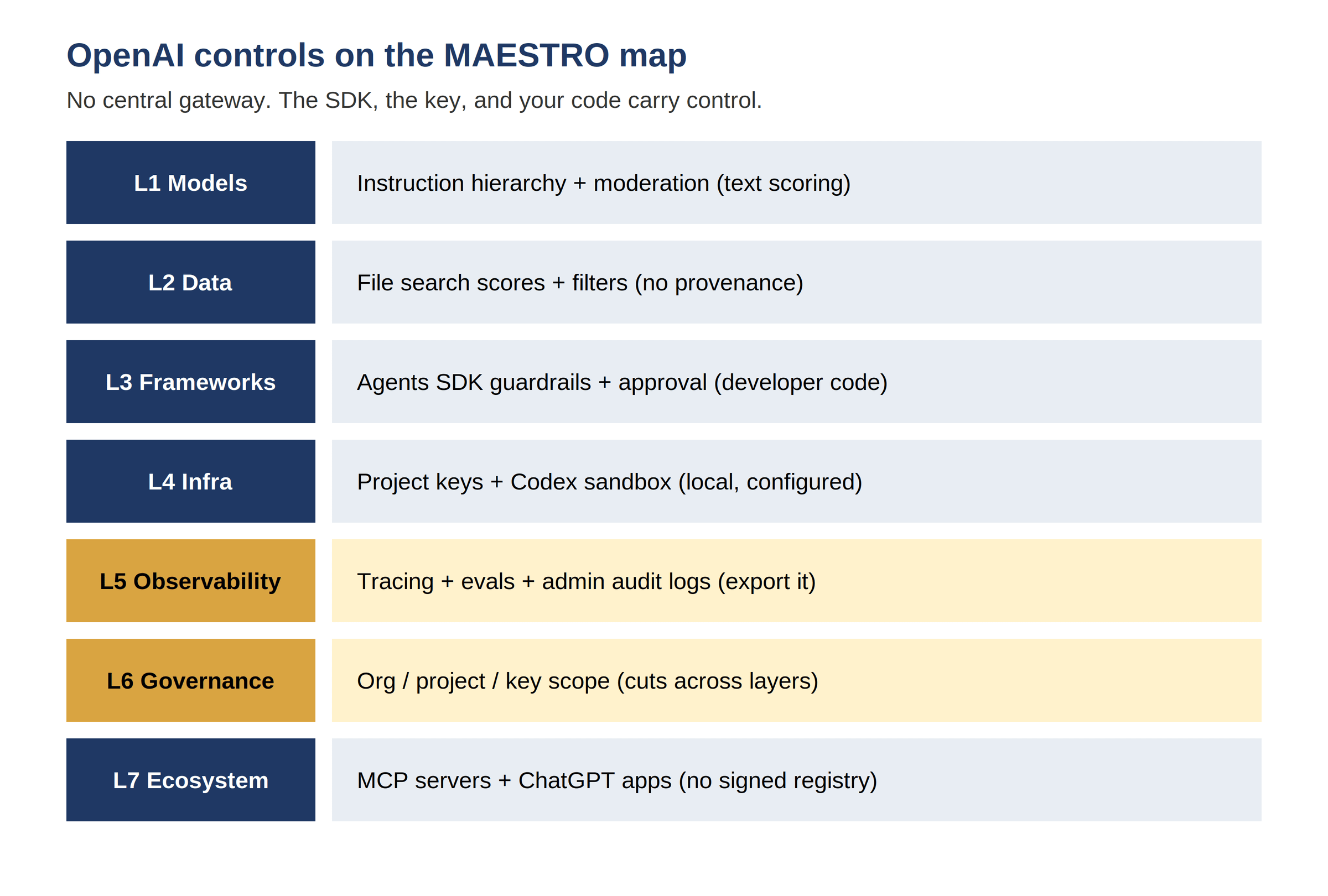
Figure 1 is the OpenAI stack on the MAESTRO map: the SDK carries L3, the key carries L6, and nothing central carries either one.
Figure 1: OpenAI controls map to MAESTRO layers, with L6 cutting across all layers. The SDK and the key carry control, and no gateway sits between them.
OpenAI instruction hierarchy gives the model a rank order for conflicting instructions, and OpenAI guardrails give a developer a tripwire for agent input and output. Those two facts show the pattern of this article in miniature: OpenAI trains strong model behaviour, and OpenAI leaves the last step, the enforced decision at the tool, to code a developer writes and tests.
L1 Foundation Models — the stake is model output. A model can follow a harmful instruction with fluent, confident text. Output alone never proves safety. The paid L1 section states what the instruction hierarchy orders, what moderation scores, and what neither control can do to a tool argument.
L2 Data Operations — the stake is retrieved text. A document, a memory record, or a tool result can carry an instruction. Retrieval turns untrusted text into model context. The paid L2 section states what file search scores prove, what filters restrict, and what no OpenAI control validates.
L3 Agent Frameworks — the stake is tool action. A plan becomes real impact only when a tool runs. Tool permission decides that impact. The paid L3 section states where guardrails run, where approval interrupts a run, and where a handoff drops every agent-level check.
L4 Deployment and Infrastructure — the stake is runtime privilege. An agent process runs with a key. That key decides lateral movement. The paid L4 section states how project keys, service accounts, and Codex sandbox modes fit together, and which defaults a team must change.
L5 Evaluation and Observability — the stake is proof. Traces, logs, and evaluations show what an agent did and why. Missing logs remove that proof. The paid L5 section states which audit logs cover admin events only, which retention promise OpenAI does not make, and which trace a team must store itself.
L6 Security and Compliance — the stake is identity separation. User identity, agent identity, and tool identity must stay distinct. One shared key hides who acted. The paid L6 section states the three identity scopes, the key-leak consequence, and the approval pattern that restores attribution.
L7 Agent Ecosystem — the stake is peer trust. A peer agent or a tool server needs vetting, registration, and scoped credentials. Registration alone never proves trust. The paid L7 section states what MCP connection gives, what ChatGPT apps give, and where peer trust remains unbuilt.
Five cross-layer attack chains — the stake is the chain, not one step. Each chain shows the step where an OpenAI control breaks it, and the step where a gap lets it pass. The paid chain section gives a test for each chain in a reader's own environment.
Four-way comparison, control gaps, reference architecture, and builder playbook — the stake is reuse. The paid closing sections cite Articles 1, 2, and 3 at each point where OpenAI differs from or shares a gap with them, name each gap plainly, and give a copy-ready guardrail, approval, and key pattern teams can apply on day one.
Start a review with the tool list and the check list. List every tool the agent can call, and mark each tool with three facts: whether a tool input guardrail is attached, whether approval is required, and whether the approval function sees the actual arguments. Mark each handoff with one fact: whether the receiving agent carries its own tool guardrails, because an agent-level check on the first agent does not follow the handoff. Mark each MCP server with one fact: whether the server runs with a dedicated credential or with a shared key. A review that skips that inventory cannot judge coverage. A review that completes that inventory can see the gaps before it reads any policy text.
Continue a review with keys and logs. List every API key and service account, and list the project each key can reach. Mark each key as single-agent, single-project, or shared across agents. Check whether a leaked key would reach one agent or every agent in the project. Check whether tool calls appear in a store the team owns, or only in a trace the team never exported. Check whether admin audit logs are enabled, and check whether the team exported those logs to its own store, because OpenAI makes no fixed retention promise for them. An identity review that finds one shared key has found a real finding, not a paperwork issue. A logging review that finds no exported tool-call store has found a proof gap that no guardrail can fix.
Finish a review with a chain test. Pick one chain from the paid section. Run the chain in a test environment with test data, test documents, and test tools. Record the step where a control stopped the chain. Record the step where no control ran. Record whether a guardrail tripped, whether approval stopped the destructive tool, whether the hierarchy ignored the injected instruction, and whether the tool call appeared in the team's own log store. A chain test gives a team evidence, not an opinion. A chain test also gives a team a repeatable check for the next release.
The paid section maps each layer in turn. The paid section gives the five attack chains, the four-way comparison, the control gaps, the reference architecture, and the builder playbook. The paid section keeps every claim tied to a primary source. The paid section drops any claim we could not source. The paid section also states, plainly, where OpenAI offers no native control at all. Those gaps are not a criticism of one product. Those gaps are the work a team must plan, fund, and own. A team that plans that work early ships a safer agent. A team that discovers that work after launch ships a delay. A team that completes the tool inventory, the key inventory, and chain testing before launch will know its real coverage. A team that skips any of those three checks will learn its coverage from an incident instead.