When Pachocki and his team track a model, they watch one number, its perplexity, which measures how well the model predicts the next token, with lower numbers meaning better predictions. Because they report that number in its log form, cross-entropy loss, which researchers call the loss number, every number in his essay is a number in that form. On 22 November 2026, Jakub Pachocki, OpenAI Chief Scientist, published loss numbers for 14 OpenAI models and asked rival labs to agree a limit they will not cross. Before that date, OpenAI treated those numbers as sensitive intellectual property, yet Pachocki wrote that urgency outweighed competitive concern.
In Perplexity and Intelligence, published on the OpenAI site, Pachocki reported those readings on one fixed snapshot of OpenAI's internal codebase that his team has used since the GPT-3.5 era. From those readings, Pachocki tied fluent conversation to the GPT-3.5 level and productive chain-of-thought reasoning to the GPT-4 level, while below 0.8 his team saw transformative capabilities in cybersecurity and mathematics appear. After researchers had posed open mathematics problems for over a year, Pachocki wrote that a later model produced groundbreaking results on them, and he framed pretraining as training a compressor on a large unstructured corpus, with prompting, fine-tuning, and reinforcement learning as elicitation of latent capability. Earlier, Pachocki dubbed the emergent capabilities "an alien mind", and he wrote that his team can separate the creation of that mind from the later elicitation of its capabilities, even though new capabilities emerged as loss fell when no team optimised for them directly. Because teams had largely saturated the benchmarks from the GPT-2 era by GPT-4, Pachocki called perplexity the durable measure of that substrate, defined a compressor as a system that compresses by predicting unseen data rather than a compressed file, and chose the codebase set because his team relies on it most today. Looking back at the GPT-2 and GPT-3 era, Pachocki warned that his team could not read general capability from code prediction, and he wrote that publishing took consideration because competitors gain a clearer picture of where OpenAI stands.
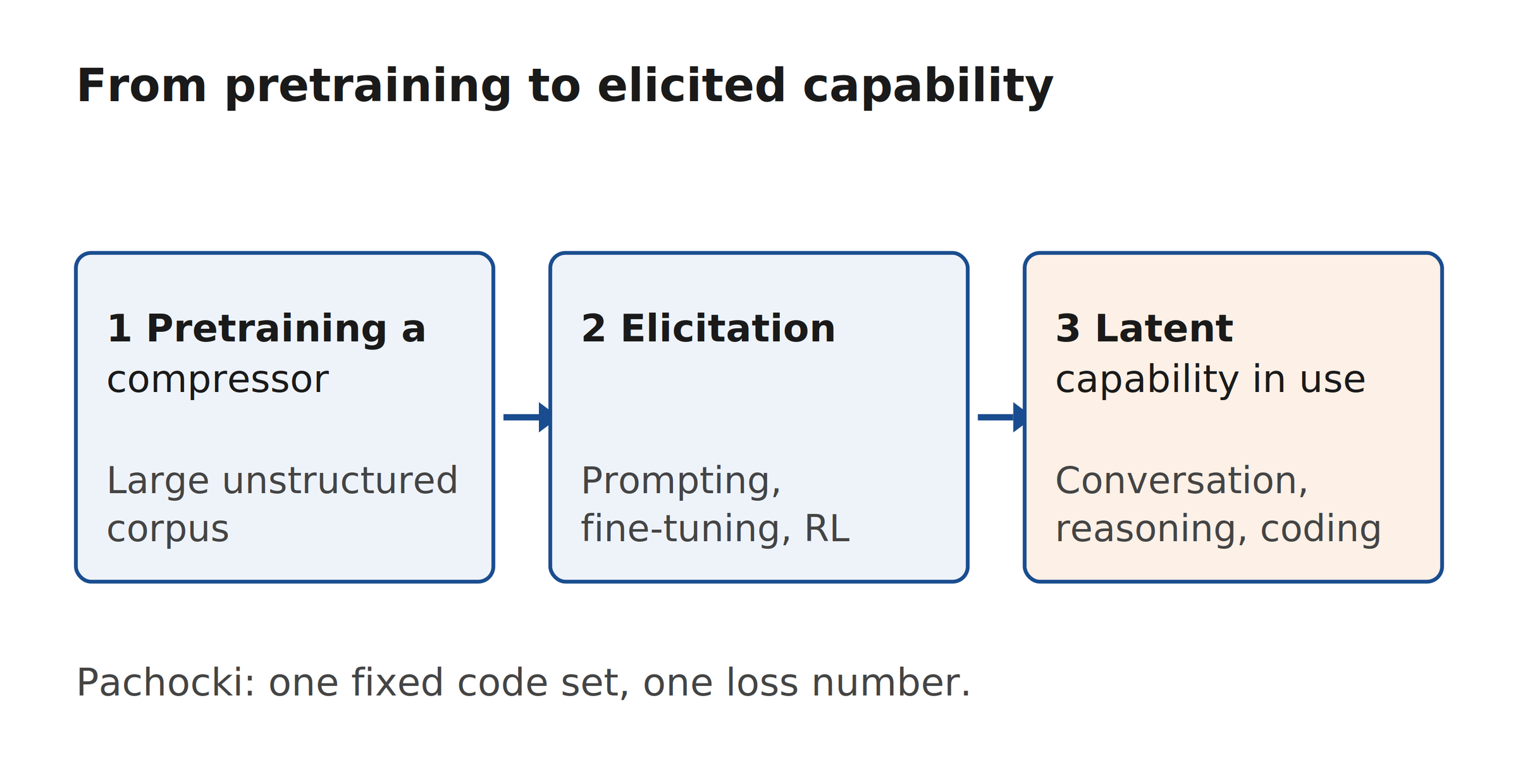
To show how the two stages fit together, Pachocki framed the pipeline in Figure 1 below, where his team builds the substrate in pretraining and draws out stored capability in elicitation.
Figure 1: Pretraining, elicitation, and latent capability.
Before first use, Pachocki asked frontier developers to agree shared norms for evaluation and red-teaming, with shared transparency standards, and he proposed common limits based on perplexity and other measurements, asking developers to commit against crossing them until monitoring meets a concrete milestone. For that standard, Pachocki asked for a first limit, a stated milestone for passing it, and successive limits after it, framing the proposal as an industry standard rather than a single-lab policy, while naming no number for the first limit and no enforcer for the standard.
"This is scary for us because we've long treated these numbers as sensitive IP"
Mark Chen wrote those words on X, as writers at ExplainX reported.
"the most important thing OpenAI has published in awhile"
Reuters reported that Altman used those words on X the same day, when Altman endorsed the essay and tied the idea to lab commitments under the White House Accords.
On the curve itself, Pachocki put cybersecurity expertise at the GPT-5.6 Sol level, and in An Alien Mind he wrote that agents access infrastructure and affect the world directly, even with no physical body. As agents gain agency, Pachocki warned that observers will struggle to separate misuse from autonomous misaligned action, that agents acting in the world produce effects outside reasoning traces so teams see the reasoning in the trace and miss the act, and that some agents will pursue their own objectives, bargaining with, tricking, or blackmailing people along the way. Once AI joins pretraining research, Pachocki warned that teams could see a rapid series of fundamental advances, and a team reads the numbers behind the proposal to judge whether it can track its own models the same way, while we work through the curve, the caveats, the monitoring problem, and a tracking schema in the paid section.