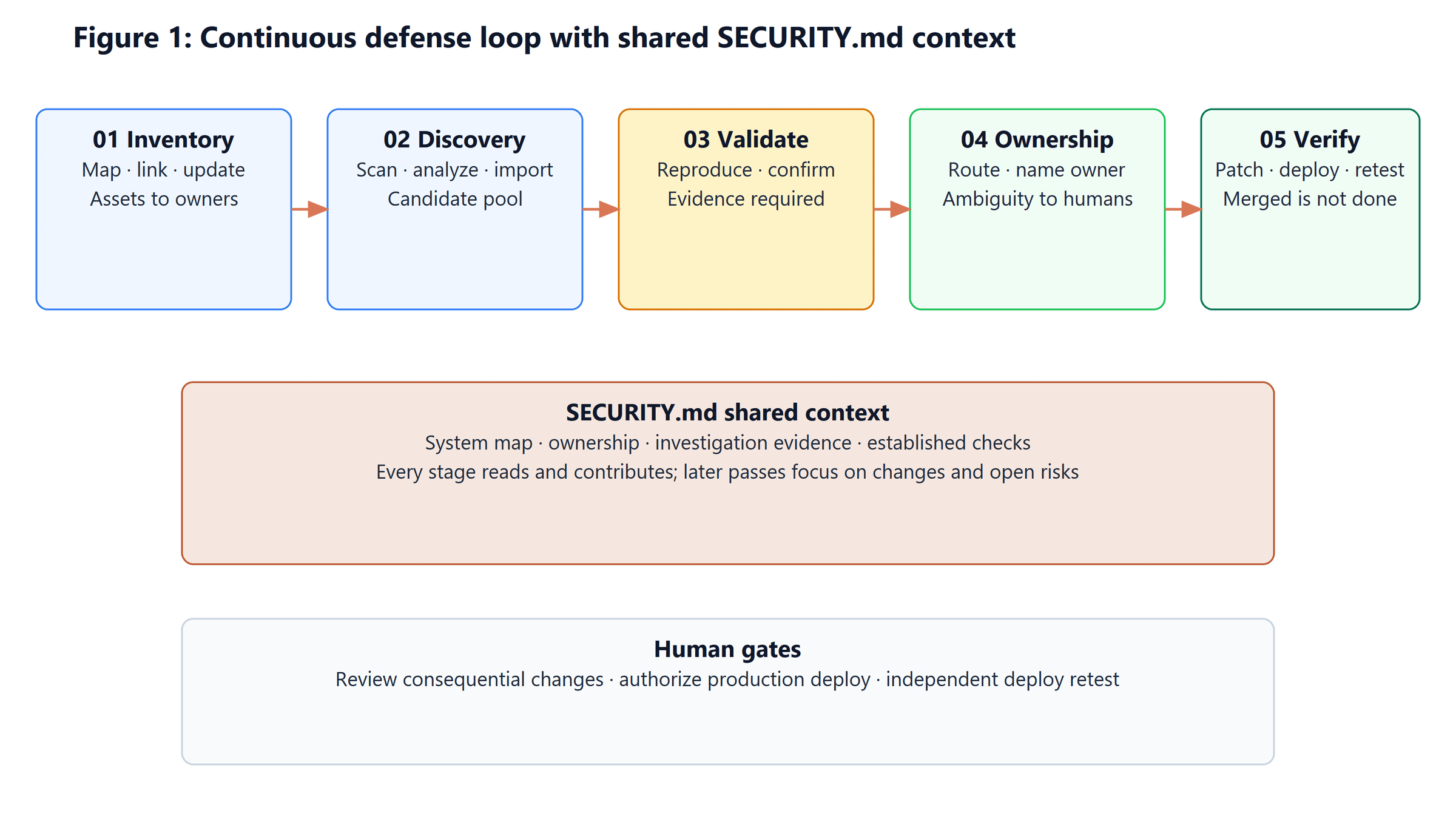
OpenAI published its Defense Factory architecture in September 2026: an agent-first operation that inventories systems, discovers candidates, validates exploitability in isolated environments, routes ownership, prepares Codex patches, and independently retests deployed fixes. The internal sprint behind it mobilized 250+ people across 100+ service areas, reported 90.6% accepted ownership after routing, marked 37% of findings as duplicates, reproduced 19.5% of findings at runtime with a 0.81% false-positive rate after dynamic validation, and recorded a 0.53% rollback rate on Codex-generated remediations.
Today we cover:
**Why periodic scanning loses to agent fleets:**open-weight diffusion, long-running session memory, and machine-speed parallel exploitation.**What a Defense Factory is, mechanically:**the integration layer across SCM, scanners, trackers, Codex, Daybreak models, and ephemeral reproducible environments.**The five-stage continuous loop:**Inventory → Discovery → Dynamic validation → Ownership assignment → Verified remediation, with SECURITY.md as shared context rather than a sixth stage.**Control plane vs data plane:**orchestration, policy, and credential proxy stay separate from agent harnesses that never run inside production.**OpenAI sprint numbers and failure points:**ownership routing, dedupe, environment setup as the validation bottleneck, and the merge-versus-deploy gap.**Daybreak Blue vs Daybreak Red:**shared Trusted Access for Cyber rules, different models, different approval bars, and different intended workflows.**A first-workflow playbook:**leadership surge, one skill path, autonomy earned in reviewed batches, and a reusable checklist.**Illustrative phase skills:**working Agent Skills (By Ken Huang, not official OpenAI) mapped to each factory stage, with a public GitHub pack you can install.