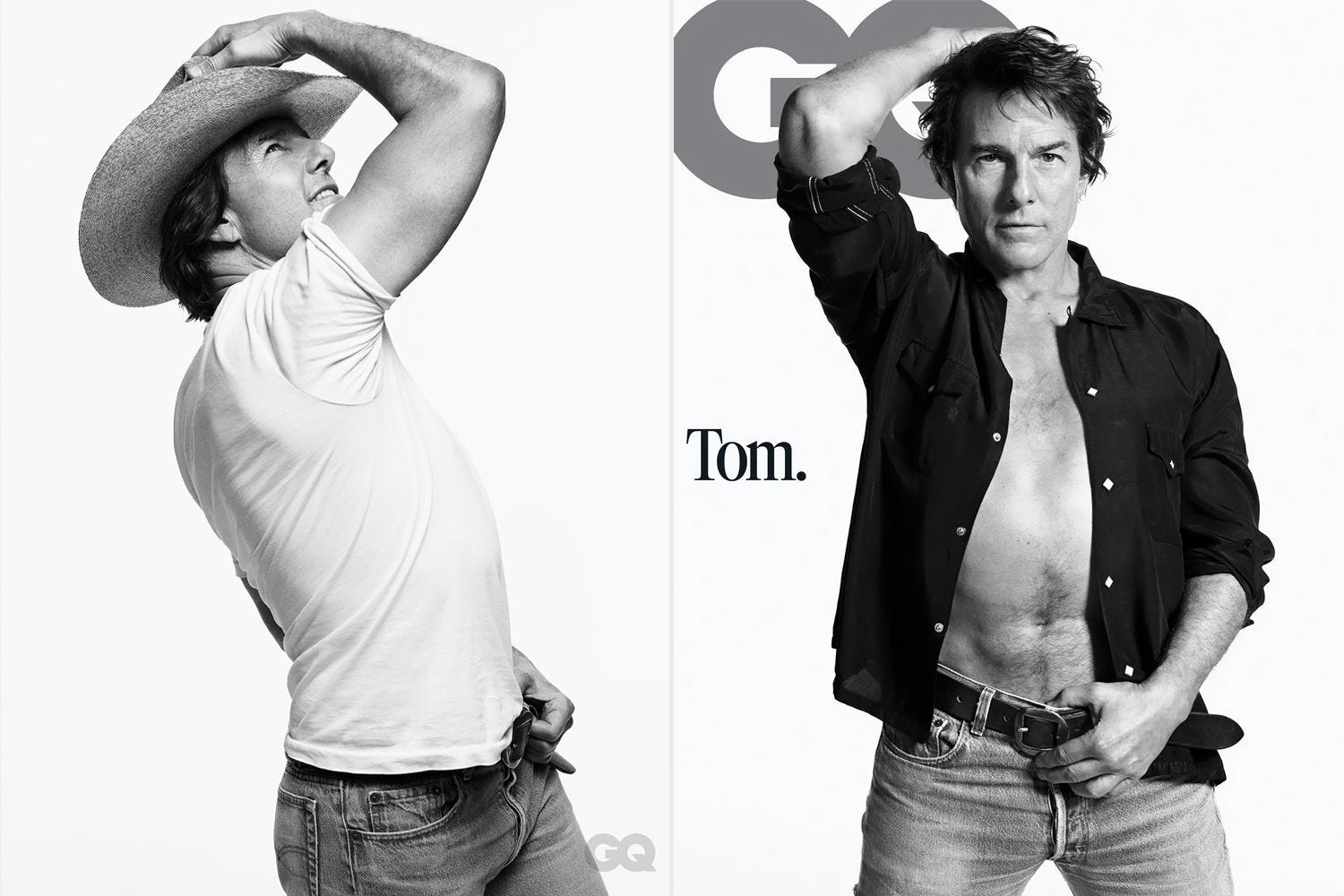
Mario Sorrenti shooting Tom Cruise for GQ encapsulates so much of the ills of our current moment. Legacy media reinforces paradigms that maintain the status quo, buying up marketable properties to hoard wealth. We’re stuck in stale concepts that maintain our existing system. The cloying, desperate tone of the photo shoot highlights that we need authentic creativity, not just the same old folks giving us the same treatment.
Sorrenti was THE person to photograph the supermodels of the ‘90s and ‘00s. His work connected with viewers for its apparent lack of artifice. Fresh-faced Kate Moss just happens to be in Ye Olde swimming hole. Carolyn Bessette Kennedy, fresh-faced like in a photo booth. His work was ideal for an era when technology wasn't evenly accessible to all. These images made the candid editorial.
Before cell phones, the candid was a pleasurable surprise. If one of your friends wasn’t a camera nerd or you didn’t have disposable cameras at hand, your lived experiences moved from action to memory without being written to the photographic frame. Even if you had Polaroids for that party or a camera at hand, the image was clearly a derivative of the experience. Lived experience was clearly superior to an amateur’s captured photographic still. The image wasn’t a stand-in but a souvenir.
Sorrenti harnessed the pleasure of the candids but the polish of professional photography. Susan Sontag wrote in On Photography that “The painter constructs, the photographer discloses.” While the photographer does open up moments to viewers, these artifacts are still constructions. A good portrait photographer shares something indelible, and ideally something unexpected, but the system is still rigged. Falseness lurks within what looks like truth.
In Sorrenti’s photographs, he wanted to create spaces where we could share a private moment with the famous. The resulting artifice tricked us into feeling a connection to the sitters. We felt like we were right there at the swimming hole or running down that NYC street. In this era, real and constructed blurred in interesting ways.
We lived in real life, our moments caught largely in printed images. Digital was creeping in, but still, those cards required a camera, a device divorced from the tool we spoke into or the tool we used to access the internet. Our lives were one thing; the tools we used were discrete. We chose to use the phone, the computer, or the camera.
Fame lived in another realm, largely on film or television. Editorials gave us one; paparazzi gave us another. PR relationships and blind items weren’t common parlance. We lived pleasantly unaware of the apparatuses of fame. Sure, we had the six degrees test of fame. How many of us knew someone who knew someone famous? But, in general, fame was neither easily accessible nor attainable.
Candids became the entry to fame for many. Consumer tools improved. Sontag also predicted the cheapening of images. She noted that imagery becomes a cheap commodity in capitalism. She highlights that “the camera’s twin capacities, to subjectivize reality and to objectify it,” create a powerful system for exploitation. Fame could happen through blogs and, eventually, social media. The earliest people to jump from social fame to real fame had surprising ideas, like Julie, who made all of Julia Child’s recipes, and/ or the willingness to put themselves out there, like the Green brothers. As with all things in capitalism, the more people there are, the fewer find big success. Now, it feels like there are at least as many creators as phones.
Social media success is similar to the Sorrenti pictures of yore, in that it's predicated on false authenticity. How many creators have been unmasked for the lies that buttressed their folksy image? We, as viewers, yearn for real people, but we also scorn the reality when it’s messy. As an audience, we get burned and reach out again. Our intellectual scars have made us cynical.
We’re especially cynical about the artifices of fame. In our decade-long affair with social media, the veil has lifted. We see the tricks. Truthfully, I think we’ll be fooled again. But people better find better tricks. In years past, Tom Cruise had a magic quality, largely earned by his big box-office earnings. When the media was more controlled, he could keep a tight lid on his image.
Compare the casual sexuality of a 1981 shoot for “Parlee,” a gay-entertainment magazine. In pulled-up tube socks and shortie-short shorts, he has the effortless cool of youth. He offers a half-smile, as if he’s going with this but isn't sure. There’s an honesty in this image. Unlike the false honesty of Sorrenti's polished work with its set and staff, Parlee was a small-scale production. A couple of guys and an unknown model.
The comparison between Parlee and GQ, though, is more than just a different setup. It’s about a man pretending the last four decades mean nothing. He’s attempting to freeze himself in the past, in a time in history when old men haven’t been getting good press.
Old men voted for a rapist/ felon. Old men are barely alive, yet they're still sitting senators. Old men have made food lethal. Old men voted to hold on to their bounty (one that has been closed to the rest of us. earning a living wage impossible.
Culturally, we’re getting sick of the trick of old men demanding we don’t see their false youthfulness. The idea of eternal youth would be an individual problem, but this photoshoot feels like the final straw. How many younger photographers can’t work because the big houses hired the same folks? How many actors can’t make it because the films only use known names and their less talented kids? How many interesting journals can’t get funding so we’re stuck with the Sydney Sweeney-loving GQ?
This issue would probably not matter if Trump wasn’t running our country with the expectation that all of us will be gone in five years. Our politicians are outrunning time rather than spending their days helping us. And it’s obvious none of them care about the future, nor do they have a true read on today.
That’s the biggest tell for me about Sorrenti’s images of Cruise. The man saw these pictures and thought, " Yup, still got it. Sorrenti saw them, having taken hundreds of the exact same kind of image, in the same format against the white background, and thought, “Yup, still got it.” GQ said, "Rubber stamp.” These old men can’t learn new tricks. This is a circuit of broken yes-men.
And it’s one we can short-circuit. We can push individual creativity. Share interesting new photographers. Share local actors. Read new journalists. Push out everything you love that feels engaging and surprising. We have the power, because all that old guard feeds off attention. If they won’t grow and change, we let them feel as wilted as Tom looks.