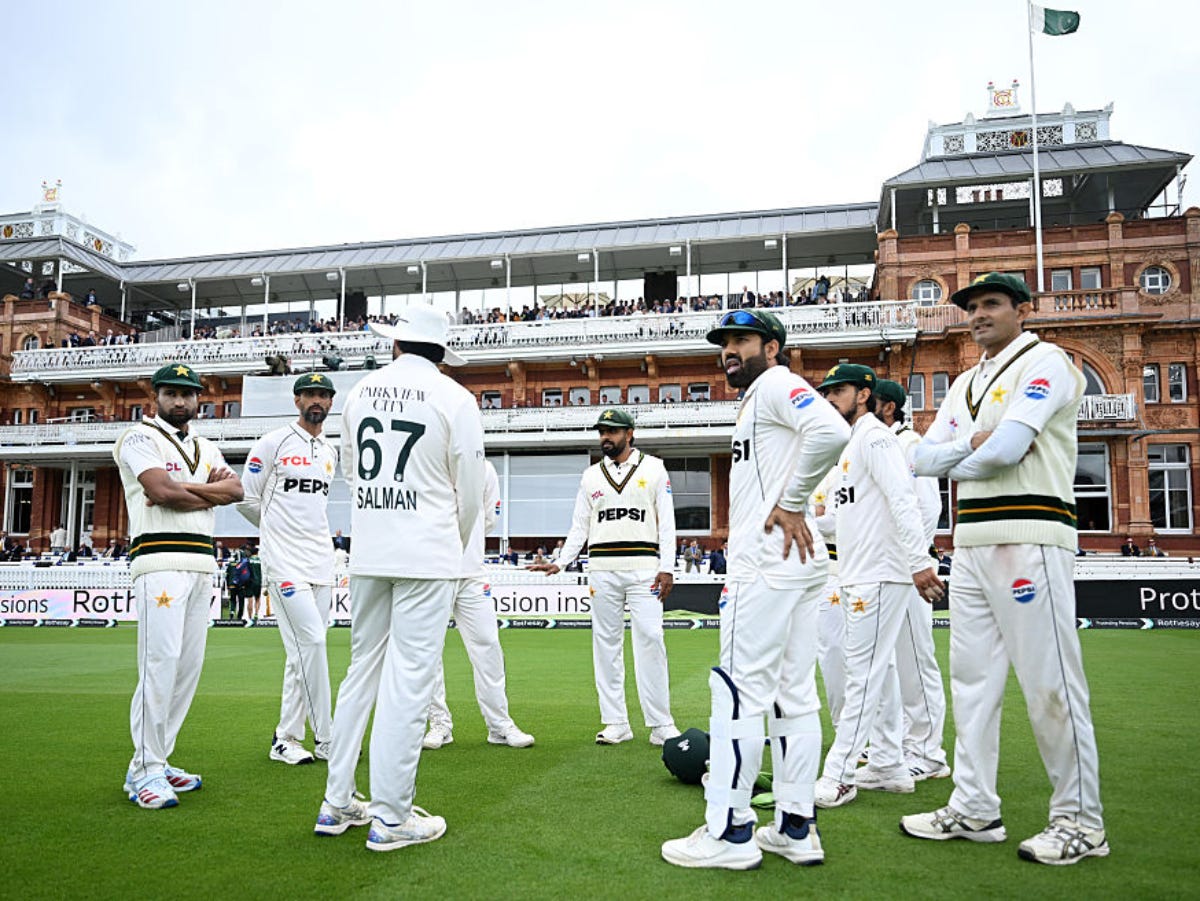
Seven players sent home in the middle of a Test series. A head coach removed barely four months after his appointment. The bowling coach gone with him. Five uncapped players called up, and the white-ball staff asked to take charge of the Test side with one match still remaining.
Pakistan’s overhaul after defeats at Headingley and Lord’s may look like another drastic response to another bad tour. In reality, it sits at the end of a much longer decline – one visible both in the results and in the instability that has repeatedly reshaped the system around the team.
From powerhouse to WTC strugglers
During the 1980s, Pakistan played 80 Tests and lost only 13. They won 23 and drew 44, producing a win-loss ratio of 1.77, bettered only by the West Indies. Retrospective ICC rankings even place Pakistan at No. 1 in 1988. The 1990s sustained that status. Pakistan won 32 of 76 Tests and lost 21. Across 1980-99, they played 156 Tests, won 55 and lost only 34. That is the clearest way to understand what Pakistan once were: not merely gifted or unpredictable, but extremely difficult to beat.
Across 2000-19, the equation changed. Pakistan played 166 Tests and lost 68 – exactly twice as many defeats as in 1980-99, despite playing only 10 more matches. There was one major recovery. Under Misbah-ul-Haq, Pakistan turned the UAE into a formidable surrogate home after international cricket disappeared from the country following the 2009 attack on the Sri Lankan team bus. In August 2016, after drawing 2-2 in England, Pakistan reached No.1 in the official ICC Test rankings.
Ten years later, they are eighth. Their World Test Championship record shows how sharply the decline has accelerated. Pakistan’s points percentage has fallen in every cycle: 43.30 in 2019-21, 38.10 in 2021-23, 27.98 in 2023-25 and 16.67 in the current campaign.
The current England tour has exposed the latest stage. Pakistan lost at Headingley by an innings and 103 runs and at Lord’s by 194 runs, failing to reach 200 in any of their four innings. The Lord’s defeat was their 10th in their last 11 away Tests. Bangladesh have also swept them 2-0 in successive Test series, first in Pakistan in 2024 and then at home this year.
After Lord’s, Pakistan’s all-time Test record stood at 153 wins and 154 defeats. Their cumulative record had slipped into the negative for the first time since 1987. For almost four decades, despite the loss of home cricket and repeated crises, Pakistan had maintained that historical balance. It has now disappeared.
When politics began producing constant resets
Political influence itself is not new to Pakistan cricket. The prime minister remains Patron of the PCB, while government nominees sit on the Board of Governors, involved in electing the chairman. The more damaging development has been the frequency with which political change has produced cricketing change.
In 2013-14, Najam Sethi and Zaka Ashraf repeatedly moved in and out of the PCB chairmanship through government decisions and court orders. Pakistan’s Supreme Court described the episode as a “game of musical chairs” and said the instability had caused immense harm. Yet Pakistan still reached No.1 in Tests in 2016. Strong cricketing continuity could still survive administrative disorder.
When Imran Khan became prime minister in 2018, Sethi resigned, and Ehsan Mani succeeded him. Under the 2019 constitution, Pakistan’s domestic structure was comprehensively redesigned. The traditional regional and departmental model gave way to six Cricket Associations, with supporters arguing that concentrating talent would improve standards and critics warning that the change would cost players opportunities and jobs.
Then the government changed again. Imran’s administration fell in 2022. Ramiz Raja was removed as PCB chairman, Sethi returned, the 2019 constitution was repealed, and the previous domestic structure was restored. Six associations gave way again to 16 regional bodies, while departmental cricket returned.
Whether the newer or older model was superior is almost secondary. The more troubling fact is that the pathway for developing Pakistan’s cricketers was repeatedly rewritten in step with political change. The pattern continued. Sethi withdrew from the PCB chairmanship race in 2023, publicly citing political disagreements involving Prime Minister Shehbaz Sharif and Asif Ali Zardari. Zaka Ashraf returned, left months later, and Mohsin Naqvi became chairman in February 2024. Naqvi also serves as Pakistan’s Federal Interior Minister.
Every defeat now seems to demand another beginning
The instability at board level has increasingly been mirrored inside the team. Grant Bradburn was appointed head coach on a two-year deal in 2023. Pakistan then moved to Jason Gillespie and Gary Kirsten, again on long-term contracts. Kirsten resigned in October 2024, and Gillespie followed in December.
Aqib Javed came in on an interim basis. Mike Hesson followed. Sarfaraz Ahmed became Test coach in April this year and was removed during the England tour barely four months later. Captaincy has followed a similar pattern, with Babar Azam, Shaheen Afridi, Mohammad Rizwan, Salman Ali Agha and Shan Masood all moving through leadership roles before Babar returned as Test captain.
Pakistan’s great teams were hardly free of politics, dressing-room rebellions or administrative intrigue. The difference was that underneath the disorder sat a durable cricketing core and a system capable of continuously producing elite players.
Modern Pakistan increasingly appear unable to preserve that continuity. A government changes, and the board can change. The board changes, and the constitution can change. The constitution changes and domestic cricket changes. A tournament goes badly, and the captain changes. A series is lost, and the coach changes.
Now, two defeats in England have produced seven player departures and another coaching overhaul before the series has even ended. Pakistan once had a cricket system strong enough to survive its chaos. Increasingly, the chaos has become the system.