A common belief is that AI detectors don’t work. It’s weird that this view has stuck around because it’s demonstrably false. It’s true that a lot of AI detectors are junk. But Pangram works extremely well. It is highly reliable. If Pangram flags your writing as AI, odds are very good that it is.
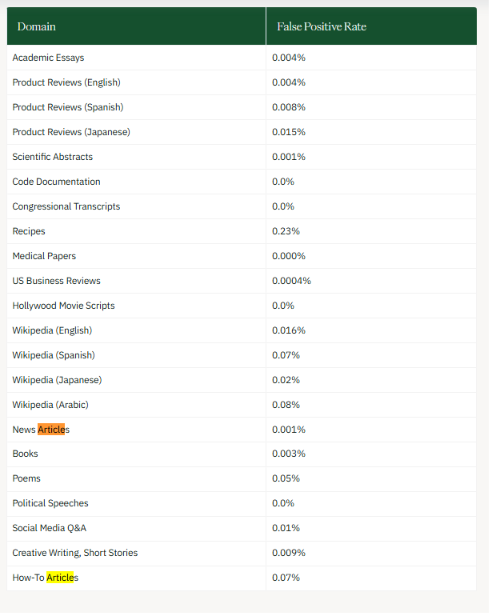
How do we know that Pangram works? Pangram claims to have a false positive rate that is extremely low, being negligible everywhere but in a few niche areas. And that was in 2025; accuracy has gone up since then.
Other reviews find similarly. A collaboration between Pangram and University of Maryland researchers found Pangram has “a false positive rate of 0.0041% and a false negative rate of 0.3396%.” While Pangram is less reliable for short snippets of text, it is still pretty reliable. And the high accuracy of Pangram has been confirmed by various other studies.
Pangram is so good that it’s almost impossible to produce an example of it being wrong. Someone named Nition on Twitter 𝕏offered people $500 if they could find a text of at least 750 consecutive words, written prior to 2019, that Pangram flagged as more than 75% AI-written. Eventually someone cracked it, but it took several weeks, and the text in question was a deeply weird poem that repeated “the next night we ate whale,” for most of the poem.
I’ve witnessed people over and over again claim to have counterexamples to Pangram only for it to turn out that the text in question really is AI-generated or that they’ve pulled some shenanigans. For instance, in one case, I saw a person literally doctor a screenshot to make it look like Pangram falsely flagged something as AI-generated when it wasn’t. If Pangram wasn’t highly reliable, people wouldn’t need to resort to such bizarre antics.
I basically think this is a pretty open and shut case. That Pangram works is a testable empirical matter. It’s been tested. It does work. There’s no longer room for debate. So what do the Pangram critics say? Mostly kind of crazy stuff. For example, one person suggested that the prize for people who could find counterexamples to Pangram was racist!
What in the world?
Emily Bender, whose main writing beat is performing mental gymnastics extreme enough to be the envy of the world’s leading gymnasts, in support of the conclusion that AI is useless junk, wrote an essay titled Pangram is not an oracle. She writes:
To get a sense of how well a language processing system is working, you need to look at both the false negative rate and the false positive rate. Looking at just overall accuracy could be misleading—it will depend heavily on the true positive rate in the test data. Similarly, looking at just false positives or false negatives is also misleading, because there is always a trade-off. Want something that has no false negatives? Design the system to always return “synthetic”. Want no false positives? Always return “authentic”.
Yes, that is obviously true, but Pangram has both low false positive AND false negative rates. Bender then writes, bizarrely:
Obviously to know your AI detector is useful, you need to know that it has a low rate of false positives and false negatives. That is why Pangram discusses the low rates of both in different places. Now, is it misleading to in some places only talk about one of them? No, obviously not, because each one carries useful information. If you want to figure out the probability that a piece flagged as AI is AI, you need only be concerned with the false positive rate. If you want to figure out the probability that a piece flagged as not being AI is AI, you only need to know the false negative rate.1
Bender then says “Regardless, before anyone uses Pangram for any specific use case, they need to be able to judge if it was actually evaluated with sufficiently similar language use.” But Pangram has been found to be highly reliable across many different kinds of texts. There’s no kind of text it’s unreliable for. So then you can use *induction *to figure out how reliable it is for a kind of text whose genre you haven’t looked at accuracy scores for. If you notice that Pangram is near flawless for news articles, movie scripts, books, recipes, medical papers, congressional transcripts, and even Japanese Wikipedia articles, then you should assume that it’s also reliable in whatever domain you’re concerned about.
It is remarkable that in a piece intending to argue against using Pangram, Bender presents no empirical evidence about its accuracy. Surely that is relevant. Surely we cannot divine a priori the accuracy of Pangram! When pointed this out in a back-and-forth with Timnit Gebru, compadre of Bender, Gebru replied:
If Pangram is unreliable, just present the evidence for that! Why can nobody do this? Why is the response from the Pangram haters to raise the problem of induction??? It makes even less sense when you consider that Pangram’s accuracy has been verified across almost every conceivable kind of text.
I’ve been pretty astonished by the accuracy of Pangram. When I tried to fool Pangram by writing in a maximally AI-like way, I was able to do it, but it was difficult, and I kept having to go back and revise. I couldn’t even get it to say that the text was wholly AI unless it was pretty short. When I plugged a YouTube script into Pangram that struck me as likely largely but not entirely AI-generated, Pangram came back with a declaration that it was 60ish% AI. It works even though I pasted it with the timestamps and all.
Now, the correct view about Pangram is more nuanced than “it’s an infallible oracle for divining the precise portion of text that is AI-generated.” It sometimes fails for short snippets of text, particularly bizarrely repetitive text (like the whale text), and the percentage of the text it flags as AI-generated isn’t always the exact percentage that is. But overall, it’s quite reliable. If it says your article is AI-generated, odds are very good that it is.
Why does Pangram have so many haters? I think there are three main reasons. First, Pangram is AI. So lots of the instinctive AI haters don’t like Pangram. This is why Bender and Gebru have such opposition to it. Second, people conflate it with other AI detectors that are much less reliable. Third, lots of people use AI to write for them—if you do this, Pangram will identify it. Pangram is hated because it works.
Well, plus the prior, but that’s not the kind of thing that you could have general reliable data on.