*This particular investigation began with a question about the national and international organizations behind the 2024 campus encampments. It stemmed from this article: *
I suspected all of October 7 was orchestrated, and so were all the subsequent events. Most of us did. But…I wanted to know who was organizing them, who was funding them, and how they were all connected. As I started digging, I came across leaked planning documents, organizing manuals, fundraising spreadsheets, bail funds, and internal university correspondence. There was far more to uncover than I’d expected. Inevitably, as they often do…this investigation grew into two parts. Part I examines how the encampments were planned, organized, and supported. And stay tuned for Part II, which follows the organizations, financial networks, and relationships behind the movement.
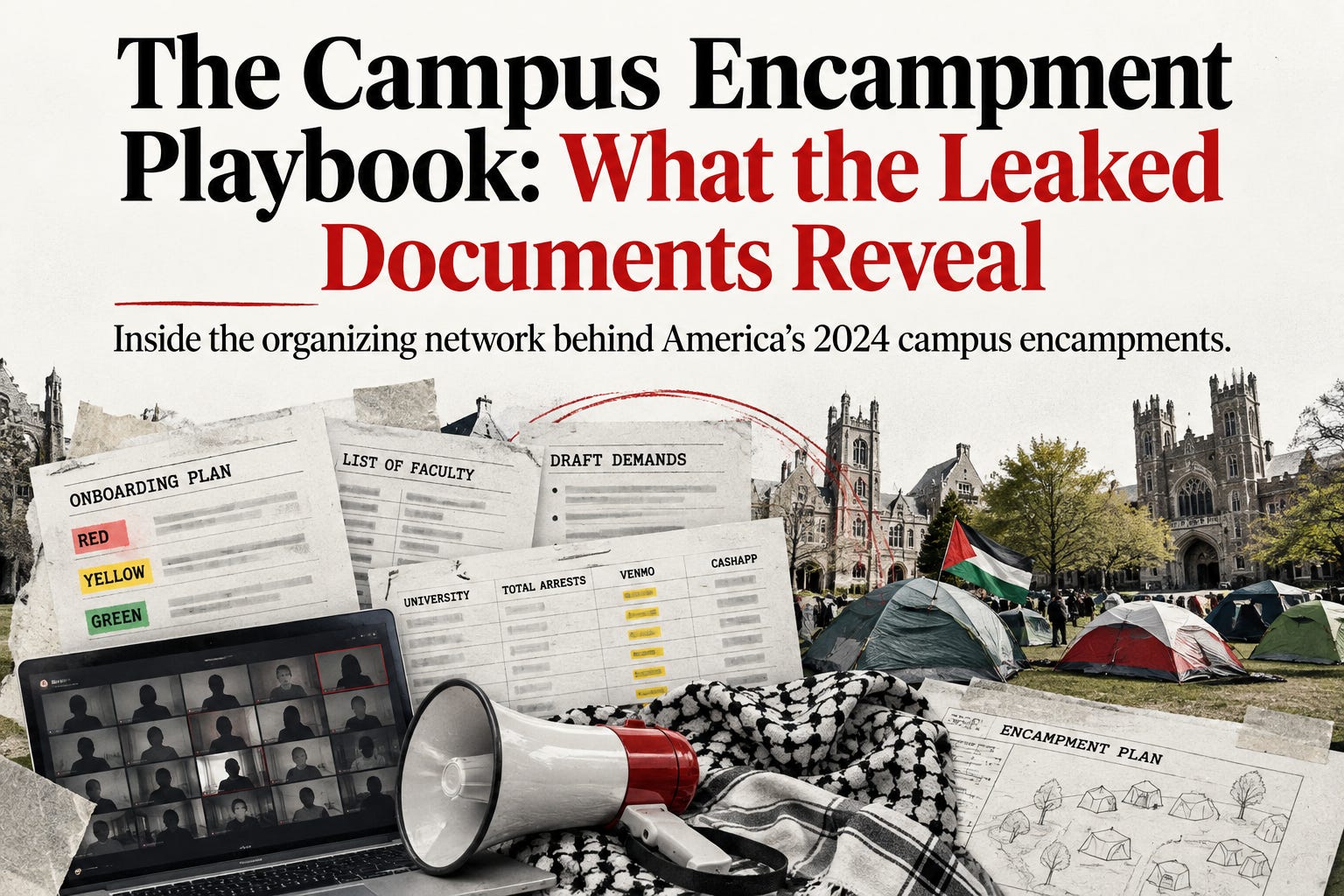
On April 24, 2024, * The Daily Princetonian* published a report about documents that had leaked before students established their Gaza encampment. The files included recruitment instructions, a spreadsheet of professors to contact, a draft statement of demands, and plans to keep at least 20 students on campus overnight. Organizers had divided prospective participants into three groups based on what they were willing to do and the breadth of consequences they were prepared to face.
One document was titled * Assessing & OnBoarding PTON-students*. Participants were assigned red, yellow, or green roles. Red participants were prepared to remain inside the encampment and risk arrest or university discipline. Yellow participants could provide supplies, communications, and other support without taking the same risks. Green participants could help recruit supporters and participate in activities outside the coordinated campus takeover area.
The cult-style recruitment rules called for organizers to ask participants for five additional contacts. They also discouraged sharing participants’ names and sensitive tactical details in messages. Another file identified professors whom organizers hoped would support this tuition-funded circus, while the draft demands called for Princeton to disclose its investments and sever financial relationships with Israel.
Princeton alumna Solveig Gold had shared the onboarding document on X on April 23. National Review obtained additional planning materials, which * The Daily Princetonian* independently verified. The student newspaper reported that the documents didn’t specify when the encampment would begin.
Princeton administrators responded before the demonstration started. On April 24, Vice President for Campus Life W. Rochelle Calhoun warned students that anyone refusing to end an unauthorized occupation after being instructed to leave could be arrested and barred from campus. She also warned that disciplinary proceedings could result in suspension, delayed graduation, or expulsion.
At 7 a.m. on April 25, the keffiyeh cult gathered in McCosh Courtyard and put up their matching tents. Seven minutes later, two graduate students, Achinthya Sivalingam and Hassan Sayed, had been arrested. The remaining barricade brigade continued their protest without their tents, using the support structure organizers had arranged beforehand.
Columbia University’s Gaza Solidarity Encampment began on April 17, while university president Minouche Shafik was testifying before Congress about antisemitism on campus. The organizers had spent months preparing, according to participants’ accounts published during the tent-city takeover. An April 21 account published by CrimethInc described an initial goal of recruiting more than 200 people, although organizers ultimately secured a little more than 100 commitments.
Around 60 participants were present when the keffiyeh campground began…4:30 a.m. sharp, on Columbia’s East Lawn. Some organizers worried that they didn’t have enough people to proceed, but others wanted to act while Shafik was in Washington. They had already bought camping equipment, made arrangements for food, and discussed how to respond to arrests. Participants described searching online retailers and Craigslist for tents and buying equipment together or in bulk.
They also recruited supporters who could head up communications, deliver supplies, and gather outside the barricade and bullhorn area when police arrived. On April 18, Columbia called in the New York Police Department, which arrested more than 100 protesters and cleared the original tent circus. Students established another occupation nearby, while the arrests drew national attention and encouraged similar demonstrations at other universities.
The Associated Press subsequently interviewed Columbia organizers about their preparations. Graduate student Elea Sun described extensive planning meetings covering communications, sanitation, supplies, and the possibility of arrest. Organizers had purchased tents in advance and deliberately scheduled the April 17 occupation to coincide with Shafik’s congressional testimony.
Basil Rodriguez, a Columbia student affiliated with Students for Justice in Palestine, told the Associated Press that Columbia organizers had been communicating with students at other universities about establishing encampments. Rodriguez described one call involving approximately 200 participants. The account identifies direct communication between campus organizers about establishing occupations, although it doesn’t establish that everyone on the call was operating under a single leadership structure.
The Wall Street Journal also investigated the preparations behind Columbia’s encampment. Its May 3 report described organizers consulting National Students for Justice in Palestine, veteran campus activists, and former Black Panthers during months of preparation. Graduate student organizer Sueda Polat discussed lessons drawn from earlier protest movements, including the handling of disagreements among participants and the responses organizers could expect from university officials.
The organizers’ April 21 account published by CrimethInc described how they had prepared for police intervention and why they had recruited supporters who weren’t willing to risk arrest. It also described disagreements over tactics, numbers, and the timing of the occupation. The authors were participants explaining their decisions to other activists, including the difficulties they had encountered during the first two days.
Another publication, * First We Take Columbia*, circulated during the first week of the occupation. Attributed to participants connected with Columbia and Yale, the pamphlet drew on Columbia’s 1968 student occupations and discussed committees, communications, security, and maintaining support after arrests. Some of Princeton’s planning materials had also been adapted from Columbia organizers, showing how organizing guidance was moving between campuses.
Brown University had its own planning document. It anticipated more than 150 participants arriving at 5 a.m. on April 24 and detailed preparations for occupying the Main Green. The day before, Brown’s vice president for public safety, Rodney Chatman, obtained a copy and circulated it to university police and the Providence Police Department.
- The Brown Daily Herald* later examined the document and related communications. More than 100 students had access to the plan through a link distributed using encrypted messaging, and organizers had discussed it during meetings with prospective participants. Four people familiar with its creation accused Brown of improperly accessing student Google Drive data. The university denied the allegation, and the newspaper couldn’t establish how police obtained the file.
The occupation began April 24 with approximately 80 participants and reached a reported peak of 112. Students received disciplinary notices that afternoon, while approximately 200 people attended an emergency rally organized by the Brown Divest Coalition.
On April 30, university president Christina Paxson signed an agreement with organizers to dismantle the encampment in exchange for Brown’s governing corporation considering a divestment proposal at a later meeting.
On April 20, National Students for Justice in Palestine announced the * Popular University for Gaza*. Its steering committee called for a “coordinated pressure campaign” against university administrations and trustees, urging chapters to occupy campus spaces, demand financial disclosure, and pressure universities to divest from Israel.
The announcement named Rutgers–New Brunswick SJP, Tufts SJP, Columbia SJP, and Yalies4Palestine as examples for other chapters. National SJP provided the campaign name and common demands, while campus groups organized their local occupations.
On April 21, National SJP published an open letter urging universities to meet those demands. It encouraged students to disrupt normal university operations, including withholding participation in classes and other activities.
A Telegram channel called Popular University 4 Gaza circulated updates about occupations at Columbia, NYU, USC, and other campuses. Contemporary reporting associated the channel with National SJP, the Palestinian Youth Movement, and Writers Against the War on Gaza, although its administrators haven’t been independently authenticated.
Additional organizing guidance was available through * The Do-It-Yourself Occupation Guide: 2024 Edition*, published on Indybay on April 29. The manual addressed establishing occupations, maintaining supplies, organizing participants, and responding to police intervention.
At the University of Illinois Urbana-Champaign, participants published a detailed account of their occupation on May 1, including ten recommendations for organizers at other universities. The document named * Defending the Camp*, described the events of April 26 through April 28 from the participants’ perspective and included criticism of their own decisions.
At 5 a.m. on April 26, approximately 30 protesters gathered near the university’s Alma Mater statue. Within half an hour, they had erected a welcome table, a medical tent, a food tent, six camping tents, and a makeshift yurt that cost less than $400 to construct.
Police and university facilities workers arrived shortly afterward and instructed the protesters to remove their structures. Organizers considered slowly dismantling the tents to gain time for reinforcements to arrive, but the authors later criticized that decision because it weakened their position during the confrontation.
George Vassilatos, an activist affiliated with the Party for Socialism and Liberation, was arrested during the April 26 confrontation, according to Illinois Public Media. His arrest documents participation by an activist associated with a political organization beyond the university’s student groups, although the reporting doesn’t establish that the Party for Socialism and Liberation directed the encampment.
The protesters regrouped and returned to the main quad on April 28. Their account described using one protest location to divert attention while preparing another occupation, as well as the decisions involved in establishing a new camp after police had removed the original structures.
The Illinois authors discussed lookouts, security teams, communications, protective equipment, negotiations, and methods for maintaining an occupation when police ordered participants to leave. They also identified the Emory University encampment and Atlanta’s Stop Cop City movement as sources of experience. Stop Cop City was the campaign opposing Atlanta’s planned police and firefighter training center, whose activists had developed methods for organizing demonstrations and responding to police operations.
The Illinois participants drew on that experience when planning their occupation and subsequently published their own lessons for other campus organizers. Their account described the early-morning preparations, police intervention, attempted delays, relocation, and return to the main quad, including the decisions they recommended changing in future occupations.