History of the Present — The Intellectualist Premium Series
The Pentagon is weighing one of the largest reductions in the American military presence in Europe since the end of the Cold War, potentially removing 25,000 troops and perhaps as many as 40,000, even as Poland warns that Russia may be preparing drone or rocket strikes on NATO territory.
No final decision has been made.
NBC News reported that the review also covers aircraft, ships and weapons, and that some forces could instead be shifted toward NATO’s eastern flank. A reduction at the scale under consideration would be the most significant drawdown of the U.S. presence in Europe since the post-Cold War reductions of the 1990s.
The review is unfolding as European governments confront increasingly direct signs of Russian pressure on the alliance.
Polish Prime Minister Donald Tusk said Thursday that intelligence from NATO, Ukraine and the United States indicated Russia may be preparing drone or rocket strikes against NATO countries while attempting to portray them as accidents.
Tusk said such ambiguity could weaken NATO’s response and solidarity. The warning places the Pentagon review inside a broader debate over deterrence.
Some American lawmakers have previously warned that reductions in the U.S. military presence in Europe could weaken deterrence and risk encouraging further Russian aggression, while the Trump administration has argued that European allies should assume greater responsibility for the continent’s conventional defense.
NATO describes hybrid threats as combinations of military and nonmilitary methods, carried out through overt and covert means. In Tusk’s account, the danger is not necessarily a conventional invasion but an attack designed to preserve enough ambiguity to complicate the alliance’s response.
Days earlier, a Russian drone struck a train near Ukraine’s border with Poland shortly after a diplomatic train carrying former British Prime Minister Boris Johnson and former Swedish Prime Minister Carl Bildt passed through the area, the Associated Press reported.
Ukraine’s state railway operator said it was “highly probable” that the diplomatic train had been the intended target.
AP reported the diplomatic train as the possible target, not Johnson personally.
History of the Present: Premium Access“The past is never dead. It’s not even past.”
— William Faulkner
Power moves before it is named. Institutions fail before they admit failure. Public narratives harden after the choices that shape them have already been made.
History of the Presentis The Intellectualist’s flagship premium series for readers who want to understand the forces shaping the world before they become headlines, scandals, crises or consensus.Members get the analysis earlier — before events harden into conventional wisdom — along with full access to The Intellectualist’s premium editorial portfolio.
Save 33% on Your First YearLimited to the first
1,000 Founding Members.The first 1,000 members will be permanently recognized as
Founding Members of The Intellectualist’s next chapter.
What Members Get:History of the Present,One Person, One Vote,Scandal,Reality Check,Thoughts & Ideas,The Cost of MoneyandBits & Bytes— plus expanding access to early briefings, curated events, member discussions and The Intellectualist’s editorial process.
Know Earlier. Understand Deeper.
Become a Founding Member
The Pentagon has framed its review as an effort to shift more responsibility for Europe’s conventional defense to European allies.
Congress has limited that effort, restricting certain Pentagon funds if U.S. troop levels fall below 76,000, though NBC News reported that temporary rotations could complicate how the restriction applies.
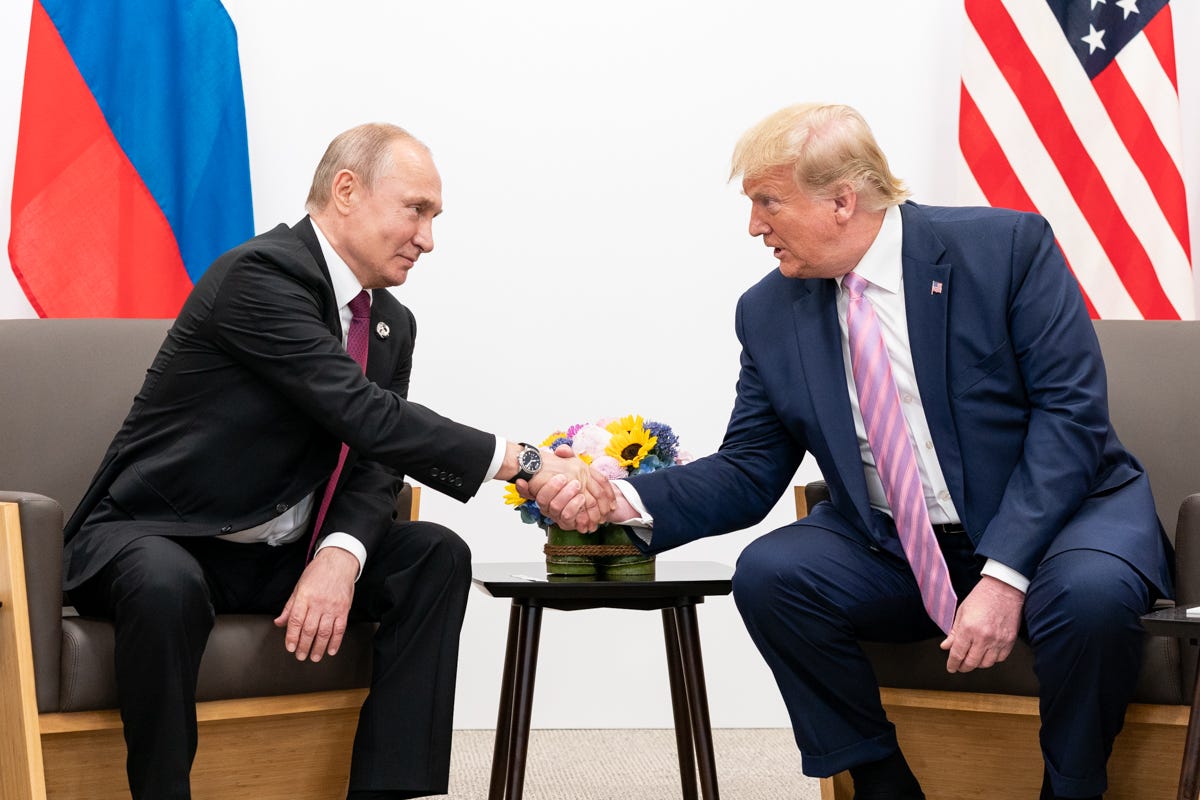
The prospect of a major drawdown comes against Trump’s decades-long record of business pursuits, campaign contacts and political controversies involving Russia.
That history reaches back to 1987, when Trump traveled to Moscow and examined possible hotel sites after Intourist, the Soviet state tourism agency, expressed interest in meeting with him.
U.S. intelligence had long described Intourist as intertwined with Soviet surveillance, with a CIA memorandum saying many of its guides assigned to foreigners were KGB agents or informants.
Weeks later, Trump spent $94,801 on newspaper advertisements criticizing wealthy U.S. allies for relying on American defense spending.
Russia returned to Trump’s business orbit in 2013, when he brought the Miss Universe pageant to Moscow, explored business opportunities and sought a meeting with Vladimir Putin.
Trump personally invited Putin and publicly wondered whether he might become his “new best friend.”
Putin did not attend but later sent Trump a letter and gift.
The trip later drew scrutiny over Trump’s hotel stay. His security chief, Keith Schiller, testified that a man offered to send five women to Trump’s room and that he rejected the proposal.
Three years later, unverified reports compiled by former British intelligence officer Christopher Steele alleged that Russian intelligence possessed compromising recordings involving Trump in Moscow. The allegation has never been substantiated.
During the 2016 campaign, the Trump Organization continued pursuing an unbuilt Trump Tower Moscow project.
Special Counsel Robert Mueller documented that work continued into June and that possible travel by Trump and Michael Cohen was discussed. Mueller also documented extensive Russian election interference while concluding that the investigation did not establish that Trump campaign members legally conspired or coordinated with the Russian government in that operation.
The bipartisan Senate Intelligence Committee later described Russia’s influence effort as “aggressive” and “multi-faceted.”
It found that Paul Manafort’s campaign role created opportunities for Russian intelligence services to obtain confidential campaign information and documented his sharing of internal polling information and campaign strategy with Konstantin Kilimnik.
Those questions followed Trump into the presidency.
At his 2018 Helsinki summit with Putin, Trump questioned the U.S. intelligence finding that Russia had interfered in the election. Asked whether he had wanted Trump to win in 2016, Putin replied, “Yes, I did,” citing Trump’s stated desire to improve U.S.-Russia relations.
That scrutiny has continued into the present.
A separate ProPublica investigation reported this week that Russian businessman Umar Kremlev, whom the outlet describes as an oligarch close to Putin, paid hundreds of thousands of dollars toward Donald Trump Jr.’s May wedding festivities in the Bahamas.
Trump Jr. and Bettina Trump, who married in May, later confirmed that Kremlev hosted two nights of celebrations, describing the spending as a wedding gift from a friend and rejecting a political motive.
1. NBC News | September 17, 2026 | Pentagon Weighs Pulling Nearly a Third of U.S. Forces From Europe
How this source is used: Provides the principal reporting on possible U.S. troop reductions in Europe, including the scale, military assets under review and the absence of a final decision. It also supports the article’s reporting on congressional restrictions, possible rotational workarounds and Marco Rubio’s intervention over proposed cuts.
2. Associated Press | September 17, 2026 | Poland Warns Russia Is Planning Drone or Rocket Strikes on NATO Territory
How this source is used: Provides Donald Tusk’s warning that Russia may be preparing strikes on NATO territory while attempting to portray them as accidents. It also supports his concern about weakening NATO’s response and solidarity and Trump’s comments on a permanent U.S. base in Poland.
3. Associated Press | September 13, 2026 | Russian Drone Hits Train Near Ukraine-Poland Border Soon After Visiting Dignitaries Passed Through
How this source is used: Provides reporting on the Russian drone strike near the Polish border shortly after a diplomatic train carrying Boris Johnson and other officials passed through. It also provides the Ukrainian railway operator’s statement that the diplomatic train was “highly probable” to have been the intended target.
4. NATO | April 21, 2021 | What Is NATO Doing to Address Hybrid Threats?
NATO explanation of hybrid threats
How this source is used: Provides NATO’s definition of hybrid threats as combining military and nonmilitary methods with overt and covert means. The article uses that definition to explain the security context surrounding Tusk’s warning to a general reader.
5. Associated Press | September 16, 2026 | House Approves Sweeping Russia Sanctions Bill, Sending It to Trump
How this source is used: Provides reporting on the Trump-backed Russia sanctions legislation passed by Congress and awaiting the president’s signature. It supplies countervailing context showing that the administration’s current Russia policy includes measures directed against Russian banks, officials and energy revenue.
6. The Washington Post | December 3, 1988 | Trump and the Gorby Connection
How this source is used: Documents Trump’s 1987 trip to Moscow after the Soviet tourism agency Intourist expressed interest in meeting with him. It also establishes that Trump examined possible hotel sites during the visit.
7. The Washington Post | September 1, 1987 | Between the Lines of a Millionaire’s Ad
How this source is used: Provides the $94,801 cost of Trump’s 1987 full-page newspaper advertisements. It also establishes that the ads criticized wealthy American allies for relying heavily on U.S. defense spending.
8. U.S. Department of Justice | March 2019 | Report on the Investigation Into Russian Interference in the 2016 Presidential Election, Volume I
How this source is used: Documents the proposed Trump Tower Moscow project and Russia’s interference in the 2016 election. It also supports the article’s precise statement that the investigation did not establish that Trump campaign members conspired or coordinated with the Russian government in its election-interference operation.
9. U.S. Senate Select Committee on Intelligence | August 18, 2020 | Russian Active Measures Campaigns and Interference in the 2016 U.S. Election, Volume 5
Senate Intelligence Committee report
How this source is used: Provides the bipartisan committee’s findings on Russian election interference and the counterintelligence concerns created by Paul Manafort’s campaign role. It also documents Manafort’s sharing of internal polling information and campaign strategy with Konstantin Kilimnik.
10. The White House | July 16, 2018 | Remarks by President Trump and President Putin of the Russian Federation in Joint Press Conference
Official Helsinki summit transcript
How this source is used: Provides the Helsinki exchange in which Vladimir Putin said he wanted Trump to win the 2016 election and explained that Trump had advocated improved U.S.-Russia relations. It also provides Trump’s contemporaneous comments questioning the U.S. intelligence finding that Russia interfered in the election.
11. The White House | July 17, 2018 | Remarks by President Trump in Meeting With Members of Congress
How this source is used: Provides Trump’s statement one day after the Helsinki press conference that he had misspoken when discussing Russian election interference. It establishes the subsequent clarification separately from the remarks Trump made while standing beside Putin.
12. ProPublica | September 14, 2026 | Donald Trump Jr.’s Bahamas Wedding Was Secretly Bankrolled by Russian Oligarch Close to Putin
How this source is used: Provides the reporting that Umar Kremlev paid hundreds of thousands of dollars toward festivities surrounding Donald Trump Jr. and Bettina Trump’s wedding. It also provides the couple’s subsequent confirmation that Kremlev hosted two nights of celebrations and their explanation that the spending was a wedding gift from a friend.
13. Central Intelligence Agency | September 10, 1964 | KGB Handling of Foreigners in the USSR
CIA memorandum / Warren Commission Exhibit 2760
How this source is used: Provides the documentary basis for the article’s description of Intourist’s relationship with Soviet intelligence. The CIA memorandum states that many, if not all, Intourist guides assigned to foreigners were KGB agents or informants, supporting the article’s carefully bounded historical characterization of the Soviet tourism system.
14. The Washington Post | March 9, 2018 | In a Personal Letter, Trump Invited Putin to the 2013 Miss Universe Pageant
How this source is used: Documents Trump’s effort to meet Vladimir Putin during the 2013 Miss Universe pageant, his personal invitation and his public “new best friend” remark. It also reports that Putin did not attend and later sent Trump a friendly letter and a traditional Russian gift, while placing the pageant within Trump’s continuing efforts to expand his business interests in Russia.
15. U.S. House Permanent Select Committee on Intelligence | November 7, 2017 | Interview of Keith Schiller
How this source is used: Provides the primary sworn testimony concerning the offer made during Trump’s 2013 Moscow trip to send five women to his room. Schiller testified that he regarded the offer as a joke, rejected it and later told Trump about it; the transcript does not establish that women were sent to Trump’s room or that Trump accepted the proposal.
16. U.S. Department of Justice Office of the Inspector General | December 9, 2019 | Review of Four FISA Applications and Other Aspects of the FBI’s Crossfire Hurricane Investigation
How this source is used: Provides the official record of the Steele reporting alleging compromising sexual activity by Trump during his 2013 Moscow trip and the FBI’s subsequent handling of that material. The report records former FBI Director James Comey’s characterization of the material as “salacious and unverified” and states that the FBI did not know whether the sexual allegations were true or false when Trump was briefed.