Perez Hilton’s recent hospitalization affords a chance to consider how and why imagery has positioned society as not only voyeurs and jailers. Perez Hilton, whose real name is Mario Armando Lavandeira Jr., exploded as a public figure in the early days of blogging by exposing the world to the exploits of the rich and famous. He annotated images of people like Britney Spears and Paris Hilton. Recently, Perez Hilton tried to harm himself while on a live video feed. How did imagery transform us as a populace over these two decades?
In those early days of cell phone cameras, when Perez Hilton came to fame, most of the images of famous people came from paid paparazzi. Even with the rise in cell phone cameras, personal images of the famous were not broadly accessible. You might see a snapshot from a friend who saw Kramer in the subway in a text or group email from friends. But, largely, imagery of the famous, even when looking busted in the grocery, still came from professionals. Partly, cell phone cameras still remained technologically inferior to professional tools. But, in these early days of the internet, there was also very little incentive to share pictures of famous people. In the days before algorithms pushed us to content, blogs rarely brought fame, and only with effort and luck.
Perez Hilton, therefore, needed to find a notable voice to get the fame he craved. In looking back at his images, they look rudimentary. I’ll need you to use this graphic to explain my point. His actual images were incredibly mean-spirited. He regularly editorialized about the downfalls of young stars. His discourse was often gendered, affording young women none of the grace their male counterparts received. His success was increased by the level of failure of the people pictured. But his early blogging era didn’t spawn a huge army of copycats.
Why? Fame wasn’t assured with a blog even if you were willing to be soullessly cruel with a bottomless appetite for exploiting people. Am I being too mean to Perez Hilton? Being near the age of the women who were being exposed on his blog, I was so disgusted with his content from the beginning. I’d been blogging by then for work, for a museum’s public blog, and for myself, as a food blogger. Had I hoped to make fame and money with my blog? No. I did end up making some money, as I had ads on my sites. We once went to Europe on my profits, and I felt like I’d really won with my small profits.
His blog started in 2008. Imagery was still largely confined to the context he added through the blog. Pinterest, in 2009, allowed people to hold onto images, as did other tools from around that era: Instagram and Tumblr. All these sharing tools did transform the idea of context. We were slowly untethering images from meaning and assigning personal meaning, something at that time that felt useful and interesting.
Now, as we all look online for something, only to find millions of replicas on long-forgotten Tumblrs or Pinterest accounts, without context, we see the problems of this early phase of image sharing. I often find myself so sad to find something so cool only to not know the provenance of the artwork shown. Take, for example, the medieval cat. As an art historian, every time I see that cat, I want to yell into the void. The cat is so clearly not medieval—to me. But, to most of the world, this painting, which turns out to be a 19th-century American folk painting, has taken on cultural meaning as a medieval cat. Both my meaning and the popular cultural meaning have validity, but for different reasons. What do we gain by creating our own shared cultural context about images? What do we lose by losing the original context?
Even then, we were not confronted by the wholesale visual policing of people online. We all began tattletales thanks to the algorithms. While monetary gain was some people’s impetus for sharing images of people they didn’t know, fame and fairness also played into the move. For fame, think of how many people share images of others just for the likes. That clout has become currency and has transformed our culture. We now often work hard to get something so ephemeral: a viral post. From the outside, how inconsequential is just kudos in a closed virtual system? What do you get, particularly as an anonymous poster? You get that short-term dopamine hit. But for what? To feed our cultural addiction to short-term dopamine hits and attention.
As to fairness, I’ve been here, not sharing images, but participating in watching images of others acting badly. With the incredible problems of our structural systems, how can you not want to stand up for the little guy? One of the moments of surveillance as collective justice was when a white woman tried to get a black birdwatcher for existing in 2020. We all were able to stand up for a man wronged by participating in this act of community policing.
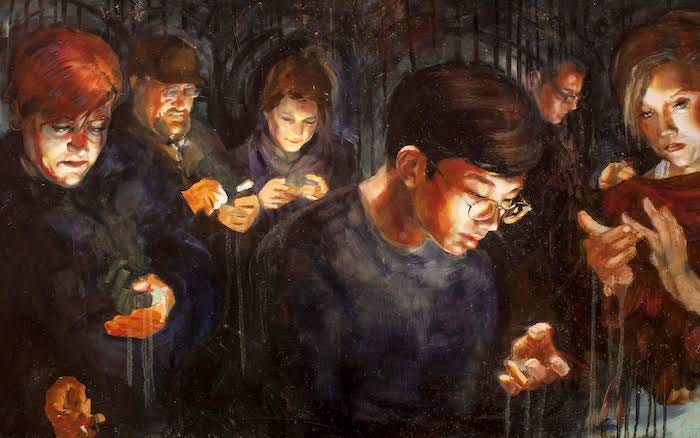
In the next six years, we’ve become a culture of imagery to police each other. We’ve also seen an increase in monetizing social media. People get paid to police each other. We’ve sold out privacy and ethics for clout and money. Our collective had already been fractured by the silos of algorithmic social media. Each phone gives a personalized feed. We’re seeing the world framed for us, rather than framing the world so we can see it better.
These huge moments of surveillance can jump from a personal network to the world or completely stagnate. The velocity of sharing and the scale of impact are unpredictable. As a result, many people who are seeking clout will push the envelope over and over. Now, everyone can be Perez Hilton, though with less effort and even less remuneration.
We’ve become a world where the image is cheap, yet the meaning could be consequential. We become addicted to policing people visually, commenting, critiquing. But this carceral attitude hasn’t made our society more just. We don’t find the worst and punish them. Instead, we each become all the awful that Perez Hilton embodied.
His desire for privacy now is a particular note about why humanity is better for not sharing so many images of the worst of us. As a human, he now understands the weight of horrible images. He gets how harmful sharing the worst of us can be. Too bad he was too rotten to realize this before being like Pandora for our cultural sickness of harmful oversharing.
In the course of two decades, we went from being so excited to share images of ourselves with our friends to becoming addicted to seeing images of people we’ll never meet. Some of those people were famous, but many are just people dressed badly or acting worse. In this move, a few people have gotten much wealthier, but most of us got the most flimsy of earnings, empty dopamine hits. But even worse, our society went from Perez Hilton being one of the few trolls to a society where everyone can, and many will, troll. The image can be revelatory. In our world, the epiphany, though, is that we’re willing to give up privacy for so little. What a sad revelation.