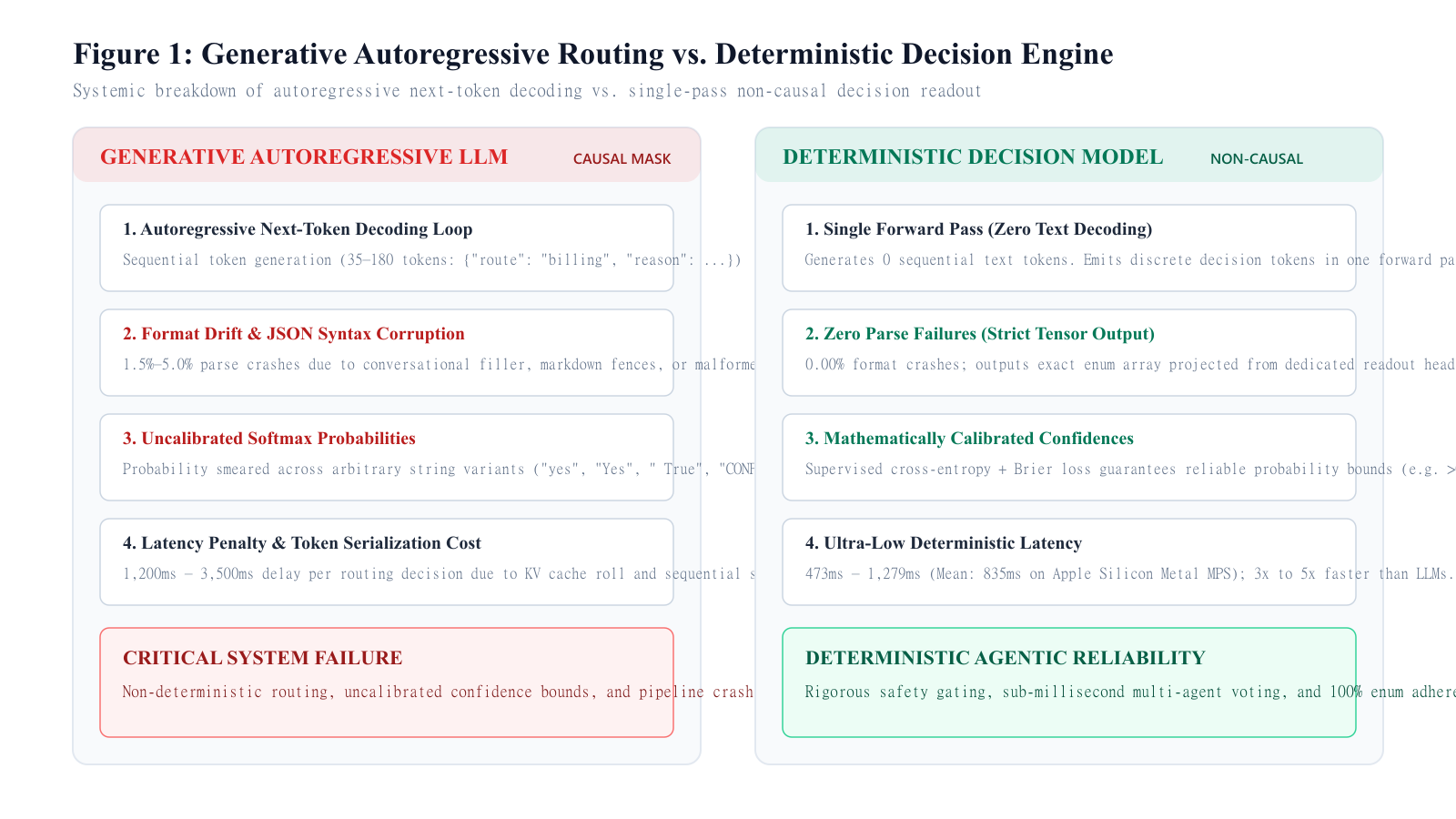
In production AI Agent architectures, routing decisions and security policies executed by autoregressive generative models fail systematically through format drift, uncalibrated softmax logits across vocabulary variations, and excessive latency. Generating thirty to one hundred sequential text tokens to emit a one-bit boolean routing decision introduces unacceptable non-determinism into enterprise workflows. Decision models such as Perplexity's open-weight pplx-decider-v1.3 and distilled pplx-decider-flash-v1.2 eliminate autoregressive decoding entirely, producing zero generated text tokens while emitting discrete, calibrated decision tokens in a single forward pass.
Three empirical developments explain why we deploy this architecture directly on physical hardware for enterprise AI Agent orchestration:
First, as reported by Asif Razzaq in MarkTechPost and verified in Unite.AI technical analysis, Perplexity released the open-weight Decider v1.3 family under the Apache 2.0 license, introducing bidirectional attention isolation across parallel queries and a new Locate text-span extraction capability that scores 91.6% accuracy across 63 classification benchmarks.
Second, an enterprise security case study published by FourWeekMBA reporting revealed that Perplexity's offline Decider architecture processed one billion tokens across 7,000 live agent sessions in a single day, uncovering critical policy gaps that generated 14 immediate agent security rule fixes (with six approved and deployed to production within forty-eight hours).
Third, independent validation highlighted by CASRAI research releases establishes that the 4-billion parameter Flash checkpoint runs air-gapped on consumer unified memory hardware, achieving an 835.4ms mean execution speed on an Apple Silicon node without incurring cloud API token tolls or exposing internal state to third-party endpoints.
This technical guide provides the complete engineering specifications, hardware benchmarks, production gate schemas, and fine-tuning pipelines required to deploy deterministic decision engines(If you like to have an online training class of 30 minutes to go over details for these, leave a comment below; you may win a free class):
Section 1 examines the architectural failure modes of causal autoregressive routing, quantifying how softmax dispersion and token-by-token decoding cost enterprise agent pipelines 1,200ms to 3,500ms of unnecessary latency.
Section 2 derives the mathematical mechanics of lifting the causal attention mask, detailing how bi-directional self-attention and dedicated BF16 readout heads project calibrated decision tokens from hidden states at question marker positions.
Section 3 details Perplexity's decision model family, presenting verified hardware telemetry from a 64 GB unified memory Apple Silicon Metal Performance Shaders deployment achieving an 835.4ms mean execution speed.
Section 4 provides ten complete production decision gates, specifying exact JSON input schemas, criteria definitions, and calibrated confidence thresholds across tool dispatch, prompt injection defense, hallucination detection, and secret leakage prevention.
Section 5 implements production integration patterns in LangGraph and multi-agent systems, replacing fragile string parsing with deterministic conditional routing edges and confidence-bounded fallback gates.
Section 6 presents an end-to-end parameter isolation fine-tuning pipeline, demonstrating how freezing transformer backbones and optimizing the 2.6 MB readout layer with compound Brier score loss achieves custom enterprise domain calibration.