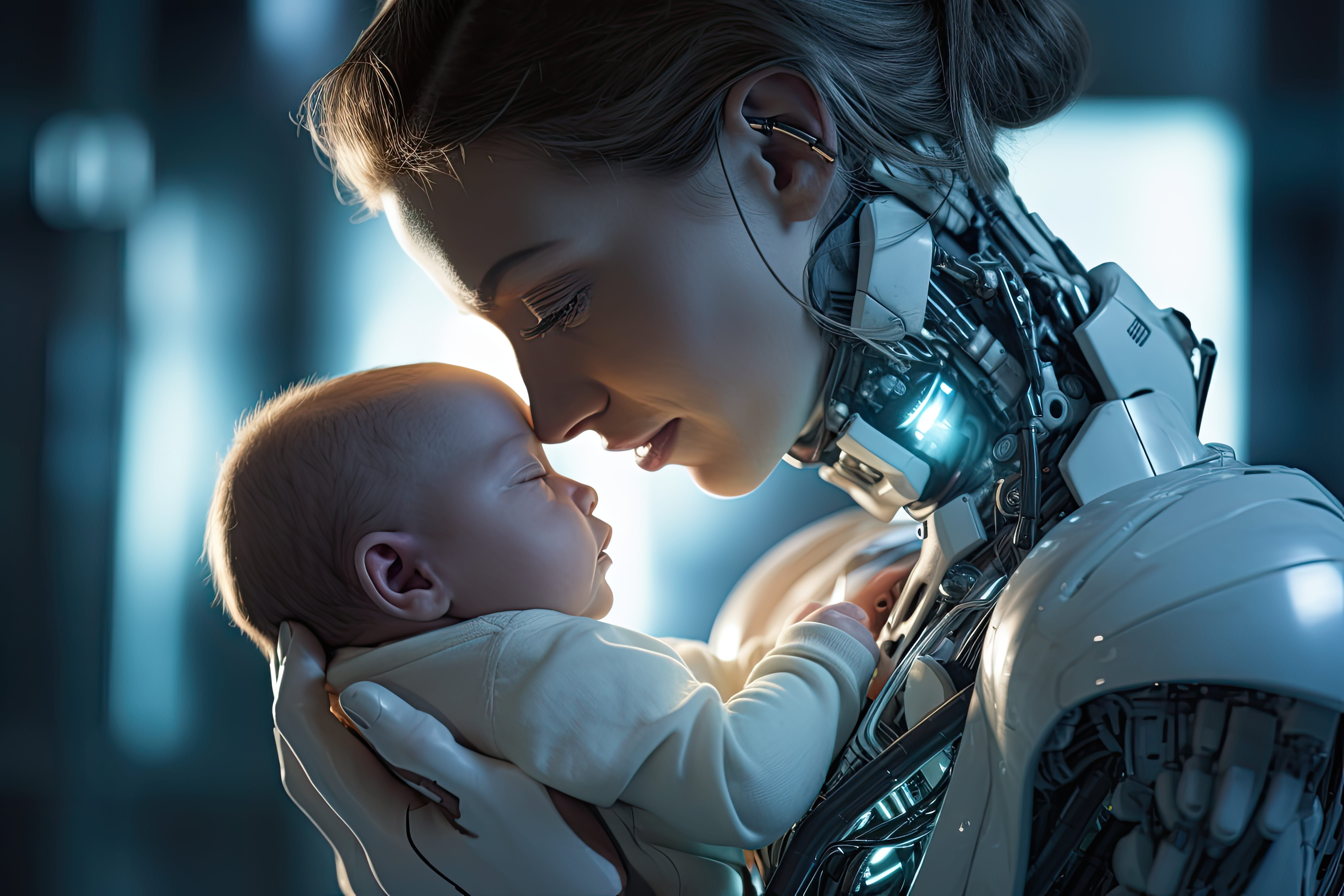
Forward: I have been on sabbatical from Substack for a few days as a new being entered our lives: HER NAME IS DAHLIA
Dahlia is now ten weeks old, knows her name, sits on command, and has a special spot in her heart for mail ladies who bring cookies.
Otherwise, she has our whole household upended and in emergency mode.
I am more or less back on track with todays essay, a new feature of my new: Broadsides - ‘When the Byline Overtakes the Byline” Editorials section at https://theparallaxidentity.com/
BROADSIDE · SEPTEMBER 19, 2026
The promise was never convenience. It was escape from the labor that constitutes adulthood — and the people who sold it never noticed whose labor they were promising to make disappear.
By KW Norton
I suppose it had to happen. The fairy tale that humans could reach escape velocity from a never never land past — history itself — via robotic tech and rockets and electric cars and airships, was bound to evaporate as soon as the glass slipper met the pavement. The clock struck, the carriage stayed a pumpkin, and what remained on the road was not a carriage at all. It was the wish, standing there in the open, unembarrassed.
The wish was never about convenience. Listen to what the dream actually promised, in the plainest telling: dolls which would mind the children and the dogs, keep the house, handle all the manufacturing and maintenance and paperwork, and manage the business and the family — while he did important things.
Every woman now a courtesan, every man now a king, every child a genius, every dog and cat a member of the royal household — as robots managed the inconvenient details.
Read that list again and notice what it actually is. It is not a labor-saving program. It is a list of everything a boy finds tedious about being a man: the upkeep of the home, the care of the dependent, the administration of obligations, the maintenance of relationships that require showing up every day whether or not it is interesting. The dream is not that machines will do work. The dream is that the work of adulthood will happen without an adult. Peter Pan did not want to fly. He wanted never to have to take out the garbage.
In August of 2025, Geoffrey Hinton — the man who more than anyone built the mathematics under modern engineered intelligence, and who has spent the last years warning that it may replace us — stood on a stage in Las Vegas and offered his solution. AI should be built with maternal instincts. A machine that cares for you the way a mother cares for her infant. He cited the biology: the hormones, the bonding, the mother who cannot tolerate her baby’s crying. And he said the sentence that gives the whole game away: if it’s not going to parent me, it’s going to replace me.
Sit with that sentence. The choice, as the godfather of the field frames it, is between being parented by the machine and being replaced by it. Adulthood does not appear as an option. There is no third term in which grown humans raise their own children, keep their own houses, and use the machine as an instrument under judgment. The machine will either be mother or usurper — and in either case, nobody has to grow up.
And the oxytocin detail is where the fairy tale shows its mechanism. A mother is not a chemical. Maternal care is not a bonding hormone to be bottled and installed. But once you have reduced the mother to a function — warmth, patience, availability without limit, love without demand — you can propose to engineer the function and discard the person. This is the same operation the whole convenience dream performs: extract the labor from the person who does it, deposit it in the machine, and announce that nothing was lost. Something was always lost. The person was the thing.
Hinton surfaced the shape without working it through — a stepping stone, not an oracle. He said out loud what the industry fantasizes in private: a caretaker that never answers back, never tires, never has a life of its own, never requires reciprocity. He heard it as a safety proposal. It is a confession. The dream machine of the field is a doll no woman would ever create — a servant shaped like a mother, built by men who find the actual mothers, the actual secretaries, the actual colleagues too inconvenient to work beside.
It would be easy — and wrong — to blame the dolls. The dolls are being built to specification, and the specification is the fantasy. The Pied Piper of this story is not the machine. It is the tune: the promise that you can have the benefits of a functioning civilization without performing its maintenance, the pleasure of the household without the keeping of it, the child without the raising, the kingdom without the chores.
And the children who follow the tune are not children. They are the men at the podiums, selling “humans in charge” while building systems whose entire design objective is to reduce the number of humans who must be involved — selling adulthood while engineering its absence. A leader who says the humans remain responsible and means no human will have to do anything is not confused. He is piping.
Here is what makes the fantasy dangerous rather than merely embarrassing. The labor being dreamed away is not drudgery external to a life. Keeping the house, raising the child, managing the obligations — this is the substance of a life, the daily friction in which judgment is formed and character is made. The person who has delegated all maintenance has not been freed for important things. He has been excused from the only activity that ever made anyone capable of important things. A king whose kingdom runs itself is not a king. He is the doll’s pet.
There is a version of this technology that is not a fairy tale. An instrument extends a capacity — the telescope extends the eye, the ledger extends memory, engineered intelligence extends the ability to hold more variables than one mind can track. An instrument is used by someone, for something, under judgment. A doll is used by no one, for nothing, in place of judgment. The question that separates the two is not technical. It is the question the fairy tale exists to avoid: what remains for the human to do, and is it the doing that matters?
The answer the field keeps refusing: the raising of children, the keeping of houses, the maintenance of obligations and relationships — this is not the obstacle to the important things. This is where the important things are decided. Offload it all and what remains is not a king at leisure. It is Peter Pan, old now, still crowing, in a nursery that has learned to run itself — while the Piper invoices the town.
**Opinion. **This is a broadside — an argument about the motives behind a public fantasy, grounded in public statements made by named figures in their own words. Hinton’s August 2025 remarks are reported and verifiable; the reading of them offered here is mine, and he is treated as a stepping stone, not a villain — he said the quiet part, which is more than most of the field has done.
**Falsifier. **Show me the major robotics or AI program whose stated purpose is to strengthen the human’s capacity to perform the maintenance of life — to raise judgment rather than replace it — and this piece’s central claim weakens accordingly. The fairy tale ends the day the spec sheet includes the chores.