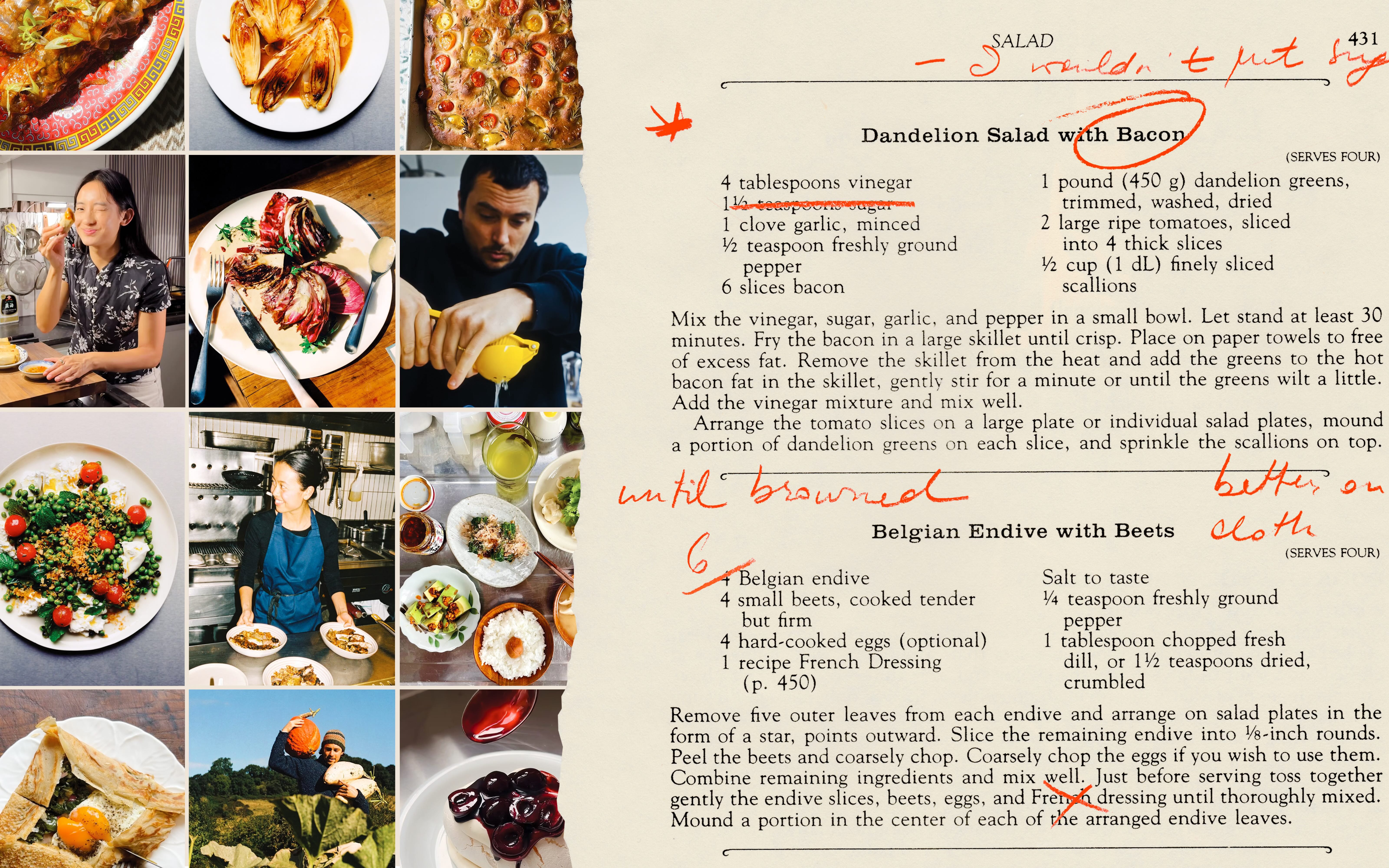
Good morning and welcome to Vittles. Today we’re publishing another online-only article linked with our third print issue, The Influencers. In this essay, Violet Conroy explores the rise of the influencer cookbook, and questions whether the skill, charisma and expertise involved in producing a compelling sixty-second recipe video automatically translate to the written word. All the articles we’ve published so far related to The Influencers are available here. To read the rest of the issue, please ** buy a copy**.
Finally, last week we launched two reader surveys: one for free subscribers and one for paid subs. Please do send us your thoughts if you have five minutes to spare – your responses will help to inform how we commission the newsletter in future.
Like many Gen Zers, I watch food content on my phone on an almost daily basis. I cycle through a well-worn rotation of favourites: Julius Roberts (@juliusroberts, 1.4 million Instagram followers), who serves up an idyllic fantasy of rural life from his smallholding in West Dorset, with recipes for simple, hearty farm-to-table dishes like chicken soup and broccoli pasta; Millie Tsukagoshi Lagares (@millielagares; 19,000 Instagram followers), who creates izakaya-style dishes such as salmon edamame onigiri and grilled mochi with cheese in her modest kitchen; and Jesse Jenkins (@adip_food, 920,000 Instagram followers), who has created a seductive cinematic universe of highly stylised, ASMR-esque videos showcasing umami-heavy, SEO-friendly dishes like ‘gochujang croque madame’ and ‘tinned fish tartare’, all executed in silence from his immaculate stainless steel kitchen in West London.
I can swipe through these videos for hours on end, hungry and hypnotised. The creators know exactly how to hold my attention – and work up my appetite – with their sensorily indulgent worlds. Yet, despite the occasional half-hearted save or screenshot, I know that I’ll never get around to actually cooking any of the recipes fed to me via the algorithm. Partly this is because I’ve learned from experience that these videos have nothing in common with how I cook, a process that I find laborious, often long, only sometimes meditative, and always messy. And partly it’s because, although useful for providing visual reference points, the video format is not always the most practical when you’ve got multiple pans on the go – anyone who has attempted to rewind a Reel with greasy thumbs, only to be confronted with Thomas Straker (@thomas_straker, 2.7 million Instagram followers) trying to pronounce ‘mozzarella di bufala’ in an Italian accent over and over again, can surely relate.
‘Young, independent creators may have pioneered the form, but in 2026, everyone – from major restaurant groups to legacy media – is moonlighting as a content creator’
Instead, I like to get my recipes the old-fashioned way: from a cookbook. Using a cookbook feels more aligned with the way I cook, and I like being able to hold these beautifully designed objects in my hands. Perhaps it’s just nostalgia for an imagined idyllic past, when people’s lives weren’t so dominated by screens. But it seems like I’m not the only one yearning for simpler times: in recent years the market has become saturated with cookbooks written by influencers, a seeming inversion of the much-discussed pivot to video.
But what is the role of such cookbooks in a world where our tastes have shifted so firmly online – a world which these influencers helped to usher in? Does the ability to craft a viral sixty-second cooking Reel necessarily translate into a quality cookbook – a medium that at its best relies on the uniqueness of an author’s perspective, their ability to build a visual world and, perhaps most importantly, the quality of their writing and recipes? Or is everyone just trying to make a quick buck?
Although the popularity of short-form cooking videos had been increasing steadily since Instagram first added video features in 2013, and was further accelerated by the global rollout of TikTok, they properly exploded during the pandemic, when many people were stuck at home and desperate for culinary inspiration. Like their WordPress predecessors fifteen years earlier, amateur and novice chefs began experimenting with producing cooking content, this time making quickfire videos that earned them viral fame. Cooks who were largely unknown at the time – people like Jenkins and Ben Lippett (@dinnerbyben, 1.2 million Instagram followers) – became famous, seemingly overnight.
Obviously, people were making audiovisual food content before this – cookery programmes have been a television staple for decades, and YouTube has long hosted a wide array of recipe channels, often with high production values, walking you through how to make almost every cuisine imaginable. But this was different: the ever-increasing power of the social media giants, and their mercurial algorithms, was sending out a clear message: move with the times, get into video, or get phased out into irrelevance. And so, the old guard had to embrace short-form video. NYT Cooking, the recipe vertical of the New York Times, massively expanded their video coverage; Ottolenghi began to create video shorts on Instagram just to promote its Substack recipes; BBC Good Food now regularly posts videos made in collaboration with content creators like Jenkins, Roberts and Justin ‘Dustbin’ Tsang (@justin_the_dustbin, 1 million Instagram followers). Young, independent creators may have pioneered the form, but in 2026, everyone – from major restaurant groups to legacy media – is moonlighting as a content creator.
According to a 2025 study by Publicis Commerce, nearly 72% of Gen Z use social media for cooking inspiration and 45% purchase ingredients directly through social media platforms, with users spending an average of four hours per week on food-related content. So, the allure of short-form video for legacy media institutions is obvious. What’s more interesting is that this shift is bidirectional – that is, content creators have, one by one, started to churn out cookbooks. Nearly every influencer mentioned in this piece has published one: in 2025, new titles included Jenkins’ Cooking With Vegetables, Lippett’s How I Cook, Tsukagoshi Lagares’s Umai and Straker’s* Food You Want to Eat* – with major mainstream publishing houses eager to get in on the action. ‘Before, you had to be a household name or be doing something really niche to get a book deal, whereas now, if you have a social media presence, it’s kind of easy,’ Tsukagoshi Lagares tells me (she got her deal after a publisher came across her Instagram content).
‘The video format is not always the most practical when you’ve got multiple pans on the go – anyone who has attempted to rewind a Reel with greasy thumbs, only to be confronted with Thomas Straker trying to pronounce ‘mozzarella di bufala’ in an Italian accent over and over again, can surely relate’
‘Even in a world of dying legacy media, the vast majority of people still love the idea of having a cookbook deal,’ says Emily Sweet, a literary agent who has worked with food content creators including Lippett and Nicola Lamb (@nicolaalamb, 321,000 Instagram followers). Cookbooks can offer a sense of credibility or legitimacy beyond the confines of online fame, ostensibly putting creators on an equal playing field with more traditional recipe writers like Nigella Lawson, Jamie Oliver and Nigel Slater. Will McSweeney, the founder of Juiced World – a food talent agency that represents Lippett, Ixta Belfrage (@ixta.belfrage, 158,000 Instagram followers), Alfie Steiner (@alfiecooks, 5.2 million followers) and Xiengni Zhou (@xiensscran, 280,000 followers) – points to print’s ability to open doors, claiming that ‘a great book is a supporting leg for entering “mainstream visibility” as a talent, like appearing on Netflix’.
The truth of this remains to be seen – bar Julius Roberts, who hosted a series for Channel 5 back in 2022, no British cooking content creator has yet landed a major TV deal, or much beyond odd guest spots on *MasterChef *or Saturday Kitchen. But Caroline Chambers, a US food content creator and writer who has had the number one food and drink Substack for three years (582,000 subscribers), says that ‘not a single morning show or print publication reached out to me about covering [the Substack] until I wrote an actual cookbook’ (the New York Times-bestselling What to Cook When You Don’t Feel Like Cooking, published in 2024). There’s also the fact that a cookbook deal will represent a big payday for some influencers. Publishing tends to be quite guarded on the size of the advances it pays, and none of the influencer cookbook writers I spoke to shared details of theirs, but Vittles has heard that at least two deals for influencers mentioned in this article were well into six figures.
‘Before, you had to be a household name or be doing something really niche to get a book deal, whereas now, if you have a social media presence, it’s kind of easy’
While the appeal for the publisher is superficially obvious – famous content creators come with a ready-made audience for their book – in reality it might not be so straightforward. Richard Atkinson, the publisher behind some of the most visually inventive and critically acclaimed cookbooks of the past two decades (including The Flavour Thesaurus by Niki Segnit and the Dishoom cookbook), points to the tension between the worlds of print and digital that is not easy to resolve. ‘Digital content doesn’t necessarily translate into books,’ he says. ‘I might see somebody who is brilliant at online recipes with a gazillion followers on Instagram, but it doesn’t follow that they would write a great book. They’re providing bite-sized ideas, plenty of which I find inspiring … but a book is a different, bigger, more expansive thing.’ Sweet concurs: ‘If you expect somebody to pay money for a book [when you’ve previously given them recipes for free], it has to give so much more than you can get from watching a video.’
Just how successful the transition from online content to cookbook has been is up for debate. @Notorious_Foodie, a semi-anonymous London-based content creator (4.6 million Instagram followers, 202,000 Substack subscribers) who has not (yet) published a cookbook, is suspicious of the publishing rush. ‘Cooking is sensory, it’s movement, sound, timing, smell – that’s hard to fully communicate on a static page,’ he tells me. ‘If I did a cookbook, it would need a strong point of view and reason to exist. I wouldn’t want it to be just another creator cookbook.’ Many of the other people I spoke to were similarly unconvinced that the bulk of influencer cookbooks represented much more than an attempt by publishers to cash in on previously established success. But whether they’re actually making much cash is unclear: as of May this year, Straker’s Food You Want to Eat had sold just over 15,000 copies since it’s publication a year earlier – a healthy number, but not exactly blockbuster sales (for comparison, the bestselling cookbook of 2024, Pinch of Nom Air Fryer: Easy, Slimming Meals, shifted over 200,000 copies in under a year).
The evolution of the content creator cookbook is still playing out before our eyes. Although the number of new releases from influencers doesn’t show signs of slowing just yet, big advances, already few and far between (unsurprisingly, most people I spoke to have made much more money from brand partnerships than from book deals), are likely to become even rarer, as online success struggles to translate to IRL sales.
What this means for the content creators – in an era of influencer fatigue and algorithmic unpredictability – is unclear. For many of my interviewees, content creation was a means to an end. Lippett was a writer before he became an Instagram star – a former restaurant chef who spent his days off writing a WordPress blog, before working at Waitrose’s *Food *magazine. Despite her impressive credentials, including working as a recipe developer for Ottolenghi (and co-authoring the 2020 book Flavour), Instagram was central to Ixta Belfrage’s success. ‘I only do content creation because I have to,’ she tells me. ‘I really hate that it has become this thing that you can’t escape. If you’re writing books, publishers these days want to see your follow count, your statistics. Your advance is constructed on how big your following is.’
Lippett is similarly fatigued: ‘You have to understand that what goes up has to come down. Make hay while the sun shines, but my God, the sun don’t shine forever,’ he says. ‘If I’m still making Reels in ten years, I’ll be very, very surprised. This is definitely not something I plan to do forever. Like, I want to go and relax somewhere.’
Violet Conroyis a London-based writer covering food, fashion, art and culture. She previously served as deputy editor ofAnOther.
Alia Wilhelmis a Turkish/German collage artist, writer and filmmaker. Inspired by her multicultural heritage and a childhood during which she moved often, Alia is passionate about themes such as cultural inheritance, transience and belonging. Working across moving image, collage and the written word, Alia creates soulful and personal work with a handmade and nostalgic feel, using printed matter from decades-old magazines to create her collages. All of her work is grounded in visual and historical research.The full
Vittlesmasthead can be found[here].