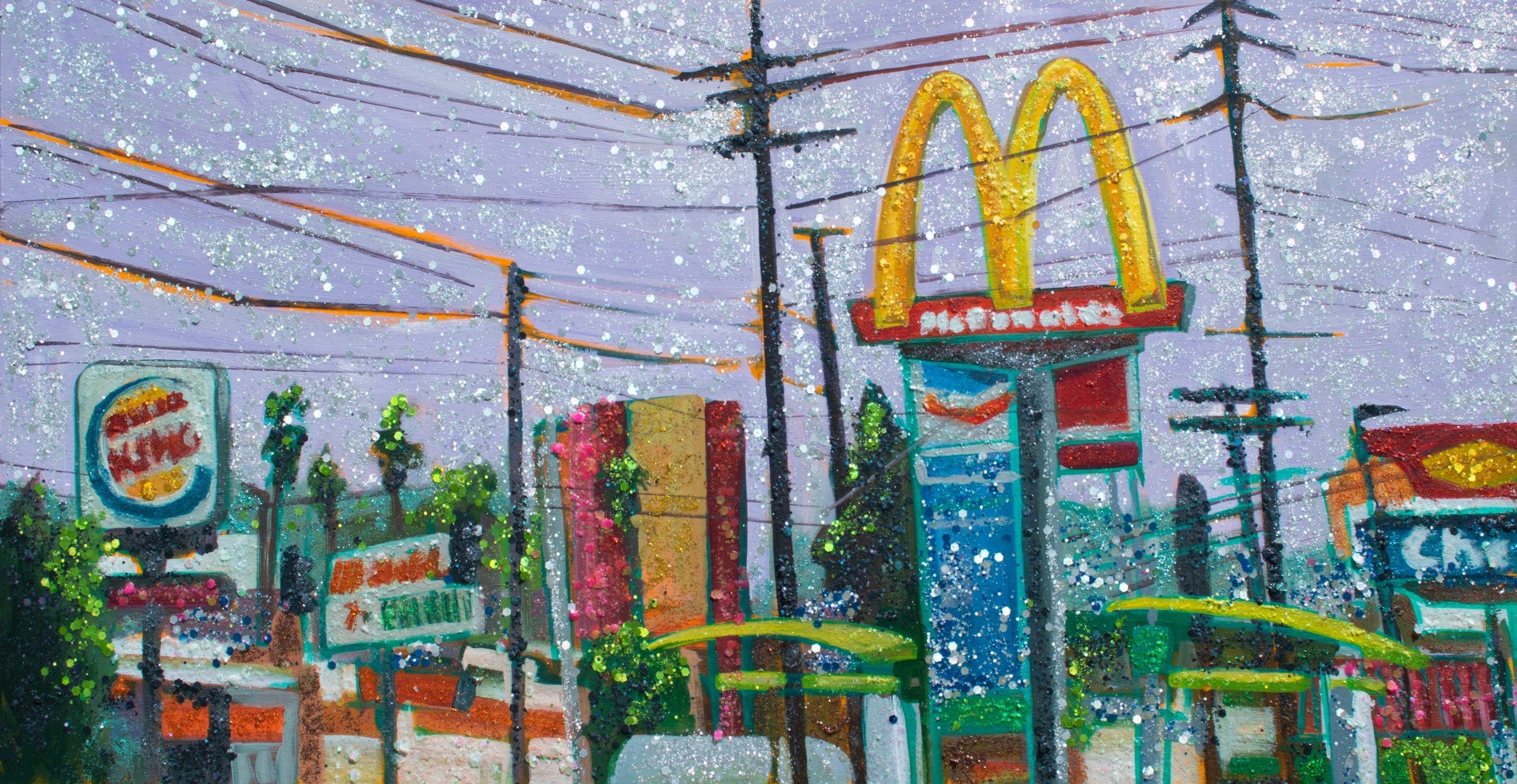
Every three business days, like clockwork, a new faux intellectual debate gets launched on TikTok. While literacy certainly causes many online misunderstandings, I’d also encourage you to consider how context and meaning get transformed in communities driven by capitalism rather than belonging.
I’m coke-spoon coffee-stirrer old. My cultural patrimony is Pizza Hut lampshades in the style of Tiffany and a newspaper styled tables at Wendy’s. When you look at the design norms of the 80s, standing out was essential to build a customer base. Companies embraced whimsy without fearing it would hurt the bottom line.
Think of the original Chuck E. Cheese’s. The founder had also been one of the founders of Atari. He wanted to harness history through a robot rodent. He said, “Whether you were talking about the summer solstice with primitive man to the circuses in Rome. There was always an entertainment element. I always felt that was something that was lacking in restaurants. I wanted to add a dimension of fun to the act of having a meal.’ Romans had gladiators. Elder millennials had a mouse. On paper, a place with animatronic robots that also serves children’s birthday parties seems like an unnecessary expense. Why spend money on robots that need fixing and dusting? It’s because the company was banking on delight to bring in customers. In Chuck E. Cheese's case, this was smart because the pizza largely tasted like cardboard with ketchup. But in today’s stripped-down Chuck E. Cheese, you still get the low-quality pizza, but with far fewer whimsical experiences for families.
What changed? A number of things have transformed the level of whimsy that can be asserted within corporate paradigms. First, many brands now own all of their outlet locations. (Many of the largest real estate holders in the US are fast food companies.) In the 1980s, for example, franchise owners could implement interesting versions of that brand. You could have a McDonald’s tricked out to look like it was about rock ‘n’ roll. Where I grew up, KFC had bought out a local chicken chain and kept the original counter with the stools.
McDonald’s, in the first flush of its nationwide expansion, really fostered playfulness and creativity as part of its role in the community, for example, having cartoon characters, having cookies, erecting playgrounds, and letting franchisees build any sort of structure. They saw franchisees as a partner in their expansion. This also afforded many people entry into the managerial or ownership class. These owner-franchisees often valued amenities because they were part of those communities. Interesting served a business function at a local level but could not scale.
Moving to a corporate model let them standardize operations and build global brands. In moving to the global corporate model, you lost that community aspect. Now corporate makes decisions for the good of the corporation. But with things like McDonald’s, when corporate makes broad decisions, they end up diluting the pleasure people get from the Brand. With beef prices increasing, McDonald’s, for example, is having major financial challenges. Their spaces have become less interesting. Their connection to community is considerably decreased as compared to the 1980s. The cold corporate spaces Do Not offer enough of a premium to necessitate spending your money there. In other words, in McDonaldization, a term employed for something becoming ubiquitous and less unique, McDonald’s has lost its specialness. Often, to succeed globally, you have to give up what made you interesting locally.
The endgame of corporate decision-making is private equity. They have gutted many a brand for parts. I often think of private equity like a parasite. Some parasites don’t destroy the system. They need you to live so they can continue on. But other parasites end up destroying the system. For private equity to succeed, the business advisors do not, and so they are at cross purposes. They have no problem destroying the organism, or in this case, the company they’ve purchased. In these business models, we see a trajectory from interesting and localized to cheaper, boring, and global.
Social media has followed that same trajectory. The earliest social media successes were driven by people for their own communities. Instagram was largely a photo-sharing app for connecting with friends. While places like Blogspot and Pinterest helped people find audiences outside their personal networks, the scale was usually fairly small and often based on specialized skills. Food bloggers actually knew how to cook. People with big Pinterest followings usually pinned within specific niches like design. Like franchise owners, they used a corporate model but connected to a specific, known community through targeted efforts.
But the speed and scale of the early social apps did not appease the financial appetite of those investing in technology. Moving from friend-based social media to algorithmic social media is not so different than the choices private equity makes about the restaurants they buy out. Algorithmic social media does not privilege personal experience, quality content, or social good. It privileges only profits for its stakeholders.
As a result, our social landscape is meant to be as accessible as possible so anybody might trip up upon your public content from any vantage point, but the algorithm has found that dissent fosters profits. That is why polarizing opinions often get served up to the people most likely to be emotionally dysregulated by them. Social media is like putting sworn enemies in a cage and rewarding the one who survives. Add in the addictive quality of these emotional hits, and you have a system that can only increase emotional dysregulation.
Finally, to return to those McDonald’s that looked different in your town compared to the one next to you, social media used to offer frames of understanding before you accessed the information. For example, if you had a blog, it was housed within your blog ecosystem. Somebody could simply check the about page to understand where you were coming from. Additionally, algorithmic social media implies you’re being served content meant for you. In a system where people come to content from their context and feel they should all get what they expect, context feels immaterial.
The academic term for expecting all content to be understood from your context is contextual collapse, coined by researcher danah boyd. Basically, when you make everything uniform, you lose the importance of uniqueness. Online, multiple distinct social audiences flatten into a single, undifferentiated group.
I often read people attribute context collapse to literacy, and that is certainly part of the issue. A common Internet meme complains that English teachers push learners when sometimes the curtains might just be blue. Underlying that is a misunderstanding of why we push learners to go beyond their initial instincts; pulling out the contextual clues within the text and then drawing meaning is essential to being a higher-level critical thinker. These are the same tools you use in a meeting to understand a coworker's subtext. These are the same tools you use when a politician attempts to trick you in a speech.
Social media is built to foster universality. We can use many of the same ideas to globalize brands. Just as McDonald’s looks the same in any country, Instagram is the same visually. Just as those universal brands create a false similarity, online spaces offer false equivalencies. But McDonald's does actually modulate its stores internationally, famously finding non-beef equivalents in India, where the internet does not. Why? For global food brands, getting people to consume means they must like it. For global internet brands, getting people to hate it means they consume more. Dissonance is social media's business model.
The classic online example of contextual collapse is bean soup theory. A woman made a recipe for being soup and posted it online quickly as she was asked. What should I substitute if I hate beans? She believed all recipes in her algorithm were meant for her, and when something didn't fit her paradigm, she felt cognitive dissonance. Rather than face the reason for the cognitive dissonance, she asked a question.
In teaching, you often say no question is a bad question. But in the classroom, you are within the same context as the questioner. Social media is the ultimate no-context; most questions are ridiculous. So even with good literacy skills, the woman might ask about soup without beans because she lives in a world where everything feels equal and uniform.
In a world where noone gets their answers, most people feel frustrated. The real problem with social media’s profit focus is that it harms people. People’s emotions become pawns in an addictive system. The real-world consequences are a society where everyone is actively dealing with addiction.
So what is the solution to context collapse? We can’t turn back the clock on globalization. Similarly, we have developed a system in which our brains have even been transformed by the way information is structured online. But you can work on these issues for yourself.
Many of us turned to the internet for authenticity, given how much globalization had stripped pleasure from our physical world. But those same forces impact our digital spaces. As such, take control of your input. Build the environment that enriches you.
First, think about the joys of your weird McDonald’s. You probably have local restaurants that invest in making spaces feel exciting. Engage with those companies and avoid spaces that feel empty. Similarly, focus your energy on intellectual content that feels surprising and challenging. Seek out content rather than just consuming what you are served up. In other words, diversify your life, both visually and intellectually. Will that keep somebody from commenting that they hate red when you show your painting of Little Red Riding Hood? No, instead it’ll give you the fortitude to understand their inability to make sense of your content. It will also give you a completely clear conscience when you block them.