We have all heard the phrase, “Religion and politics don’t mix.” I disagree — because the Founders established this nation believing that the Christian faith was not only relevant to good government but essential to it. Our Declaration of Independence declared our rights to be unalienable gifts from God our Creator. In 1854, some 67 years after the drafting of the Constitution, the Congressional Record stated:
“At the time of the adoption of the Constitution and the amendments, the universal sentiment was that Christianity should be encouraged.… In this age there can be no substitute for Christianity.… That was the religion of the founders of the republic and they expected it to remain the religion of their descendants.”
The Founders, and the generation of leaders who followed them, believed that Christianity was a positive force to be woven into the fabric of American politics. We are fortunate in America to have a voice in our political structure through our right to vote for our governing leaders. Most of the world does not enjoy this privilege, which is why it baffles me that 40 million-plus Christians do not bother to vote. In this writing, I will explain why I believe Christians must vote, and how they should vote. It all comes down to the political reality in which we live and the role the Christian must play within it.
As a Christian, my highest loyalty belongs to Jesus Christ, and obedience to Him is my first priority. His final command to His disciples, which falls squarely on Christians today, was: “Therefore go and make disciples of all nations, baptizing them in the name of the Father and of the Son and of the Holy Spirit” (Matthew 28:19, NIV).
That life priority means doing everything possible to create the best conditions for advancing the gospel so that this command to make new disciples can be fulfilled. Voting is one of those things. If I can help place people in government who enact policies and pass laws that advance rather than hinder the Christian faith, then I am obligated to do it.
The first reality every Christian voter must face is this: there are two major political parties — the Democrats and the Republicans. One or the other will control the White House, the House of Representatives, and the Senate. One party may hold all three, or just two, or only one. That is the reality. When a Christian steps into the voting booth, the choice is clear: do you want Democrats in control, or Republicans?
It was not always structured this way. The Constitution originally called for the runner-up in the presidential race to serve as vice president. Imagine Trump as president and Hillary as vice president — or Biden as president and Trump as vice president. The system has evolved, but the binary choice at its core has not.
The two major parties no longer share anything in common. They once did, even into the early 1980s, but that is no longer true. Their core values do not align. The late Rush Limbaugh voiced this point relentlessly on his radio program, and he was right. This is precisely why we see such dramatic shifts in government every time power changes hands from one party to the other.
Majority matters in the chambers of Congress. Each party has leaders in both the House and the Senate. Whichever party holds the majority in the House, its leader becomes the Speaker — a position of enormous power. The Speaker decides which bills come to the floor for a vote and wields significant influence over which members of his party chair the key committees where most legislation is hammered out.
The Senate operates similarly, with a few critical differences. The Vice President serves as President of the Senate and casts the tie-breaking vote when needed. The majority party’s Senate leader functions much like the Speaker of the House. The Senate also has a unique rule called the filibuster, tied to the Cloture Rule, which requires 60 of 100 votes to advance a bill, a supermajority threshold. This rule does not appear in the Constitution and can be changed by the Senate at any time.
When one party controls the White House and the other controls even one chamber of Congress, the result is split government, and the president’s agenda can be slowed, altered, or completely blocked. Given that the two parties today share no common ground whatsoever, this dynamic is more consequential now than at any point in American history.
The fourth reality is the alarming number of uninformed voters. I asked Google: “How many Americans can name the two senators who represent their state?” The AI response: only 24 to 35 percent. That is a staggering figure given how much hangs on every election.
These four realities define our political landscape. I do not necessarily like them, but they exist, and we must navigate them wisely. They present both opportunities and dangers for the Christian faith, and election results determine which way the scales tip.
As a Christian, voting is not optional. A Christian who does not vote is effectively declaring that they do not care who controls their government, what laws get passed, or how those laws will affect their lives and their faith. I do not believe this pleases the Lord.
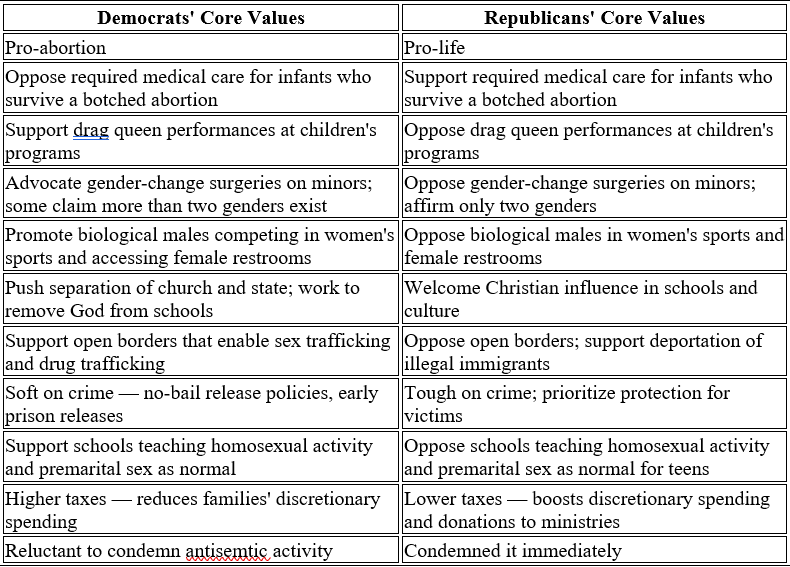
Given the realities above, examining the core values of each party is not just useful; it is essential. Because of the power the majority holds in each chamber of Congress, the party matters more than the individual candidate. The policies and laws a party produces carry far more lasting weight than the personality of any single politician.
I will vote for a state senator I personally dislike. He ran a dishonest primary campaign lying about his opponent. Majority matters and a Republican majority will produce laws more favorable to Christianity in the state. This is why I am frustrated by Christians who say they cannot vote for or support President Trump because of his brash personality or blunt manner, some even calling him arrogant. The fact is, the policies Trump champions are far more beneficial to the mission of the Christian faith than anything the Democratic Party supports.
For me as a Christian, deciding who to vote for is straightforward. I evaluate the two major parties on their core values, paying particular attention to the biblical standards at stake.
Many more issues could be added to this table, and the result would remain the same: the two parties stand in total opposition because, as stated above, they share nothing in common. Neither party is a perfect match for the Christian faith, and neither is a precise echo of the Founding Fathers’ values. But the table above makes clear that the Republican Party stands far closer to the Founders than the Democrats do. If Republicans are one hundred miles away, Democrats are a million miles away. The Founders revered the Christian faith. Today’s Democratic Party does not. It once did, back in the 1960s , but that is no longer the case. I wish both parties honored and respected the moral values of Christianity, but the Democratic Party has concluded that abandoning those values serves its political interests.
After examining the core values of both parties, the conclusion is clear: the mission of Jesus Christ in America fairs better when Republicans hold power in the White House and in both chambers of Congress. If you are a Christian, you carry a responsibility to help the gospel reach as many people as possible in America, and one concrete way to fulfill that responsibility is to help put a party in power that is friendly to the Christian faith, welcomes its influence on the life and culture of the nation, and creates conditions for it to flourish.. At this moment in history, that party is the Republican Party. When it comes to voting, a Christian must look at the big picture over a long range. Policy must always win over personality. We don’t get perfect in life and for surer we don’t get it in politics. In primary elections you vote for the person. In the general election you vote for the party.
**Steve Feazel is **an ordained minister and bestselling author. He coauthored The Three Cs that Made America Great: Christianity, Capitalism and the Constitution with Mike Huckabee. His newest book is Return to the Arena: Why Christians Need to be Active in Politics.
This has been a special edition of the Huckabee Post. We hope you enjoyed it.