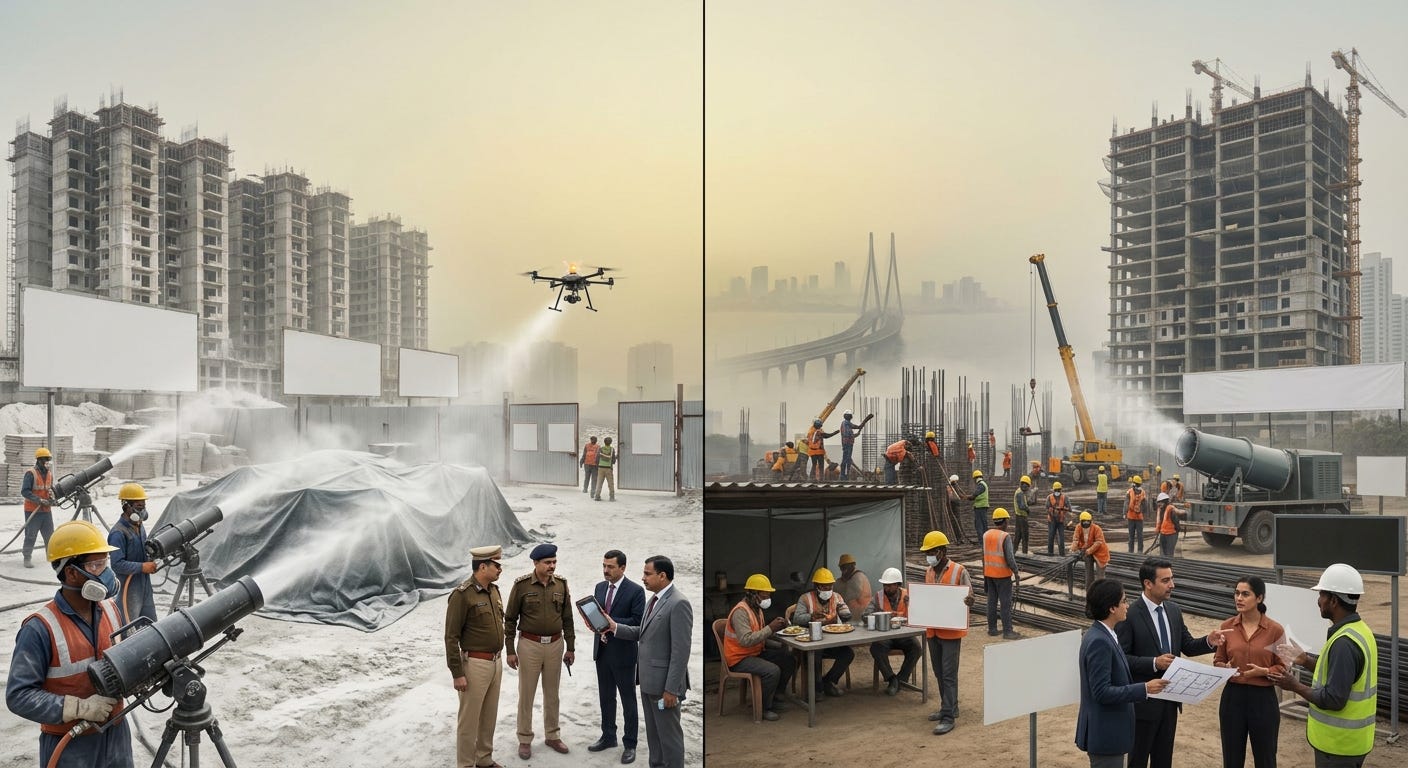
As air pollution intensifies during the winter months, the real estate sector in Delhi-NCR and Mumbai faces a growing challenge: balancing environmental compliance with construction activity, project delivery commitments and the livelihoods of construction workers. While authorities are tightening pollution-control measures to protect public health, developers are calling for a targeted approach that addresses dust emissions without unnecessarily disrupting construction activity.
Last week began with the Commission for Air Quality Management (CAQM) invoking Stage I of the Graded Response Action Plan (GRAP) across Delhi-NCR on October 21, after the capital’s air quality deteriorated to the ‘poor’ category. The move has renewed the focus on construction-related emissions and the need for stricter dust-control measures across the region.
Real estate developers have supported efforts to improve air quality but urged authorities to focus on pollution-intensive activities rather than impose blanket restrictions across construction sites.
“The deterioration in air quality across Delhi-NCR is a serious concern, and all stakeholders must work together to address the issue,” said Parveen Jain, president of NAREDCO. He emphasised compliance with dust-control measures, including water sprinkling, covering construction materials, and proper debris management, while advocating targeted restrictions on activities that contribute significantly to pollution.
Jain also highlighted the importance of a coordinated NCR-wide approach, cautioning that restrictions confined to private construction projects in Delhi may not deliver the desired results without uniform enforcement across neighbouring areas and other pollution sources.
The Delhi government’s Winter Action Plan, scheduled for implementation from November 1 to February 28, further underscores the challenge. The plan includes restrictions on construction and demolition activities and the transportation of construction materials, alongside monitoring of construction sites through AI-enabled cameras linked to the government’s control and command centre.
Construction projects depend on coordinated schedules involving contractors, labour, machinery and material deliveries. Restrictions introduced during critical stages can disrupt this coordination, delay subsequent activities and increase overhead costs. Developers warn that prolonged stoppages can affect project completion schedules, contractor arrangements and material procurement. The impact varies according to the stage of construction and the duration of restrictions.
One of the most significant challenges is labour remobilisation. According to industry experts, bringing workers back after a shutdown can take nearly three months in some cases, as workers relocate to other projects or return to their hometowns. The resulting delays can extend beyond the period of the original restriction. Even after construction resumes, developers may need additional time to rebuild teams, reorganise contractors and restore work schedules.
Harshvardhan Bansal, president of NAREDCO Delhi, has called for a balanced and practical approach, noting that prolonged restrictions could delay projects, raise construction costs and affect homebuyers and daily-wage workers. He also highlighted the potential of AI-enabled monitoring to improve compliance and accountability at construction sites.
For developers, construction interruptions can affect cash flow planning, financing costs, and contractual commitments. Delayed work may also lead to changes in the timing of construction expenditure.
During DLF Ltd’s Q2 FY27 earnings call on October 17, managing director and chief executive officer Ashok Tyagi said the company did not foresee challenges to its project completion timelines at that point. However, he indicated that construction outflows could experience a slight slowdown in the preceding quarter and potentially Q3, citing the festive season and GRAP guidelines as contributing factors.
For homebuyers, the primary concern is delayed possession. Buyers may face extended rental expenses, ongoing financial commitments, and uncertainty about relocation plans. However, a pollution-related restriction does not necessarily mean every project will be delayed; the impact depends on the duration of the restrictions, the construction stage, and the developer’s ability to adapt.
Developers have suggested allowing activities such as internal finishing, electrical installations and plumbing to continue wherever permitted under applicable environmental directions. Advance procurement planning, flexible scheduling and improved site-level pollution controls could also help minimise disruption.
Mumbai is confronting similar concerns as deteriorating air quality prompts stricter scrutiny of construction and redevelopment activities.
Mumbai’s pollution-control measures have also drawn judicial scrutiny. The Bombay High Court this week expressed concern over the city’s deteriorating air quality and questioned the effectiveness of enforcement against construction sites contributing to pollution.
“This is shocking. The city has a sea breeze coming, which has a lot of open spaces, the whole openness of the sea, still we are facing this... You should see to it that Mumbai skies are clear,” the bench had said.
For developers, these developments underline the importance of compliance, particularly in a market where redevelopment and high-density construction are significant components of real estate activity.
The real estate industry’s central argument is not against pollution control, but in favour of implementing it through targeted restrictions, consistent enforcement and practical alternatives. A coordinated NCR-wide approach, stricter monitoring of dust-intensive activities and clear guidelines on permitted construction work could help reduce emissions while limiting avoidable disruption. Developers, meanwhile, must invest in effective dust suppression, covered material storage, debris management and contingency planning.
Ultimately, environmental protection and real estate development must progress together. The challenge for policymakers and industry stakeholders is to ensure that cleaner air does not come at the cost of unnecessary project delays, rising housing expenses and prolonged income uncertainty for construction workers, say experts.
This newsletter is written by Vandana Ramnani. You can reach her at vandana.ramnani@htdigital.in