History of the Present — The Intellectualist Premium Series.
While Jared Kushner and Steve Witkoff were negotiating with Vladimir Putin over ending the war in Ukraine, Putin raised a roughly $20 billion Russian oil deal and the Americans agreed to work on it. The proposed buyers include investors tied to Trump, Kushner and the Witkoff family, while the U.S. government is both seeking a stake and controlling whether the sale can proceed.
President Vladimir Putin raised a multibillion-dollar Russian oil deal with Jared Kushner and Steve Witkoff while the two men were negotiating with him over ending the war in Ukraine, according to The New York Times.
The Americans told Mr. Putin they would work on it. They later did.
A senior administration official told The Times that Mr. Kushner and Mr. Witkoff helped negotiate the financial terms of a proposed U.S. government investment involving roughly $20 billion in foreign assets owned by Lukoil, the Russian energy company sanctioned by Washington last year.
The Lukoil talks were part of a broader strategy. Mr. Kushner and Mr. Witkoff have argued that restoring economic ties with the West could give Mr. Putin an incentive to compromise in Ukraine, while President Trump has described Russia as a “tremendous opportunity” for business.
That strategy has created an unusual convergence of diplomacy, sanctions policy and private commerce. The men negotiating with Mr. Putin were also working on a transaction he personally raised, while the U.S. government occupied three roles: foreign-policy decision maker, sanctions authority and prospective investor.
There is no evidence that Mr. Kushner or Mr. Witkoff personally stand to profit from the Lukoil sale.
But several investors seeking to acquire the assets have separate financial relationships with Mr. Kushner or with ventures associated with Mr. Trump and the Witkoff family.
History of the Present: Premium Access“The past is never dead. It’s not even past.”
— William Faulkner
Power moves before it is named. Institutions fail before they admit failure. Public narratives harden after the choices that shape them have already been made.
History of the Presentis The Intellectualist’s flagship premium series for readers who want to understand the forces shaping the world before they become headlines, scandals, crises or consensus.Members get the analysis earlier — before events harden into conventional wisdom — along with full access to The Intellectualist’s premium editorial portfolio.
Save 33% on Your First YearLimited to the first
1,000 Founding Members.The first 1,000 members will be permanently recognized as
Founding Members of The Intellectualist’s next chapter.
What Members Get:History of the Present,One Person, One Vote,Scandal,Reality Check,Thoughts & Ideas,The Cost of MoneyandBits & Bytes— plus expanding access to early briefings, curated events, member discussions and The Intellectualist’s editorial process.
Know Earlier. Understand Deeper.
Become a Founding Member
Treasury sanctioned Lukoil in October 2025, saying Russia had shown no serious commitment to ending the war. The sanctions helped push the company toward selling foreign holdings that include oil and gas fields, refineries and filling stations.
Washington now holds one of the decisive keys to the sale. The Treasury Department’s Office of Foreign Assets Control permits negotiations and due diligence, but a transaction cannot close without separate federal authorization. Treasury says any sale must advance American national-security and foreign-policy interests.
The government is also positioned to invest.
The U.S. International Development Finance Corporation is participating in a consortium pursuing the Lukoil holdings, meaning one part of the federal government could acquire an economic interest while another controls whether the deal may proceed.
The consortium is led by Todd Boehly.
He donated $1 million to MAGA Inc. in December 2025, and his investment firm, Eldridge Industries, contributed another $1 million to Mr. Trump’s inauguration, according to The Times.
The bidding history adds another question.
Treasury previously rejected an offer from Gunvor, a Swiss energy trader with past Russian ties, saying the company would not receive a license while Mr. Putin continued the war.
Carlyle, the private equity firm, later reached an agreement to acquire much of Lukoil’s international portfolio. Final approval did not arrive. As that transaction stalled, the Boehly-led consortium, backed by the U.S. government and Gulf investors, moved to the forefront.
There is no evidence that Carlyle’s delay resulted from political favoritism.
Other consortium members bring additional financial relationships.
One investor is associated with Sheikh Tahnoon bin Zayed Al Nahyan, the U.A.E.’s national security adviser. MGX, an investment company he chairs, made a $2 billion investment in Binance using USD1, a stablecoin created by World Liberty Financial.
World Liberty is the Trump-family cryptocurrency venture co-founded by Steve Witkoff. The Times reported that it generated $799 million for Mr. Trump last year.
Another Abu Dhabi investment company associated with Sheikh Tahnoon, Lunate, has supplied capital to Affinity Partners, the private equity firm Mr. Kushner founded after Mr. Trump’s first term. Bloomberg reported that Lunate and the Qatar Investment Authority together committed an additional $1.5 billion to Affinity in 2024.
The proposed consortium also includes interests associated with Moutaz and Ramez Al-Khayyat, who are involved in a multibillion-dollar luxury resort development in Albania with Mr. Kushner and his wife, Ivanka Trump.
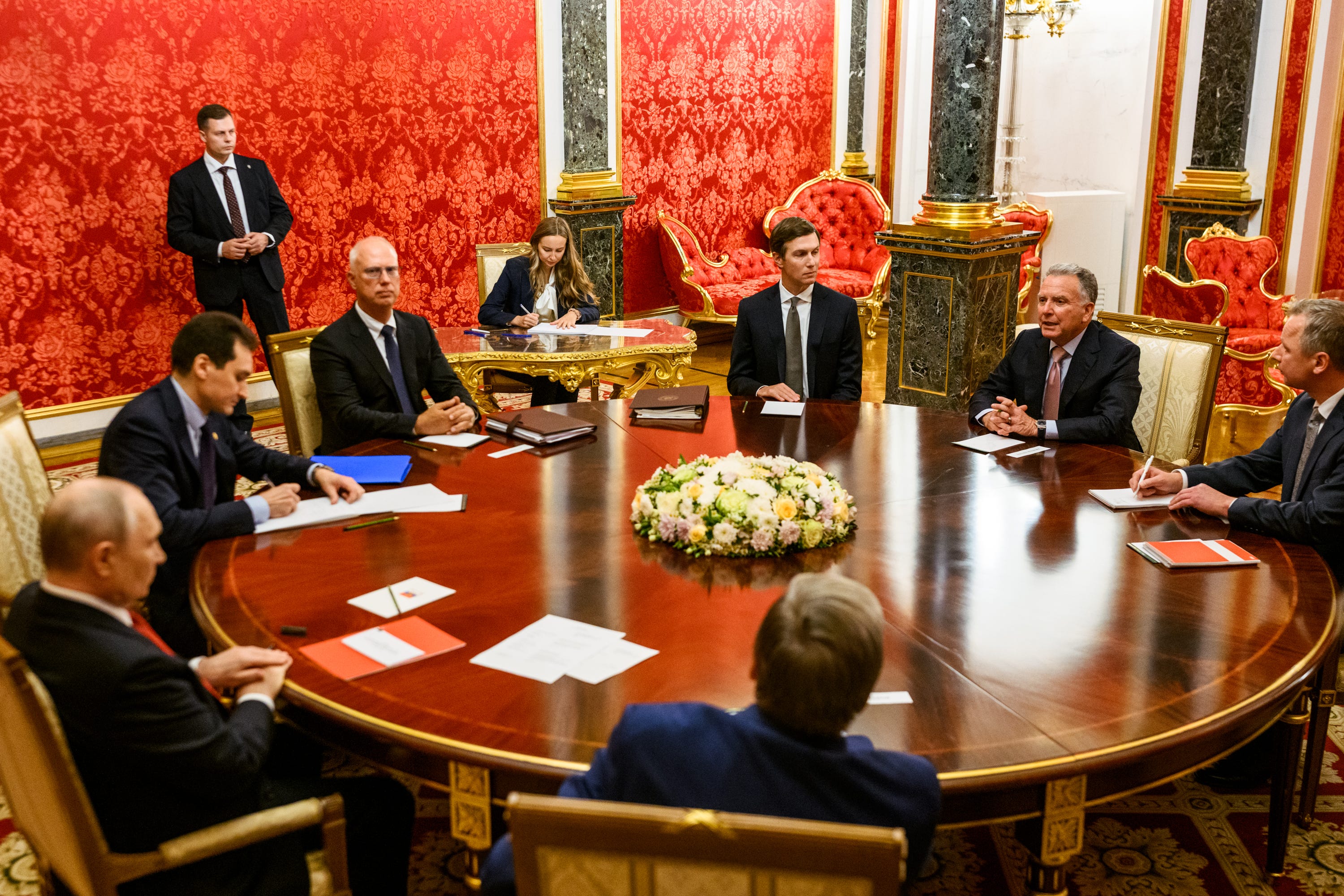
During their Sept. 5 Kremlin meeting, Mr. Putin suggested that completing the Lukoil transaction could demonstrate that Russia and the United States could again do business together, according to people familiar with the discussion.
Although Lukoil is technically private, Mr. Putin is widely regarded in Moscow as the ultimate decision maker over the transaction, The Times reported.
Treasury has repeatedly extended licenses allowing parts of Lukoil’s international operations and sale process to continue while a buyer is sought.
The latest divestiture authorization runs through Oct. 22, and a separate retail authorization through Oct. 29.
There is also a substantial national-security argument for a sale.
Treasury requires any approved buyer to sever the acquired businesses from Lukoil, keep money owed to the sanctioned company blocked and prevent it from receiving an improper windfall. The Development Finance Corporation argues that Western-aligned ownership could strengthen U.S. allies and produce returns for American taxpayers.
Those arguments explain why Washington might want the assets sold. They do not explain how it is evaluating the buyers.
The administration has not publicly released its evaluation of the competing bids, the full terms of the government’s proposed investment, the ownership stakes of all consortium members or any ethics and recusal determinations involving Mr. Kushner and Mr. Witkoff.
Those records would show whether political and business relationships played any role in how the bids were evaluated.
For now, the public record establishes the overlap, but not the answer. Mr. Putin raised the deal during negotiations over Ukraine.
1. The New York Times | October 3, 2026 | U.S.-Russia Talks on Ukraine Now Involve an Oil Deal Tied to Trump Allies
The New York Times investigation
How this source is used: This is the principal originating investigation for the private diplomatic discussions, including Putin raising the Lukoil transaction with Jared Kushner and Steve Witkoff, their reported agreement to work on it, and their subsequent role negotiating proposed U.S. financial terms. It also supports the reporting on Boehly, Carlyle, Gunvor, the Al-Khayyat and Tahnoon relationships, World Liberty, Putin’s decision-making role and the finding that there is no indication Kushner or Witkoff personally stand to profit.
2. U.S. Department of the Treasury | October 22, 2025 | Treasury Sanctions Major Russian Oil Companies, Calls on Moscow to Immediately Agree to Ceasefire
Treasury sanctions announcement
How this source is used: This is the controlling primary source for the sanctions imposed on Lukoil and Treasury’s stated rationale that Russia had shown insufficient commitment to peace and that pressure on its energy sector would reduce revenue available for the war. It independently establishes the sanctions chronology and the connection between Lukoil policy and the effort to end the war in Ukraine.
3. U.S. Department of the Treasury, Office of Foreign Assets Control | September 18, 2026, updated | FAQ 1224: What negotiations does Russia-related General License 131J authorize, and what transaction conditions will OFAC consider when evaluating requests for further authorization to effectuate a sale of Lukoil International GmbH (LIG) assets?
How this source is used: This is the controlling primary source establishing that negotiations and due diligence may proceed but an actual Lukoil sale requires separate OFAC authorization, which Treasury says will be evaluated against U.S. national-security and foreign-policy objectives. It also establishes the requirements that an approved transaction sever the assets from Lukoil, keep funds owed to Lukoil blocked and avoid providing Lukoil a windfall.
4. U.S. Department of the Treasury, Office of Foreign Assets Control | September 18, 2026, updated | FAQ 1225: What activities do Russia-related General License 128C and General License 131J authorize related to Lukoil International GmbH (LIG)?
How this source is used: This is the controlling primary source for the successive Lukoil authorizations, documenting the extensions that permit portions of the company’s international operations and divestiture process to continue while a buyer is sought. It establishes that GL 131J runs through October 22, 2026, while the retail-service-station authorization under GL 128C runs through October 29, 2026.
5. Financial Times | September 22, 2026 | US government and Gulf billionaires back Todd Boehly bid for Lukoil assets
How this source is used: This is the principal independent corroborating source for the Boehly-led consortium, including participation by the U.S. International Development Finance Corporation, Sheikh Tahnoon bin Zayed al-Nahyan and the Al-Khayyat family, as well as the prior stalled Carlyle agreement and the roughly $20 billion value assigned to Lukoil’s international assets. It also reports that Boehly and DFC would control a majority of the board and highlights the unusual position created by U.S. government participation in a bid requiring U.S. approval.
6. Bloomberg | May 1, 2025 | Trump-Tied Stablecoin Used for MGX’s $2 Billion Binance Deal
Bloomberg report on MGX, Binance and USD1
How this source is used: This independently establishes that MGX’s $2 billion investment in Binance was to be settled using USD1, the stablecoin created by World Liberty Financial, and that the arrangement was publicly announced by World Liberty co-founder Zach Witkoff. It corroborates a material financial connection between Sheikh Tahnoon’s investment network and the Trump- and Witkoff-linked cryptocurrency venture, but does not establish that the transaction influenced U.S. policy toward Lukoil.
7. Bloomberg | December 20, 2024 | Kushner’s Affinity Gets Additional $1.5 Billion From Qatar, Abu Dhabi’s Lunate
Bloomberg report on Affinity Partners financing
How this source is used: This independently establishes that Jared Kushner’s Affinity Partners raised an additional $1.5 billion from the Qatar Investment Authority and Abu Dhabi-based Lunate, deepening the documented financial relationship between Kushner’s investment firm and Gulf capital connected to the broader Lukoil network. Bloomberg also reports Kushner saying the fundraising was structured in advance to avoid potential conflicts, but the source does not establish that the investment influenced his diplomatic work or the Lukoil bidding process.