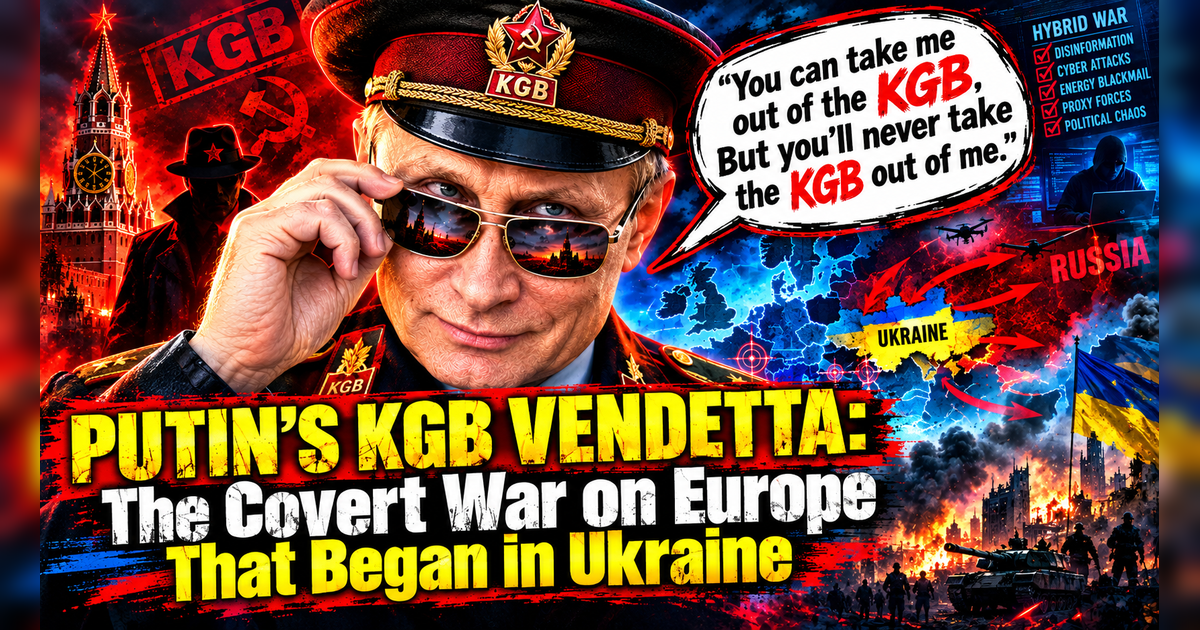
How Russia is dismantling Europe without firing a shot.
They are not trying to win a war.
They are trying to make you lose trust in everything you used to believe.
That is the sentence to hold onto as you read this. Everything that follows is the evidence for it.
You sense something is wrong.
The headlines are loud. The explanations are thin. The war in Ukraine has been going on for years, and every time you think you understand it, the picture shifts. Something in your gut tells you the story you are being told is not the whole story.
This article confirms what your instinct already suspected.
The war was never only about Ukraine.
It was the doorway. Behind it, a quieter, colder, and far more dangerous campaign is already inside the house. By the time most people realise it, the war will be half over.
Read slowly. Every layer connects to the next.
European intelligence chiefs do not gather in the same room over small worries. When they do, the threat has outgrown any single nation’s capacity to manage alone.
On 5 October 2026, the heads of Germany’s three intelligence services appeared together before the Bundestag’s Parliamentary Oversight Panel. Martin Jäger, president of the Federal Intelligence Service (BND), said something that should have been on every front page in Europe: “The confrontation we are in with Russia has taken a new, more dangerous form: Germany is at risk of becoming involved in a violent conflict with Russia.”
He described Moscow’s activities as a “shadow war” aimed at ensuring that Berlin and other European capitals do not make political decisions directed against Russia in the future. He cited an incident involving a drone carrying explosives at Leipzig Airport as one example. Germany’s domestic intelligence chief, Sinan Selen, added that Russian operations were extending beyond traditional espionage, with sabotage and critical infrastructure “in the crosshairs”.
Read that again. It changes the meaning of everything you have been watching.
For years, the world has followed the war in Ukraine as a duel between two principal players: Russia and Ukraine. Two armies. Two capitals. One front line.
That picture is obsolete.
The war is no longer contained by those two actors. It is spreading, and it now appears to be reaching across all of Europe.
Look closely at the strategy Vladimir Putin is pursuing at this very moment, and one conclusion is hard to avoid:
Europe is standing in an extremely volatile situation. Think of a room slowly filling with gas. Nothing has happened yet. But one spark is all it takes.
On 15 December 2025, the Council of the European Union adopted restrictive measures against twelve individuals and two entities over “Russia’s continued hybrid activities, including Foreign Information Manipulation and Interference (FIMI) and malicious cyber activities against the EU and its member states and partners.”
The list names members of the Russian Military Intelligence Agency GRU, Unit 29155, and the cyber threat group Cadet Blizzard — for cyber-attacks against Ukraine’s government and against EU and NATO states “to gain sensitive information and aiming to destabilise their political situation.” It also names the 142nd Separate Electronic Warfare Battalion, based in Kaliningrad, “linked to the recent cases of GPS signal failures experienced by several EU member states.” And the International Russophile Movement, for** “amplifying destabilising narratives globally on behalf of the Russian government.”**
This is not a trade dispute. This is a legal designation of war. The sanctions regime targets those “engaged in actions and policies by the government of the Russian Federation, which undermine the fundamental values of the EU and its member states, their security, stability, independence and integrity.”
And it is happening across the whole continent. ** European intelligence officials say Moscow has launched at least 200 hybrid attacks in 2026** — and NATO suspects the true number is much higher, not including hundreds of attempted cyber attacks and multiple suspicious fires.
So the real question is not what is happening on the front line. It is this:
To answer it, we have to rewind. Not to 2022. Much further.
Let us hand you a lens. Once you look through it, many things fall into place.
For a very long time, the United States treated certain states in the Middle East as testing laboratories for its weapons industry. New systems were deployed, refined under combat conditions, displayed to the world, and then sold. Conflict doubled as a product demonstration.
But laboratories run out of experiments. Eventually the Middle East reached the point of being stabilised. The testing ground that had served the weapons industry for so long had finished its job. So the industry needed a new laboratory. In military language, a place where a conflict is fought is called a “theater.” Washington needed a new one. Where could it go?
The weapons industry does not stop. It moves. And the next theater was not chosen by accident. It was chosen because it was available, willing, and strategically positioned.
The laboratory was not the whole story. But it was the lens. Everything else follows from it.
Every other candidate had a fatal flaw.
South Asia. America could not run its experiment here. During the Cold War, Washington tried to use Pakistan against India — not once but twice. It did not end as Washington hoped. India redrew Pakistan’s very geography in 1971.
That moment taught Washington something permanent. A power like India retaliates in ways nobody can predict. You cannot run a controlled experiment beside a force you cannot model. South Asia was definitely not the place.
East and Southeast Asia. Washington never wanted these regions as theaters of war. They were worth far more as markets. You do not burn down your own shop.
South America. This is America’s own backyard, and what happens there does not stay there. Nobody sets fire to their own garden.
The Middle East had served as the main theater for a very long time. Now it was behind Washington. Every other door was closed.
Which leaves one place on the map.
Europe. And inside Europe, one territory: Ukraine.
Ukraine had once been part of the Soviet Union. When the USSR disintegrated in 1991, a long hunt began in Washington. The question was simple: which territory in Europe can we secure that is strategically favorable to us?
Favorable matters. A laboratory needs a willing host. You cannot test weapons in a place that will throw you out.
The purpose was clear. Turn that territory into a testing laboratory.** Use it to modernize the American arms and ammunition industry. Then sell those upgraded weapons across the entire world.**
But here is where we need to be precise, because this is the point where many readers will ask the obvious question: why Ukraine? And why does the fight in Ukraine look like it belongs to a much older story?
The answer has two layers, and both matter.
The first layer: the war in Ukraine is not the beginning of a conflict. It is the tipping point of a contest that has been running for decades.
For over thirty years — since 1991 — Washington and Moscow have been locked in a strategic competition over the post-Soviet space. That competition has taken many forms:
The expansion of NATO eastward
The fight over energy pipelines
The colour revolutions in Georgia and Ukraine
The battle for influence over the Black Sea
The question of whether Ukraine would align with Brussels and Washington or remain inside Moscow’s orbit
None of this began in 2022. All of it fed into 2022.
The second layer: the war has its own immediate causes. The 2014 regime change. The annexation of Crimea. The eight-year war in the Donbas. The failure of the Minsk agreements. The decision by Moscow to recognise the separatist republics and launch a full-scale invasion in February 2022.
Now, if you take the laboratory thesis alone, you might conclude that the United States started the war in Ukraine just to have a place to test weapons. That would not be entirely true.
The weapons laboratory is one dimension of a much larger picture. It sits alongside a set of American decisions that created the conditions for the war.
At the root of it is a collision of empires. American post-Cold War strategy — the drive to expand NATO, to pull every former Soviet republic into the Western orbit, to ensure no rival could ever again challenge American primacy — **clashed directly with Russian interests. **Moscow had watched for decades as its buffer zones were peeled away, one by one.
The 2014 regime change in Ukraine was the flashpoint.** The CIA/United States played a key role in toppling a democratically elected president, Viktor Yanukovych, who adhered to neutral positions, in order to install an anti-Russian regime**. Assistant Secretary of State Victoria Nuland was caught on a leaked phone call discussing the composition of the new Ukrainian government and the role of the United States in shaping it. She later confirmed that the US had invested over $5 billion in Ukraine’s **“future.” **By February 2014, President Yanukovych had fled the country in what was widely regarded as a coup d’etat. Putin called it what it was: a coup “with the backing of CIA, of course.” He added: “Technically, they did everything right. They achieved their goal of changing the government.”
Putin responded immediately. He annexed Crimea — not just the peninsula, but a maritime zone more than three times its size, with rights to underwater oil and gas reserves potentially worth** trillions of dollars. He backed separatists in the Donbas. He moved to prevent Ukraine from becoming a permanent American forward operating base on Russia’s border.**
None of this erases the fact that Russia launched the full-scale invasion in February 2022. That was Putin’s decision, and it was an act of aggression. But the war did not begin in 2022. It began in 2014,** and the roots of 2014 run back to 1991 and beyond.**
Make no mistake: the United States engineered the conditions. Not the war itself — that was Putin’s decision — but the conditions. The 2014 regime change. The NATO expansion. The $5 billion investment in Ukraine’s “future.” The push to pull Ukraine into the Western orbit. The refusal to negotiate a settlement that both sides could live with. All of these were American choices. All of them led toward the tipping point.
And the weapons industry was one major dimension of that strategy. The quiet understanding that if a major land war broke out in Europe again, the weapons industry would need somewhere to test, refine and sell its products. That is not the cause of the war.** But it is one of the reasons America was so well positioned to exploit it — and one of the reasons it kept pushing.**
Ukraine became the laboratory not because it was chosen overnight, but because every other option closed, and this one had been in play for a generation. But the laboratory was never the whole story. The whole story is a collision of empires that began in 1991 — and has not yet ended. The laboratory was one dimension. The collision of empires was another. And when the war came, the laboratory was ready.
Ukraine was never just a battlefield. It was the place where thirty years of American strategy, Russian grievance, and unresolved history finally collided.
Washington’s ambition did not stop at a weapons showroom.
The deeper calculation:** the war would weaken Russia all over again, pushing it to a point where it could not stand on its own feet.**
A laboratory. A global sales pitch. And a rival on its knees.
On paper, it was an elegant plan.
There was just one problem. Russia had a strategy of its own. It was older, colder, and far more personal.
Moscow decided to use this very war to settle a score that had been waiting for decades.
This is the part mainstream coverage avoids.
If you ever get the chance, read the original history of the Soviet Union. Not the headlines. Real books by people who studied the collapse in depth. Read how the USSR came apart, and you will find the story of a major, global-scale covert operation carried out by the United States to bring about its disintegration. This is the reading that matters here, because it is the one that shaped the men who now run Russia.
Everything that follows grows from it.
Now picture the moment. A superpower is coming apart. And inside its machinery stands an officer of Soviet intelligence, attached to the KGB, the Soviet spy agency. He watches his country dissolve.
His name: Vladimir Putin.
He did not forget what he saw.
In December 1991, as the Soviet Union collapsed, Putin was an** “obscure and resentful KGB colonel watching his world shatter before his eyes.”** That image is not poetry. It is biography. And biography becomes strategy.
In his mind, and in the way he talks about history, the collapse of the Soviet Union was not just an internal failure; he believes that America had a very big hand in breaking the Soviet Union, using economic pressure, ideological warfare, and covert influence. He has even called the Soviet collapse “the greatest geopolitical catastrophe of the century in his 2005 address to the Russian parliament.”
Let that sink in for a second.
Years after 1991, he and a handful of carefully chosen allies took complete control of power inside Russia. Not shared control. Complete control.
And together they made a decision.
Whatever happens, the death of the Soviet Union will be avenged.
But how do you avenge a dead empire? They concluded there was only one way. In Moscow’s eyes, the United States had built a structure right beside Russia’s border: the European Union.
The revenge would be to break it apart.
Tear down the European Union, and the score is settled.
So Ukraine was never only a battlefield. For Moscow, it became the opening move in a long, patient act of revenge.
The only thing that explains this level of sustained, patient investment in the destruction of European unity is a fixed, generational objective**. That objective is revenge for 1991. The pattern is the proof of the motive.**
The war in Ukraine is not the war. It is a move in a game that has been playing for thirty-five years. Once you see it, you cannot unsee it.
Now, some readers will push back on this. They will say: this is psycho-biography. You are inferring motive from biography. You are telling a story rather than proving a case.
That objection deserves an honest answer — and it is the reason we are preparing something for members that goes far beyond what is possible in a public article.
In the coming weeks, we will publish** a members-only classified intelligence grade profile of Vladimir Putin’s psychological makeup** — drawing on** insider-grade sources that rarely enter public discussion, including behavioural analysis, historically documented decision patterns, private statements, and assessments from people who have studi…