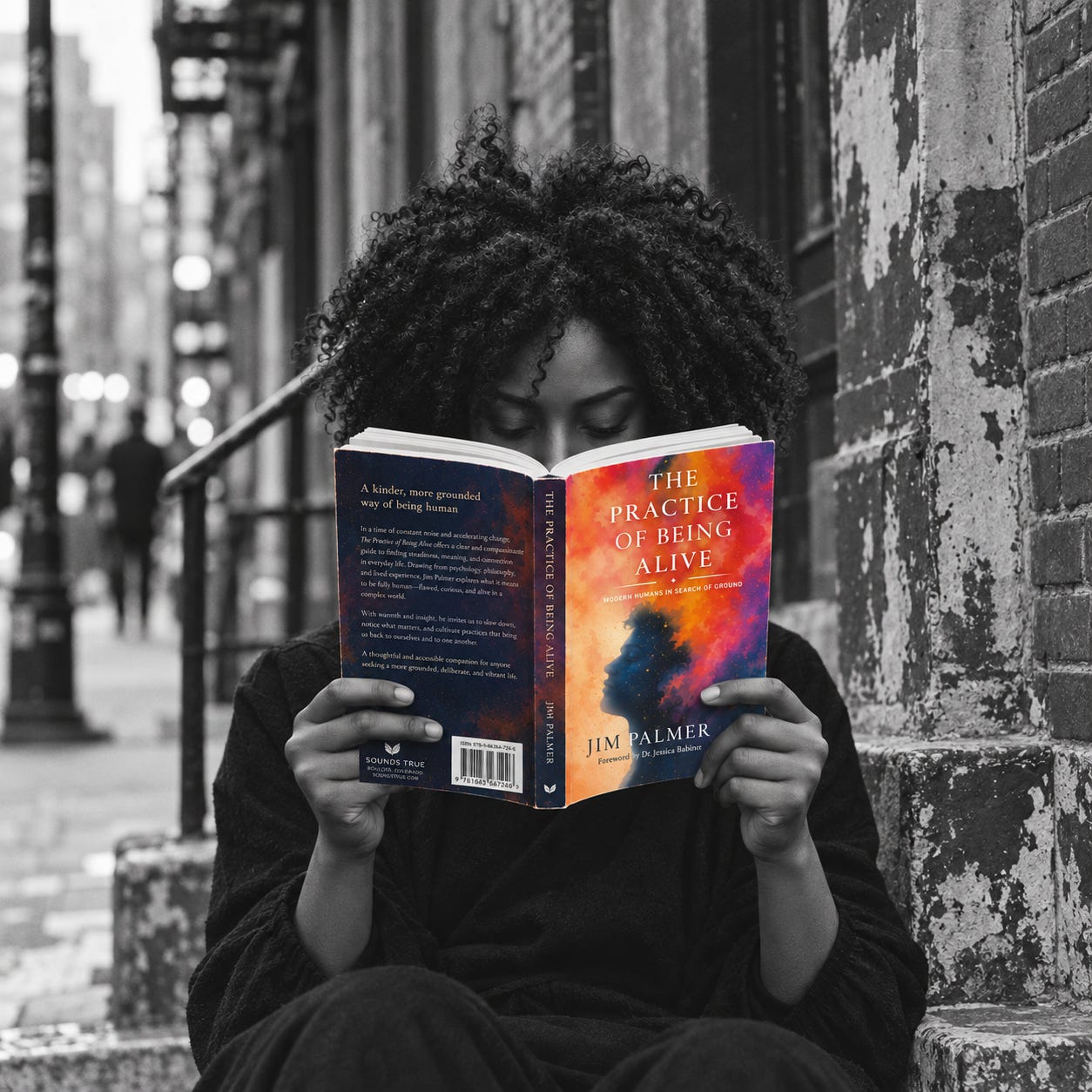
The Kindle edition of is now
Writing a book about being alive carries an obvious complication: nobody needs my permission to live, and reading my words will never substitute for inhabiting your own life. Still, a book sometimes gives us language for an experience we have struggled to name. It helps us recognize where we have become stuck and what deserves our attention.
Here are some questions about the book and the experiences that led me to write it.
This book is for people who are trying to inhabit their lives more honestly in a world that offers endless advice about what to believe, who to become, and how to succeed. Some are questioning beliefs they inherited. Others still hold those beliefs but find that familiar answers no longer reach the experiences they are having.
A life that looks good from the outside sometimes feels strangely distant from within. Loss can change your sense of the future, and an identity you worked hard to build may no longer fit. Or the longing is simpler: a deeper relationship with ordinary existence, without turning yourself into another improvement project.
The book begins with the human situation we share: we are here, our time is finite, our choices matter, and we have to live without knowing everything we wish we knew. None of us gets to resolve those conditions before participating in life.
No. Religious deconstruction is part of my history, but the book addresses questions that belong to being human. Someone who has never been religious still encounters uncertainty, grief, responsibility, belonging, and the difficulty of deciding what deserves their life.
Leaving religion sometimes makes these questions more visible because a familiar structure of meaning has fallen away. Yet people also lose their ground through divorce, illness, retirement, political disillusionment, or the collapse of a cherished ambition. Others discover that the structure remains intact while their trust in it has quietly disappeared.
You do not need a religious past to recognize yourself in these pages. The central concern is how we relate to existence when no explanation relieves us of the responsibility to live it.
By existential health, I mean the quality of our relationship with the fundamental conditions of being human. It concerns how we meet uncertainty, exercise agency, participate in meaning, encounter mortality, and belong with others while remaining faithful to our own experience.
A person might be highly capable and still struggle to hold the life they are living. They know how to perform, achieve, organize, and solve problems, but an unanswered question feels intolerable. A change in someone’s opinion threatens their identity, or a loss leaves them unable to imagine meaning beyond what has ended.
This is why I distinguish capability from capacity. Capability concerns what we are able to do; capacity concerns what we are able to hold. Existential health involves developing the capacity to remain present and responsive when life exceeds our explanations or refuses our preferred outcome.
There is no level of development at which grief stops hurting or uncertainty becomes entirely comfortable. The possibility is a more grounded relationship with those experiences, one that leaves us room to choose, care, and participate.
Success gives us evidence that we have met certain expectations. It does not necessarily tell us whether those expectations deserve the authority we have given them. We might become very good at pursuing a life we have never seriously examined.
Many of us learn to experience ourselves through external confirmation. Achievement reassures us that we matter; approval tells us we belong. Over time, we become dependent on maintaining those signals, even when the effort pulls us further from what we actually value.
There is also a basic limit to what success provides. A promotion will not settle our relationship with mortality, and recognition will not remove the uncertainty involved in loving another person. We sometimes ask achievement to supply a kind of ground it was never equipped to give us.
Feeling ungrounded is therefore worth listening to before rushing to correct it. It might reveal a neglected part of life, an allegiance we need to reconsider, or a way of living that has become too expensive to sustain.
The book offers a way of understanding our human situation and explores the postures through which we participate in it. I take ideas seriously because our interpretations shape what we notice, what we fear, and what we believe is possible. But an idea earns its place in our lives through what it helps us meet.
Practice begins where an insight asks something concrete of us. Recognizing that certainty is unavailable might mean making a necessary decision before we feel fully reassured. Understanding belonging differently might mean telling the truth in a relationship where we have habitually concealed ourselves to remain accepted.
These are ordinary actions with existential depth. Asking for help, keeping a boundary, attending to grief, or changing our mind brings our understanding into contact with the life we actually have.
I want the book to support that movement. Its value ultimately depends on what readers discover through their own participation, including discoveries that take them beyond my language.
Much self-help begins with something we want to change: a habit, a difficulty, a goal we have not reached. Those are legitimate concerns, and practical guidance often helps. My starting point is the relationship we have with being human, including the conditions that no amount of improvement will eliminate.
We will remain vulnerable to loss. Our decisions will have consequences we cannot fully anticipate, and the people we love will remain beyond our control. Treating every discomfort as a problem to solve leaves us poorly prepared for experiences that require patience, courage, companionship, or grief.
The Practice of Being Alive asks what makes a life more inhabitable from within. That includes our ability to act and change our circumstances, but it also includes learning to hold what remains unresolved. I am interested in the freedom that develops when we stop requiring ourselves to become invulnerable before we trust ourselves to live.
My earlier books grew out of questions I was living through, especially the unraveling of religious certainty and the recovery of my own authority. Over time, my attention widened to what follows that freedom: how we build a life when inherited answers no longer hold and little prepares us for the responsibility that remains.
Through writing, teaching, and the Center for Non-Religious Spirituality, I have met people navigating that territory in very different circumstances. Their experiences sharpened a concern that became central to my work: freedom requires capacities we are rarely taught to develop.
This book brings that concern into focus after decades of questioning, conversation, and revision. I wrote it to give language to experiences many people face without adequate support, and to explore how we develop the capacity to choose, belong, and participate in life without surrendering our authority.
I want readers to trust their contact with reality, including the moments when it interrupts a cherished story. Meaning takes shape through involvement, and belonging loses something essential when its price is self-abandonment.
More personally, I wrote this book for anyone waiting to feel certain, healed, qualified, or complete before participating fully in life. There are things we need to work through and circumstances we need to change. But life is already happening while we do that work, and our unfinishedness does not disqualify us from it.
I want you to read this book because I believe it has something meaningful to offer. Let its words accompany you into a more direct relationship with your own life, where the choices, conversations, risks, and discoveries are yours. The path is made by walking.
The Practice of Being Alive: Modern Humans in Search of Ground is now ** available for preorder** in the Kindle edition. Thank you to the readers whose questions, experiences, and honest responses helped shape the book.