Robina Khalid’s note suggesting "A world without rape is possible" puts in mind the ways in which veneration and exploitation of women show up in art.
Khalid was citing the work of anthropologist Professor Peggy Reeves Sanday, who compared 150 tribal societies to develop a concept of rape-free or rape-prone societies. Sanday was working against a commonly held belief in Western society that men are biologically predisposed to violent and aggressive uses of physicality to dominate women. Instead of seeing rape as a given, she explored why some societies do not have rape. In her sample, 47% of societies had no rape. These cultures were largely much less focused on binary sexuality, and also severely punished those who used sexual aggression. Masculinity in these societies was not seen as opposed to femininity but as complementary to the female state. When dominance was privileged, collective good prevailed.
Many of Sunday’s cited tribal communities in Borneo are rape-free. This depiction of mother and child from Borneo shows a woman who is nude holding a baby. This stylized composition offers little realism in the woman’s facial features. Her bright eyes and teeth are highlighted with shells, but the composition otherwise uses very little detail. The baby’s legs cradle the woman as it suckles at her breast. This artwork is part of a cultural tradition that celebrates women as essential to social continuity. By drinking their mother's milk, this baby continues this long tradition.
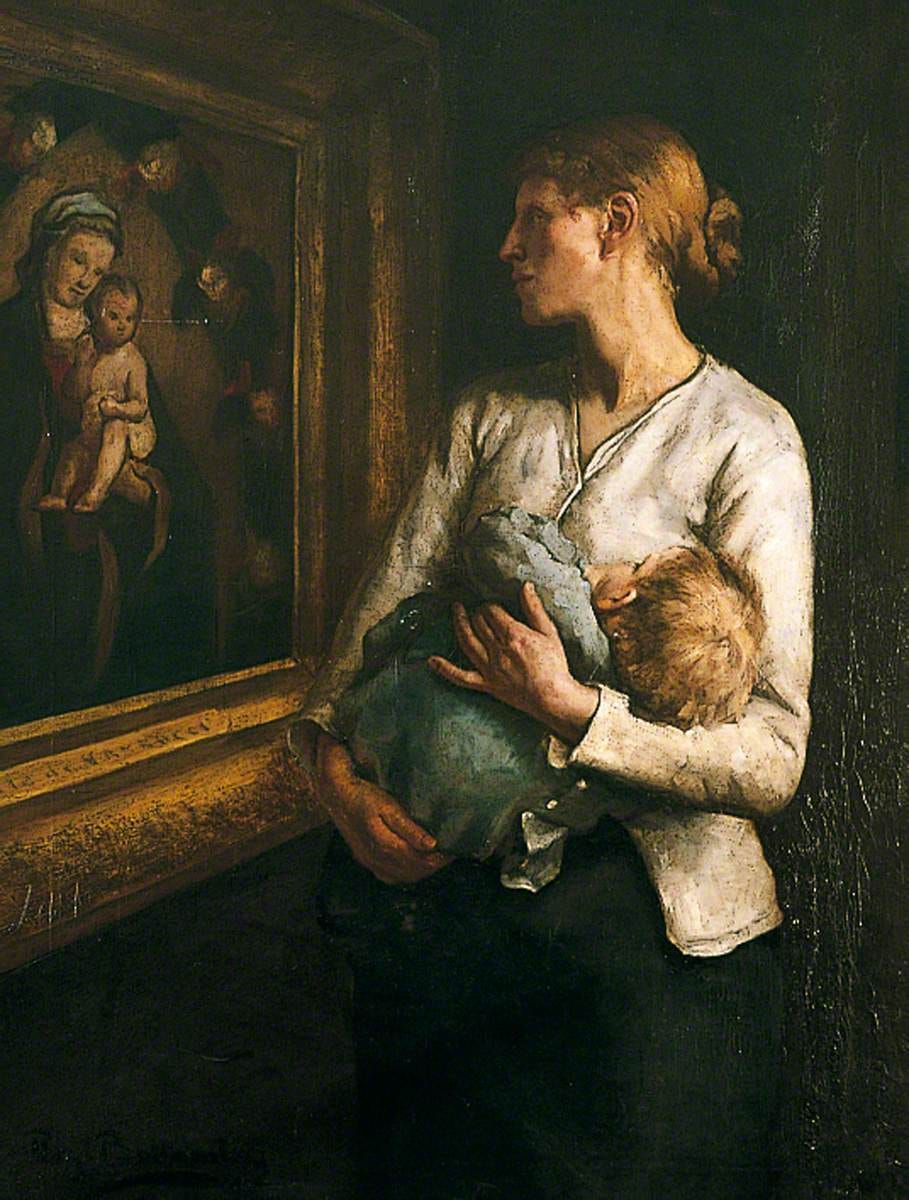
Now compare the depiction of the Virgin Mary. In the years after the Black Death, Marian imagery rose. Many church fathers feared for women's condition, partly because they were necessary to birth the next generation of parishioners, and they made a concerted effort to promote the veneration of Mary. This gave rise to many very naturalistic depictions of the Virgin often suckling the infant Jesus. The Virgin is authentically depicted as young and beautiful, the perfect vessel for the Son of God. But these depictions usually still center the son. Jesus is depicted as preternaturally alert. So even in depictions where the mother is meant to be the center, she is seen only as a foil for the man.
In a society constructed by men to center men in the image of God, who was born a man, women are always secondary. The system places them in subordinate positions, either as the good mother or the wicked seductress. So, in the depiction from Borneo, mothers nurse all people in society; depictions of the Virgin Mary focus on mothers’ role in bearing sons. The opposition between the two artworks shows how different ways of thinking can produce very different lived experiences.
In a society where even the most important mother is, but a subordinate to her child men will always see women as passive. The ownership of women is therefore central to Christian societies. Additionally, if men need to retain privacy, they cannot allow any nuance to gender or social structure. Anyone outside of the gender binary destabilizes their position. All women are also fair game in retaining the social order. Scholar Maria Bevaqua, in writing about the politics of assault, points out that, due to the sexual entitlement of American men, “the anti-rate movement is a threat to the male right of sexual dominance.” Societies that see women as people who continue the line would never violate their history. Societies that see men as the pinnacle need to use violence to maintain their dominance.
When we look at why rape happens, we need to focus more closely on why men rape. By centering men in the act, we don't let them escape punishment.
Many of the communities that do not rape are also communities that Western society has tried to suppress. In 1779, General Clinton wrote to his lieutenant about the Iroquois: “Bad as the savages are, they never violate the chastity of women.” In this quote, we should see the contradiction: for the colonists, their society, which included raping prisoners, was seen as normal, whereas Native Americans, with their respect for women, were seen as savage.
The Asante of Ghana are another society in which rape is very uncommon. This mother-and-child figure, like the one from Borneo, is highly stylized. Similarly, here the figure is nursing. This woman stands in for all women, as this is a matrilineal society. But the generalized look of these figures also highlights how universal motherhood is as a standard in that community. The mother is depicted with beautifully coiffed hair, ritual scarification, and neck-lengthening jewelry. In this depiction, the mother is being venerated. She is not just a vessel for the future, but also a pillar of society today.
One cannot help but notice that these communities whose art abstracts women seem to treat women better. That Mary is so beautiful and specific in comparison highlights how our society treats women’s looks and function as tools to maintain male power. Until men reckon with their inability to see women as more than objects, we will remain in a society that claims to be based on Christian values, and yet would rape a woman who looks like the Virgin Mary.