In early July, 𝕏Cassie Pritchard argued on Twitter that liberalism had failed; it bet the farm on economic progress making people happier, but although it delivered impressive economic progress, happiness had failed to follow.
In late July, I countered that Pritchard had made a mistake by comparing happiness to income, when the literature instead supports a correlation of happiness with log(income). Add the log term, and most happiness-income relationships reappear, and liberalism goes back to looking pretty good.
Last week, Pritchard responded on her Substack. I don’t have the interest to give this the full treatment it requires, but she deserves some response, so I’ll make a few points.
Pritchard argues that the effect of income on happiness, though real, is small:
In short, a correlation does exist, and it’s plausibly causal. But it’s pretty small.
How small? Well, Alexander cites
[another article from Killingsworth]that gives us the correlation across the entire dataset of individual observations, not just across these smoothed-out groups: “the correlation between average happiness and log(income)is 0.09in the experience sampling data...the effect of an approximately fourfold difference in income is about equal to the effect of being a caregiver...andless than a third as large as the effect of a headache.” (Emphasis added).So, according to Alexander’s strongest sources, quadrupling one’s income from $50,000 to $200,000 explains less impact on your happiness any given day than a bad hangover. This is not a suitable foundation on which to build an
entirepolitical program--or even most of one.Why didn’t he deal with the
smallnessof the income effect in his post? I don’t know, but he may have misinterpreted my original tweet as sayingincome doesn’t matter at all,in which case this data functions as an effective rebuttal. If that’s what happened, I don’t begrudge Alexander for it; Twitter context-collapse comes for us all.
Pritchard admits that the effect of her income change is the same as requiring a person to be a full-time caregiver for a disabled elderly relative - then dismisses that as too trivial to matter! This is bizarre; I’ve seen strong healthy men get PTSD from having to be full-time caregivers. It’s is one of the most profound life changes imaginable, and Pritchard just mocks it as pathetically small, then starts speculating about my motives for not admitting how utterly insignificant it is!
Is it weird that Pritchard’s source lists becoming a full-time caretaker as only one-third as bad as having a headache? No. Because it asks about point-in-time happiness, all things that happen at a specific point in time will seem large compared to protracted state changes in lifestyle. Put another way, since rich people are rich every day, the proper comparison is having a headache every day. I thankfully don’t get headaches, but my wife has migraines. I can tell when she’s having them because she locks herself in her room with all the lights off and moans for several hours. Being in this state day in and day out sounds too horrible to contemplate - so 3x as bad as the already-terrible badness of having to be a caretaker for a disabled elderly relative seems about right. If quadrupling my income is really one-third as good as going from having a permanent headache to normal and healthy, I should be trying harder to quadruple my income!
(I don’t drink much, so I can’t speak from experience, but I bet having hangovers every day, or even one-third of a hangover, would also be pretty bad.)
Since we apparently disagree on the badness of forced caregiving, headaches, and hangovers, it might be helpful to look at Pritchard’s ultimate source (Kahneman & Deaton, 2010) for some other anchors. Here are some other things that affect happiness about as much as a 4x income difference:
The difference between married people and divorced people.
3x the difference between normal-weight people and obese people
The point-in-time difference between it being a weekend vs. a weekday.
This is merely a 4x income difference; Pritchard and I are alternately discussing the antiquity-modernity difference or the First-Third World difference, both of which are 100x income differences. Since 100x is greater than four cubed, we ought to be able to stack all of these, and say it’s like the difference between being an obese person stuck at the office on Monday morning after a nasty divorce, vs. spending a Saturday afternoon with your true love while you’re both thin and beautiful.
(or if you prefer national-level comparisons to personal ones, remember that a quadrupling of national income represents about 3x the happiness difference between pre-pandemic America vs. worst-part-of-COVID-lockdown America.)
Much of the rest of Pritchard’s post then goes on to savage me for paying any attention to such a trivial difference which she has so thoroughly proven to be irrelevant; I can only say that none of the anchors above seem irrelevant to me and so I deny that income is irrelevant either. I’ll skip over those parts and focus on some of her other claims.
She next points out that happiness scaling with log(income) might be an argument for redistribution:
Remember, happiness scaling with log(income) rather than with income means that
each marginal dollar of income procures less happiness than the last.This means that giving an amount of money to poor people (like through redistribution) improves happiness a lot more than if the same amount went to richer people.Killingsworth says this himself: “decision-makers that seek to improve collective happiness might find that preferentially increasing incomes of those who earn the least generates a large ROI for collective happiness.”
This study finds an extremely robust income-happiness correlation, and yet
redistributionemerges as an essential policy concern, distinct from growth. Clearly, if our ends are maximizing happiness, Alexander’s monomaniacal focus on output is misguided. People can—and should—prefer certain redistributive tradeoffs even if they have negative effects on growth. Alexander anticipates this response to some extent, but handwaves it away in his discussion of an international dataset.
I know extreme adjectives are in fashion these days, but I think it’s unfair to call me monomaniacal: I say several times in my post that other things besides income also matter, and we should pursue those too. I am responding to her claim that income doesn’t matter; this shouldn’t require reciting a list of every other thing that does. I endorse redistribution and have written about this elsewhere, at length.
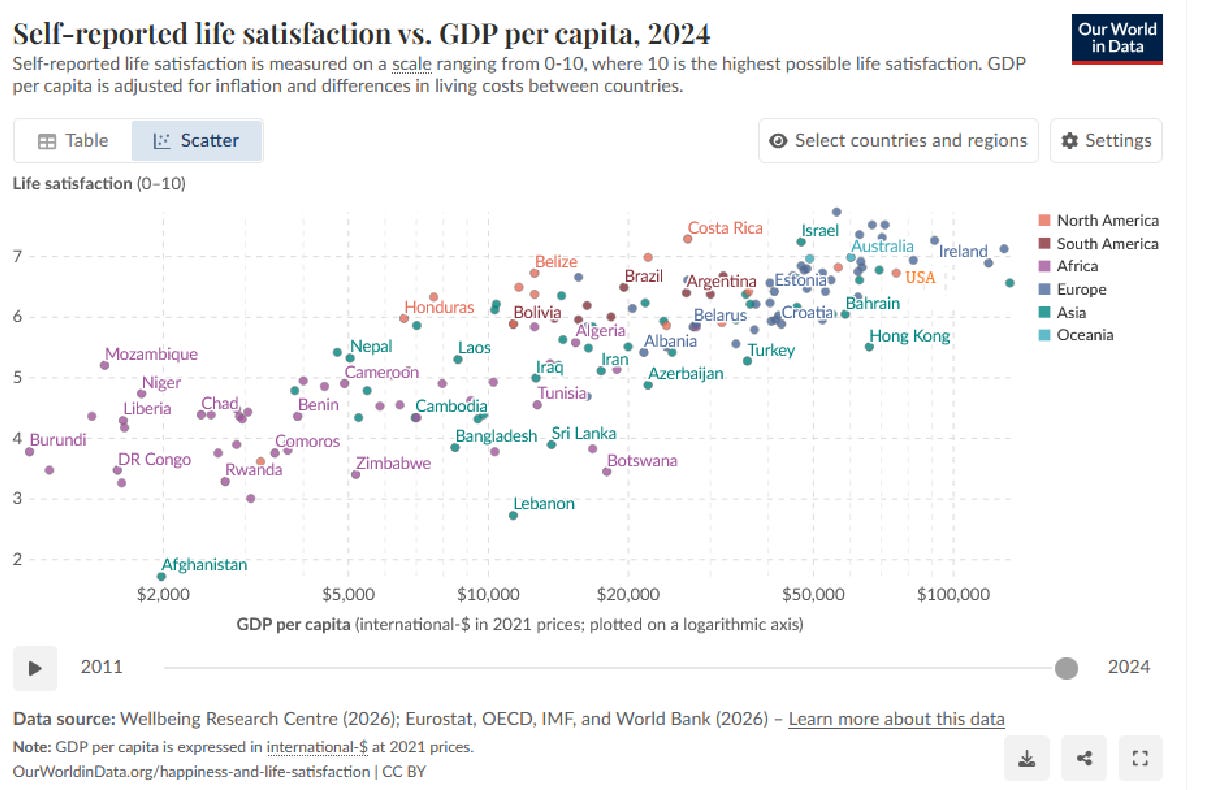
But redistribution can only go so far; there’s no scheme for redistributing the income in Burundi which will make the average Burundian as rich as even a poor American. And Belgium, the country with the highest level of redistribution in the world1, has a happiness rating on the graph we’re both using of only 0.1 points higher than the US, despite a similar GDP per capita ($60,000 vs. $75,000 according to the constant international dollars used to make the chart, although more like $60,000 vs. $90,000 in real life). So at current margins, going from US levels of redistribution to match the most redistributive First World country might gain 0.1 - 0.2 points of happiness, assuming that US redistribution programs were implemented as well as Belgium’s are2.
(remember, the difference that Pritchard was mocking as trivial above - quadrupling income - corresponded to 1.2 points).
Why does redistribution matter so little? I think Pritchard’s comment about log(income) above, while correct in direction, doesn’t grapple with size. Suppose that we redistribute all billionaire wealth in the US to poor people. Under the simplest version of this - invest it all in a sovereign wealth fund making 3%/year and give the interest to the bottom 20% - the average poor person’s household income goes from about $20K to ~$25K-$30K, the bottom quintile’s happiness goes up by log(30,000/20,000)*observed_slope = 0.28, and total national happiness goes up by ~0.05 points on our 1-10 scale3.
(again, Pritchard previously dismissed a 1.2 point difference as insignificant).
I don’t see “grow the economy” and “do redistribution” as opposing priorities. For a given willingness to redistribute, the dollar amount of redistribution you can do is entirely a function of the total size of the economy. You can’t change willingness-to-redistribute by an order of magnitude, both for practical/political reasons and because it’s already within a factor of 2-3x of the mathematically possible ceiling (eg you can’t triple tax rates on people who are already taxed at 40%). But you can grow the economy an order of magnitude - and countries have and will, again and again.
(I do think that you can, and should, increase the efficiency of redistribution, and might be able to get bigger gains out of this, but this doesn’t trade off against economic growth, and liberalism of course also endorses efficiency.)
Pritchard says we should pursue redistributive policies “even if they have negative effect on growth”. I think this is a manifesto for eating your seed corn. In order to squeeze out an extra 0.05 - 0.2 points now, we should permanently disable the motor that has lifted society by 3 whole points over the past few centuries - indeed, the same motor that will power her redistributive programs a century hence. This is a good way to get a trivial electoral gain today, while being cursed by your great-great-grandchildren. I would die of shame if I knowingly made this tradeoff.
She thinks my claim that policy differences matter less than culture differences ignores some counterexamples:
Right off the bat, he compared Finland and Israel against the USA—this elides how big the differences can be between the countries that get policies/culture right, and those that “screw them up.” For example, Botswana is slightly richer than Belize, but Belize is 3.27 points higher in life satisfaction. That 3.27 point difference is
functionally the sameas Alexander’s estimate that, “since the medieval era...happiness should have increased about three points on a 1-10 scale” thanks to economic growth. So even if you buy that growth has bought humans three extra happiness points since 1000 CE, you could apparently get that same boost just by being more like Belize instead of Botswana—today, without waiting a thousand years.
Since we’re talking about the effect of policy (and income) in the US, I think it’s more helpful to base our comparisons off the US than off Botswana. The 1-10 point scale is distorted - real happiness is likely logarithmic - which means that the 7-8 range of the 10 point scale should be interpreted as in some sense bigger than the 3-4 range. I’m trying to respect the weirdness of the scale by judging the possibility of interventions in the US by other countries close in income to the US - comparing Belize to Botswana makes it harder to adjust for the graph’s deceptive scale.
(as demonstration, consider that if we naively imagined that improving US policies could bump us up by 3.27 points - the same as improving Botswanan policies to be more like Belize - then the US would rank at 10.1 on a 1-10 scale4, which is impossible. If either Pritchard or I were virtuous, we would be subjecting all of this to some sort of horrible logarithmic transformation before talking about it; absent that virtue, the best we can do is try to extrapolate from countries like the ones we’re considering, rather than ones in a wildly different part of the income distribution)
But also, a glance at the full-color graph gives some hints to why Belize is so happy, and it’s not policy:
All Latin American countries rank unusually highly, from El Salvador (controlled by a right-wing dictator) to Nicaragua (controlled by a left-wing dictator) to Belize (controlled by a centrist democracy plus some legacy British colonial institutions). Rather than speculate that Belize has solved policy, we should assume that Latin Americans are dispositionally sunny, which also matches my observations of most Latin Americans I know. This can’t be imported to the US by policy fiat.
(except by importing the Latin Americans themselves; the reader may decide whether liberals deserve credit for this happiness-increasing policy).
Finally, even if despite these cautions we were to accept Pritchard’s comparison at face value and attribute the 3.27 point Botswana - Belize difference entirely to policy victories that could be replicated in America, the proper expectation would be half that - 1.63 points. Pritchard got her high number by comparing an outlier low country to an outlier high country, but America is neither anomalously low nor high. So it couldn’t benefit from ditching Botswana’s anomalously bad policies5, and could only reap the gains from adopting Belize’s anomalously good ones - thus, half her previous estimate.
I continue to think that looking at the range of countries similar in culture and income to America makes a better comparison, unless Pritchard genuinely believes there’s something special about Belize’s policies - in which case she should explain what that is.
Contra my claim that economic growth is stable and policies variable, economic growth is not stable.
But Alexander also overstates the extent to which growth is stable, and other policy unstable. For one thing, deep and enduring declines in output are possible even outside of state-collapse scenarios.
[Greece lost about a quarter of GDP per capita in just five years]after the 2008 financial crisis. This wasn’t the result of a civil war, or a revolution, or state collapse. Greece was a relatively high-income liberal democracy that simply cratered due to bad policy and external economic shocks. Growth dividendscanbe reversed through bad governance,contraAlexander’s “growth is stable” formulation.
I agree that Pritchard could find one example of this, but the question hinges on whether this is an unusual deviation that she had to work overtime to find, or a relatively common occurrence in the natural order of things. We can check this graph:
Only a tiny handful of countries, mostly war-torn near-anarchies, saw negative growth over this period.
Also, I’m happy to report that Greece is now almost back to its 2008 GDP per capita. Losing eighteen years is obviously still bad, but on a purely evidential level, I think this suggests the crash put them below their capacity in a way that allowed them to regress back to the mean later.
Conversely, policy can be durable. Social Security and Medicare have survived decades of hostile-party governments. When you establish a popular redistribution regime in a democratic state, it can be pretty fucking tenacious. The Nordics have also largely retained their ample welfare states; there has been some degradation at the margins, but the core policies remain intact, and people in these countries are the happiest in the world.
Again, I think this attempts to replace nearby relevant examples with far-off irrelevant ones. The Nordic countries may have a deep historical disposition to ample welfare states; meanwhile, in the US, the most impressive welfare state expansion of my lifetime, Obamacare, was hobbled within ten years, and Trump has reversed most Biden-era policies out of some combination of general principle and spite. If a Democrat w…