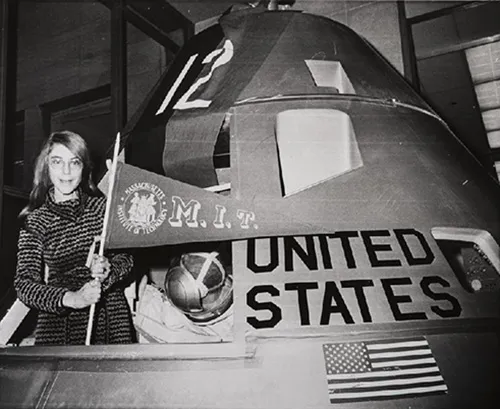
One of my favorite historic pictures is a young, happy woman standing next to what is essentially a tally of computer code. This image shows the reason we made it to space and why you can read this article right now. In 1969, Margaret Hamilton was a computer scientist who ran the software engineering division of MIT’s Instrumentation Laboratory. For the previous eight years, they’ve been contracted by NASA to develop Apollo’s program guidance system. Much of her work helped popularize software engineering. All those computer science pros who made it big in Silicon Valley should be thanking this woman. Many of them don’t even realize she existed.
This image was taken by the staff photographer at MIT in 1969, annotated with the caption “Here Margaret is standing besides listings of software developed by her and the team she was in charge of, the LM [lunar module] and CM [command module] onboard flight system software.
Looking at this photograph, I am reminded that our word computer used to mean a person. The term was derived from the women who worked in businesses on computing, literally adding and subtracting numbers for ledgers. Similarly, I am reminded that our earliest codes were the tools used to create weavings. Basically, they developed systems to make the looms run algorithmically. British scholar ada love lace in the 19th century took this tapestry skill and developed some of the earliest code.
Unlike those historic mathematical advancements that diminished the importance of female labor, this photograph of Hamilton treats her as the colleague she was. She does not have to dress in a pantsuit like a man. She does not have to diminish her style. She would keep her hair in that 1960s side part for her whole life. As the caption suggests, this is a picture of a team leader whose group has created a mountain, or in this case a measuring stick, of essential work.
Hamilton studied mathematics with a minor in philosophy. Raised in Michigan, she said her poet dad and her headmaster grandfather made her want to take philosophy. When still a grad student at Brandeis, she was poached by MIT to work in their software lab. She’d never get her degree but certainly it was no barrier to her university work.
There are other pictures of Margaret from this time, one with proceeded at a computer that’s larger than a hatchback. Another photo shows her again in her iconic side profile, working on a mock-up of what the astronauts would use in space.
In an era when it feels like so much of women’s advancement requires us to conform, or to be serious all the time, the palpable joy in these photographs of Hamilton is such a pleasure.
Margaret Hamilton died September 30, 2026. She was 90 years old.