Quick note—Substack moved quickly and deplatformed the person imitating me—good news! Thank you to anyone who reported the false account.
“It is not the strongest who command respect, but the calmest’ ~ Marcus Aurelius
On this day in 1867, the U.S. took formal possession of Alaska from Russia after paying $7.2 million in the Alaska Purchase. What a deal!!
Hide-and-Seek was fun growing up; getting found was disappointing, but nothing worse. In fact, how many times would you give up and come out if it took too long to find you?!
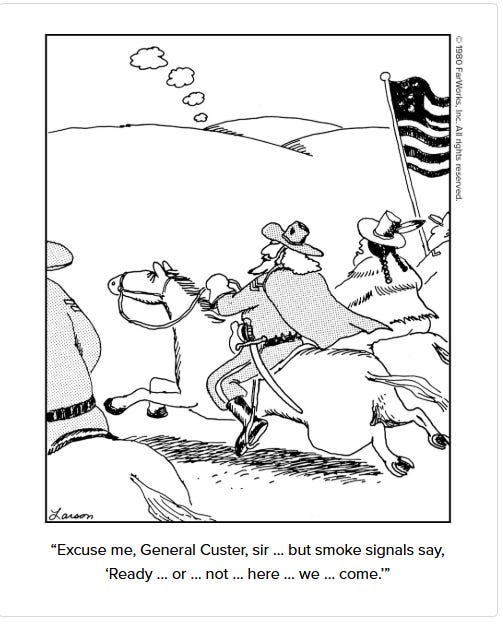
Sadly, it's not quite so easy or fun in the real world. Going back to Custer’s last stand depicted in Gary Larson’s brilliant Far Side, there is often an inevitability to events, consequences be damned. The midterm elections are 2 weeks away, and the Democrats will control at least one House. The Houthi menace ( sounds like Star Wars, no?) is growing and causing political as well as economic damage to the KSA. Israeli elections are next week, with the potential to change the government there. Massive riots are ongoing in France and India. “Other than that, Mrs. Lincoln, how did you enjoy the play?” * Caveat emptor* my friends.
**Duration:**Fade the long-end rally until the 27-28 October FOMC. The bid in the 10-year is growth fear, and the 2-year at 4.74% still prices in a hike.**Sector:**Long energy and staples against technology. Technology gave back 7.16% on the week, and the earnings tape has not yet confirmed a turn.**Credit:**High yield sits at the stress line. Two prints above it, and the growth-scare call wins the argument.**Where the tape is wrong:**The market is pricing growth into the long bond and inflation into the front end. Both cannot be right for long.
The S&P 500 closed Friday at 7,659.44, down 1.95% on the week. The Nasdaq 100 proxy fell 5.52% and the Russell 2000 proxy fell 3.05%.
VIX closed at 19.99 from 14.84. The 10-year closed at 5.09%, down 15bp, the 30-year at 5.43%, down 17bp, and the 2-year at 4.74%, down 6bp.
The September 2026 PPI rose 1.3% month-over-month and 6.3% year-over-year. Core CPI rose 0.3% against 0.2% expected.
Brent settled at 109.86. Bitcoin closed at 81,501, down 1.27% on the week.
Technology fell 7.16%. Energy rose 4.47%. Consumer staples led with a 5.37% gain.
The week was supposed to be about inflation, and it turned out to be about money. The hottest producer print since early 2023 arrived on Thursday and the dollar fell anyway. The stock market lost two percent, with the damage concentrated in the names that borrow to build. CoreWeave lost a quarter of its value, and its five-year default insurance widened to 1,117bp.
That is a financing story wearing a macro costume. Whether it stays one depends on the next two high-yield prints and the Meta and Tesla calls on Wednesday.
The regime moved this week from ‘soft landing with a hike in the back pocket’ to ‘inflation shock absorbed by the long end while AI financing resets equities.’ Monday’s regime had the Fed patient. Friday’s has a December hike near consensus and a bond market that still rallied through the worst inflation data of the cycle.
Equities. S&P 500 down 1.95% on the week to 7,659.44. The Dow Jones ETF gained 0.58%, the Russell proxy fell 3.05% and the Nasdaq 100 proxy fell 5.52%. Semiconductors fell 10.53% on the week. The index held up because the Dow and the energy complex carried it. Breadth was the weak part: sixty-eight of seventy-five technology names closed lower on Friday.
Rates. The 2-year closed at 4.74%, down 6bp from 4.80%. The 10-year closed at 5.09%, down 15bp from 5.24%. The 30-year closed at 5.43%, down 17bp from 5.60%. The 2s10s spread flattened to +35bp from +44bp. The curve bull-flattened on a week when the Fed’s own pricing moved toward a hike. That is the asymmetry I am watching: the front end still reads inflation and the long end reads growth.
Credit. High-yield spreads widened through the week and ended at the stress line. Investment grade widened by a few basis points. The widening sits in AI infrastructure. Goldman Sachs and JPMorgan both reported and the market split them on trading revenue against securities losses.
FX. The dollar index fell about 0.5% on the week after touching roughly 103.00 on Wednesday. It closed near 101.8. The dollar gave back a hot-inflation move inside two sessions. A positioning read has to explain that first.
Commodities. Brent settled at 109.86 and the United States Oil Fund gained 9.15% on the week. Natural gas fell 3.18%, with the fund at 10.66. Gold held, with the gold fund down 0.18% to 382.01. The energy complex is pricing a supply shock and the gas complex is not. That gap is the most interesting cross-asset fact of the week.
Volatility. VIX closed at 19.99, from 14.84 on October 9, with an intraday high of 22.31. Hedging demand came back into a market that had been under-hedged into the CPI print. The move is real and it is not yet a panic.
FLIGHT CHECK. Haven flows were mixed. Treasuries rallied, a haven bid. Gold barely moved, so it was not one. The dollar weakened, which is not a haven signal at all. The equity tape sold off hard into Friday with the long bond bid. The cleanest read is that the haven was in duration, not in dollars or gold, and that the duration bid reflects growth fear rather than a Fed pivot.
The week-ahead regime call. Bull flattening on hot inflation, led by credit and the AI complex, with the Fed on hold until the 27-28 October meeting. The long bond is the growth hedge and the front end is the inflation read. The regime turns if the front end follows the long end lower.
The case against this call: the bond rally is the market telling the Fed it has done enough, and the front end is wrong to price a hike. The other read is that the long end is a term-premium repricing, not growth fear, and then the rally is a fade.
I’M WRONG IF the 30-year closes above 5.60% without the 2-year moving with it. That would say the CPI spike was the signal and the rally was a one-day event.
The October 9 issue got the shape of the risk right: PPI, credit and duration. It put the stress in banks and small caps, and it arrived in semiconductors and AI credit instead. Small caps did fall, 3.05% on the week, so the bank call was half right.
Verdict: right on the shape, wrong on the location. The growth-scare cell moved up for the right reason: credit and volatility, not payrolls.
Every line above this one is free. Three Saturdays a month, the rest is paid: the book sizes and stops, and the full netting, live in the paid edition. Subscribe at marketmusing.com.
Disclaimer: Opinions are mine alone and may change. It does not constitute an offer to buy or sell or a solicitation of an offer to buy or sell any security, loan or asset or to participate in any trading strategy. It is not intended to form the basis of any investment decision, should not be considered a recommendation, and does not constitute an offer or solicitation with respect to the purchase or sale of any investment, nor is it a confirmation of such terms.