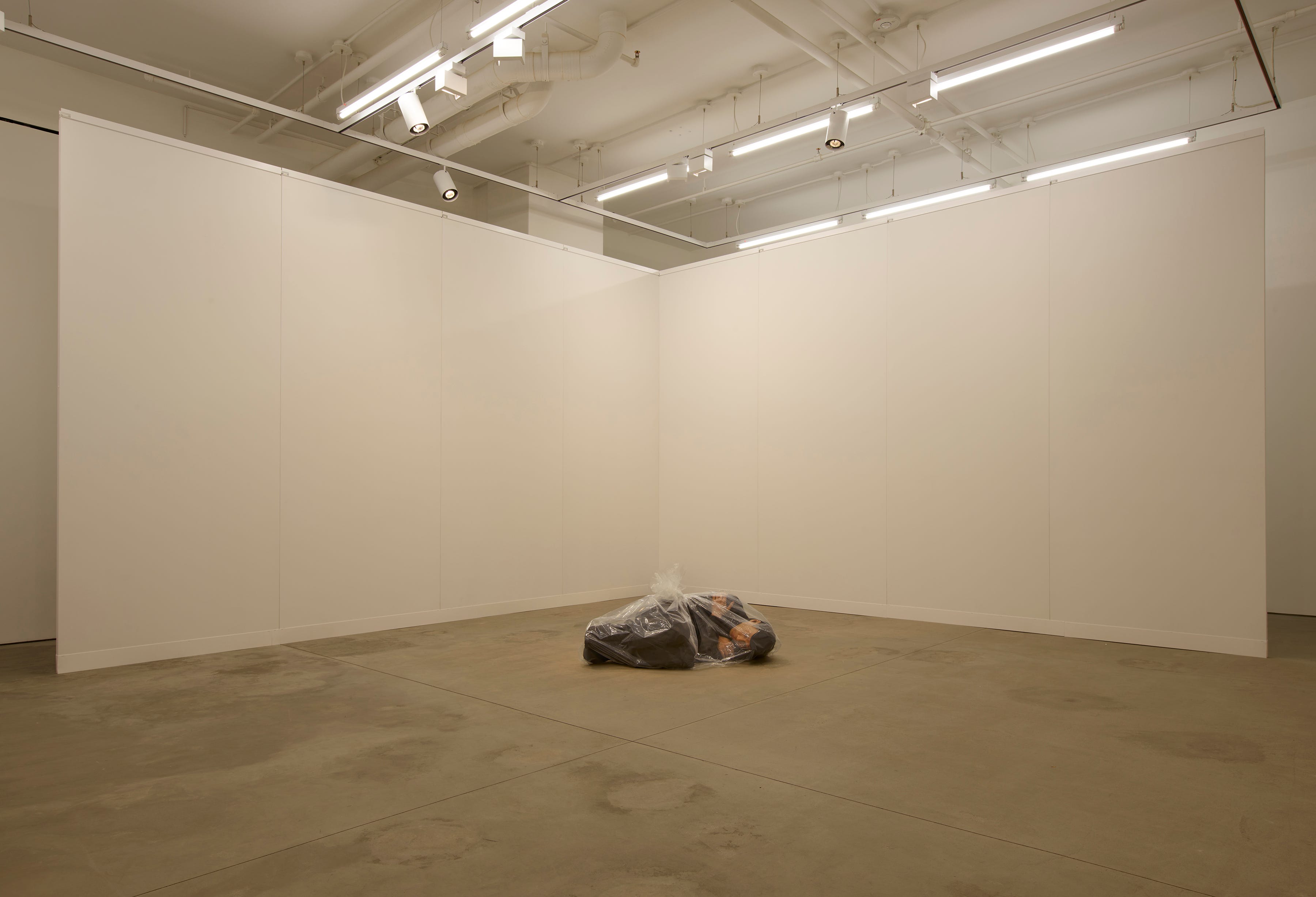
In 1972, John Berger wrote Ways of Seeing taking off from the eponymous show produced by the British Broadcasting Corporation in which he uncovered the biases and blindspots that lay at the heart of how we are encouraged to see and consume modern art and culture. Half a century later, American sculptor Josh Kline’s article, New York’s Real Estate and the Death of American Art, published in October, in an academic art journal published by MIT Press, attempts to offer a similarly barebones look at the art market.
The real estate market of New York is pricing out experimental, young artists, leaving behind a legacy of overpriced, decorative artworks that fail to push the envelope, Kline writes, and adds that even successful mid-career artists like himself are downsizing or closing studios.
Tracing the impact of inaccessibility to affordable real estate on everything from the kind of art being made (fewer and fewer large-scale sculptures, for instance) to the prices in the primary and secondary markets (falling, a recession is on the way), Kline’s piece expands the scope of art criticism to “industry criticism”.
“Any conversation about New York City real estate and how it shapes the art of our time must confront class and race. Artists from poor, working-class, or middle-class backgrounds tend to be excluded thanks to New York’s high rents and cost of living. Artists of color coming from lower-economic-class backgrounds, especially Black, Indigenous, and Latino artists, whose families were historically excluded from the generational wealth creation during the New Deal boom years from which their white peers benefited, are also filtered out. Their ideas, concerns, and perspectives are filtered out at the same time,” he writes.
At the heart of his argument lies an impassioned plea to save art from market-oriented, upper middle class curators and/or professionals who run art institutions, and rich collectors who buy art as investment alone—the twin poles of a force field that warps all art practice that comes in contact with it.
Artists alone can lead the way, Kline writes. They may not be able to do much about real estate rates or art prices, but their collectivising is essential to saving the art industry, he contends. “In non-commercial artist-run spaces, artists hold a final veto on decisions about who exhibits, what a show is, and what art can be: Dealers, institutional curators, and educators do not get the final call.”
When the gatekeepers are kept out, the impetus is not to sell but to create ambitiously and expansively, he writes.
And yet, given the increasing scarcity of such spaces—something he and his peers, coming up in the early 2010s, did not face as much as the younger cohort does today—Kline asks us to consider a significant question.
“What would a twenty first-century American art world look like in which many different kinds of artists—not just well-off, market-approved white painters—put forward arguments about what contemporary art could be? What would happen if these questions were reclaimed by artists and taken away from the art industry?”
Perhaps Kline’s response to the obscene sums of money which circulate in Western art markets of the United States, United Kingdom and Europe, and the Chinese art market—the third largest in the globe—isn’t so surprising.
According to the Art Basel and UBS Art Market report released last month, although sales in the US were still below their peak in 2022 and pre-pandemic 2019 levels, they still grew 5% year-on-year led by high-end art sales. The combined value of fine art works sold at auction for over $10 million increased by nearly 40% in the US, bringing the overall value of the market to a whopping $26 billion in 2025. Sales in the UK reached $10.5 billion in 2025, up 2% from 2024.
Sales in China increased by over 1% to $8.5 billion.
In light of these numbers, the question Kline asks about what would art, produced predominantly outside market considerations look like, seems rhetorical and dare I say, almost quixotic. But it is vital, because such vast sums of money have little to do with the political, world-changing aspects of art.
Real estate seems to be on the mind of Sudheer Rajbhar too.
The founder of Chamar Studio, a product design studio that employs Dalit and Muslim leather workers who found themselves out of work after Maharashtra banned the sale of cow meat in 2015, rued that only a few workers versed with leather remain in Dharavi — a slum in the heart of Mumbai that was once the hub of small-scale and cottage industries, including tanneries. What’s more, Rajbhar told me at a recent mixer of curators of the upcoming Serendipity Arts Festival, he finds it difficult to even rent a studio in Dharavi because of the increasing costs.
“Earlier a small 10x10 square feet place would easily fit 5 to 7 workers. Now they find it impossible to find even this much space because of the rising costs,” Rajbhar says. The closing down of tanneries has also forced many workers to move out of Dharavi. The rising costs have also made it impossible for him to fulfil his life-long dream of building a materials-based art school in the area because to do so will be too expensive to rent, he says.
The designer started his studio in 2017, and uses recycled tyre material (recycled in Dharavi) mixed with pigment and rubber to create a range of products which are stocked in high-end stores, shown across the globe in fairs like Design Miami (where Rihanna famously plonked herself on one of his creations), and praised by people like 𝕏Rahul Gandhi who celebrate his innovation and industry.
But redevelopment, Mumbai’s age-old story, is snapping at the ankles. Adani’s project vehicle, Navbharat Mega Developers Pvt. Ltd., will develop 151 acres (61 hectares) of Dharavi’s 641-acre sprawl to rehouse residents, while another 118 acres is expected to be used for offices and apartments that will be sold in the open market, and the rest will be allocated to public infrastructure, according to a Maharashtra government presentation on the masterplan in May 2025. The urban renewal project—as it is being called—is expected to cost the firm $11 billion over seven years. The plan, according to Adani Realty Managing Director Pranav Adani, is to convert the narrow lanes into a township with “spacious layouts, dual toilets, open spaces, schools, hospitals, transit hubs and parks”.
“The first problem that no one discusses is the beef ban and how it affected the leather industry, and the second problem is the upcoming demolition,” Rajbhar says. The designer now has his recycling machinery in Turbhe, another far-flung suburb of Mumbai. “Dharavi is a huge space, but it’s not just about industry, it’s a whole cultural ecosystem. Instead of demolishing the warehouses, these occupations should have been regulated better. That’s real development for the people.”
Much like Kline, Rajbhar’s concerns also circle around a larger loss: the entry of a real estate mogul and the meat-ban law have done more than shift people out of their area of work; it has facilitated the disappearance of specific skills and artisanry.
Artist M Pravat’s long-time pre-occupation has been the shifting urban landscape that turns residents into palimpsests: we are nothing if not shaped by the architecture and the forms that surround us, his canvases have consistently reminded us.
His latest set of works, up at Gallery Espace in New Delhi, is titled Urban Sedimentation and builds on his practice of using debris, bricks, mortar and other construction material that the artist recovers from building sites and processing them into material that eventually goes into his work with other kinds of material like slate and rubber. In effect, the works—an ongoing collection which the artist hopes will be “never-ending” and one day adorn the wall of a large institution in a line, from top to bottom—resemble the city broken down into pieces of a jigsaw. Relentless urban expansion reshapes human sensibilities, the artist reminds us.
Dhamini Ratnam is culture editor at Hindustan Times. Ways of Seeing is her weekly newsletter that takes you through only the most important cultural happenings you need to know of. You can write to her at dhamini.ratnam@htlive.com or comment on this newsletter below.