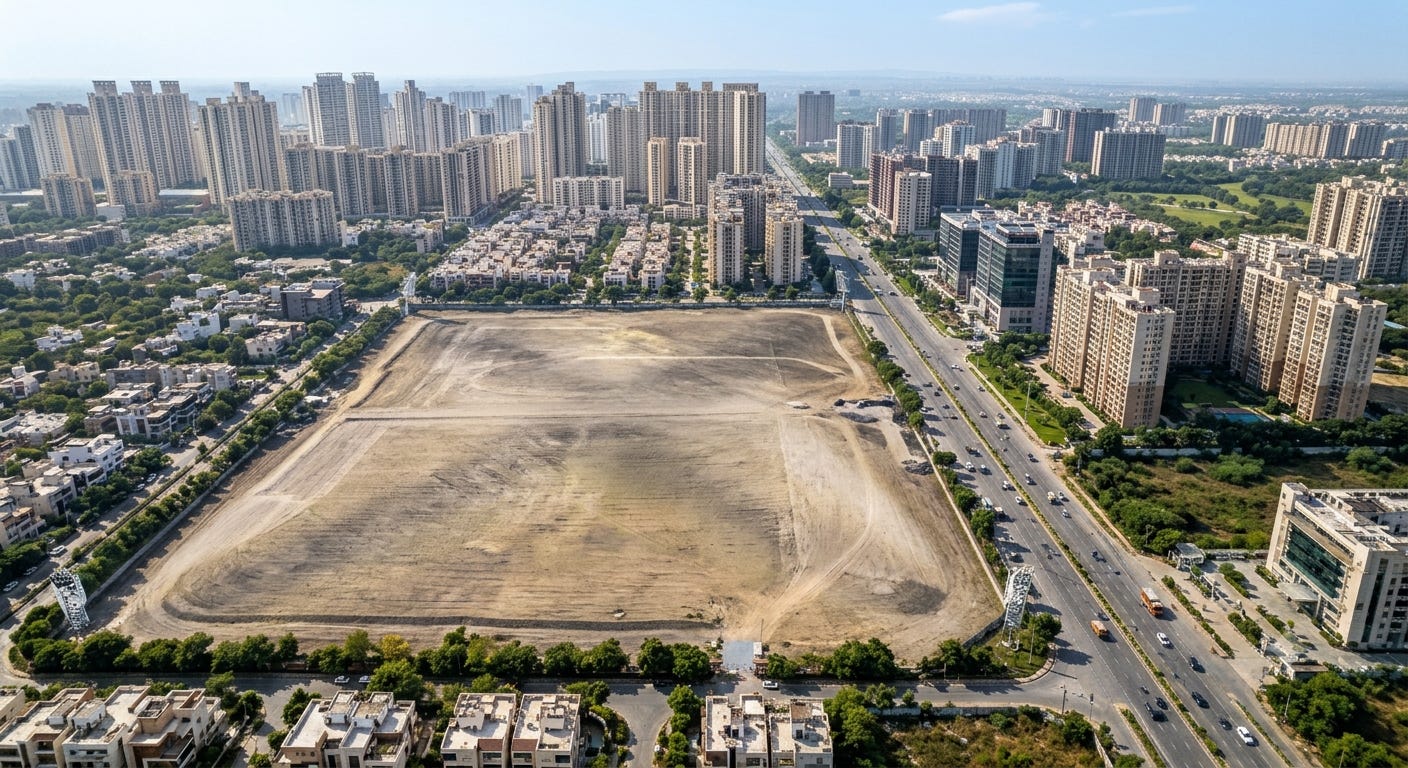
Land acquisitions by real estate developers declined 56% year-on-year to 1,445 acres in the first nine months of 2026, reflecting a more cautious and selective approach towards expansion. Rising land prices, construction costs and tighter project economics are prompting developers to scrutinise parcel sizes, locations, connectivity and demand prospects before committing significant capital.
Instead of aggressively building land banks through outright purchases, developers are increasingly turning to partnership-led models, such as joint development agreements (JDAs), which allow them to access land without the upfront financial burden of acquiring it. Experts say the shift reflects a growing emphasis on capital efficiency, risk management and project viability, with developers prioritising strategic acquisitions and execution over expansion at any cost.
According to Anarock Research & Advisory, developers concluded 76 land deals covering approximately 1,445 acres between January and September 2026, compared with 99 deals spanning 3,292 acres in the corresponding period last year. JDAs accounted for at least 19 of the 76 transactions, or one in every four deals, highlighting the growing preference for partnerships with landowners.
The data points to a sharp decline in large land transactions. Deals involving parcels of 50 acres or more fell from 12 in the first nine months of 2025 to just five in the same period this year. The combined land area involved in these transactions dropped from approximately 2,398 acres to 588 acres.
Experts believe the current environment is prompting developers to reassess their expansion strategies. Rising land prices, construction costs and concerns over project economics are making outright land purchases a more calculated decision.
Geopolitical uncertainty has added to these concerns. Prolonged tensions in West Asia, including the US-Iran conflict, can affect energy prices, logistics, construction material costs and overall business confidence. Committing substantial capital to land without sufficient visibility on future costs and project returns could therefore become a risky proposition. Experts point out that housing launches across several major Indian cities have remained healthy in the post-Covid period, prompting developers to focus on optimising acquisitions rather than pursuing aggressive expansion. Geopolitical uncertainty has further contributed to this recalibration of land-buying strategies.
A noticeable shift is also emerging in how developers access land. Under joint development agreements, developers partner with existing landowners instead of purchasing land outright, sharing the developed area or project revenue. The preference for this model has been growing steadily. The number of JDA transactions increased from 10 in 2022 to 30 in 2025. Their share of total land deals rose from around 12% in 2022 to nearly 24% in 2025 and 25% in the first nine months of 2026, Anarock data showed.
Experts say the growing preference for JDAs is closely linked to the importance of project economics. By partnering with landowners, developers can avoid substantial upfront land acquisition payments and preserve capital for construction, statutory approvals, marketing and other project-related expenses. In an uncertain market, this approach offers greater financial flexibility and allows developers to share project risks with landowners.
The slowdown in land acquisitions does not mean developers have stopped looking for expansion opportunities. Instead, the geography of transactions indicates that emerging markets continue to attract interest, with some of the largest land parcels being transacted in tier-2 and tier-3 cities. Between 2022 and September 2026, the Mumbai Metropolitan Region (MMR) led cumulative land acquisitions with approximately 2,798 acres, followed by the National Capital Region (NCR) at 2,012 acres and Bengaluru at 1,679 acres, according to Anarock. Experts note that developers are likely to favour partnerships, smaller acquisitions, and locations with greater visibility into demand as geopolitical and economic uncertainties persist.
For homebuyers, the shift towards more selective land acquisitions could translate into a more measured supply pipeline, with developers focusing on locations where housing demand, connectivity and infrastructure support project viability. A more disciplined approach to land buying could also encourage developers to prioritise project execution, financial planning, and delivery commitments rather than aggressively expanding their portfolios.
However, a slowdown in land acquisitions does not necessarily mean lower property prices or reduced housing costs. Land remains a significant component of development costs, particularly in established urban markets, while construction expenses and infrastructure-related costs continue to influence pricing, say experts.
The growing use of JDAs could help developers manage upfront costs, but the extent to which these savings are reflected in home prices will depend on landowner revenue-sharing arrangements, development costs, market conditions and the pricing strategies of individual developers, they say.
For buyers, the key considerations will remain the location, the developer’s financial strength, project approvals, construction progress, and delivery track record. In a market where developers are becoming more selective about acquisitions, homebuyers may also see a greater emphasis on projects with clearer demand and stronger execution potential. The broader shift points to a real estate market where expansion is increasingly driven by project economics and capital discipline rather than the size of a developer’s land bank.