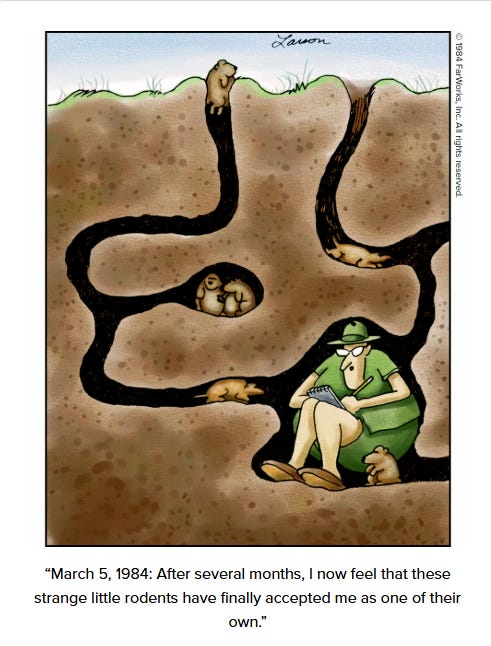
"The first principle is that you must not fool yourself and you are the easiest person to fool." Richard Feynman
People have a seemingly infinite ability to fool themselves, or to convince themselves of a ‘reality’ that is not quite true. We have lots of names for it, many of them borrowed from science: ‘confirmation bias,’ ‘cognitive dissonance,’ the ‘backfire effect.’ Kahneman called one version ‘the illusion of validity,’ and then there is the Dunning-Kruger effect. Echo chambers and opinion masquerading as news accelerate all of it. Of course, we only notice when other people are doing it! * ‘Not me!!’* we all say to ourselves. ‘I’m thinking logically and clearly.’ Were that the case. No, really, the rodents have accepted me….
As in life, so in markets. We ‘fit’ market action to confirm our pet theories, and we assign catalysts well before the truth is known. The market is a tough grader. Be too stubborn and you won’t last long, but knowing that doesn’t seem to change the behavior. We all know people who could not adapt or accept they were wrong, and who are now selling real estate or coaching high school sports.
I wonder whether the explosion in AI use helps or hurts. Is it just a more powerful way to convince ourselves we are right, or can it show us some clarity through the fog?
**THE INDEX IS TWENTY STOCKS WEARING FIVE HUNDRED NAMES.**Equal-weight is back on its 2025 low. I take no index beta. I’M WRONG IF the equal-weight ratio closes a week back above 0.2871.**THE MARKET SOLD THE WRONG FINANCIALS.**Agentic shopping threatens distribution, not throughput. I like Goldman from the long side and BlackRock from the short side. I’M WRONG IF high yield widens through 290bp.**THE FRONT END STILL OWES THE FED ONE MORE HIKE.**Diesel and the OECD both argue for the dots. I stay short the 2-year. I’M WRONG IF the 2-year closes under 4.55 percent.
I think the market has mistaken a very good quarter for twenty companies for a very good quarter for the economy, and the tape is starting to say so in places that are easy to miss because the index itself looks fine.
THE SETUP.
The S&P has gained 93 percent since ChatGPT’s release in November 2022, and nearly three-quarters of that came from 20 mostly AI-linked companies, led by Nvidia (Bloomberg).
Equal-weight against cap-weight closed the week at 0.2752 on the weekly chart. That is the 0.2755 line that marked the 2025 low, inside a channel that has run down since the start of 2023. The 200-week average sits at 0.3121.
Since March 2025, cap-weight is up about 34 percent and equal-weight about 21. More telling is the 90-day correlation between the two: 0.70, down from 0.95 as recently as July 2025.
Tech’s ratio to the S&P is back to 0.2538, above the 0.2413 50-day average and closing on the May high near 0.26. Equal-weight tech against cap-weight tech fell to 0.3391, under its 50-day. The rally inside tech is narrowing too.
THE ARITHMETIC OF THE PRIVATE SIDE.
OpenAI, Anthropic, and SpaceX together carry a valuation of about $5.2 trillion, compared with $4.1 trillion for the combined first-day value of all 3,365 US tech IPOs from 1980 to 2025 (FT, via Steve Rattner). Some of that paper is coming to market. The rest is being financed: SoftBank is paying record yields on one of the largest junk sales ever to fund its AI push, and bond buyers are asking more from Alphabet, Meta and Nvidia on AI debt (Bloomberg).
WHAT YOU ARE PAID FOR IT.
Goldman puts the US implied equity risk premium at 2.8 percent and the world at 3.1, levels last seen in the late 1990s. A 10-year at 4.96 percent is competing directly with that. Equities also sit about one standard deviation rich on their own valuation history, gold further out still, and Treasuries cheap.
WHY IT MATTERS FOR A PORTFOLIO.
An index hedge no longer hedges the average stock. At a 0.70 correlation, a short S&P futures contract protects the 20 leaders far better than the 480 names below them.
A long-only book benchmarked to cap-weight has to own more of the leaders every week just to keep up, and that flow is what holds the ratio down.
I would rather express the narrowing through what sits underneath it (financials, staples, the fee layer) than fight Nvidia directly.
**THE EVIDENCE.**Tuesday supplied it. Analysts turned net negative on US earnings for the first time in 23 weeks, ending the longest run of upgrades since September 2021 (Bloomberg, citing a Citigroup index). Consumer weakness and rates were the reasons given. On the same session the Nasdaq printed a record. Revisions roll over first at the margin, and the margin is the other 480 companies in the index.**THE CASE AGAINST.**Narrow markets can stay narrow for years; this one has been narrow since 2023 and paid anyone who fought it to stop. The earnings behind the leaders are real (Micron, Sandisk and AMD are not 1999 balance sheets), and a revision index that flips negative after 23 positive weeks may simply be analysts catching up to a softer consumer that the leaders do not sell to. I would take that seriously if equal-weight had bounced off 0.2755. It has not bounced yet, and the correlation break says the two indices are no longer the same trade.
**09:45 ET, US flash PMIs.**Composite survey 55.25 against 56.0 prior. Europe beat hard at 53.1 against 51.7 expected. A US beat pushes the front end toward the dots; a miss hands the SOFR call buyers their argument.**The 5-year auction.**The 2-year came through with a two-tenths tail on Tuesday. A second tail with the 2-year rallying is the combination that tests the front-end short hardest.**Barr on housing, and Goolsbee.**The OECD this morning raised its 2027 US headline inflation forecast to 2.6 percent y/y, up 0.5pp, and penciled one more Fed hike this year (Bloomberg). Anyone softening the projection round moves the 2-year.**Trump and Xi in Washington, today and Thursday.**Expectations are low on purpose. Beijing’s probe into DeepSeek and Moonshot hit Hong Kong tech 1 percent overnight.**Hormuz, on paper.**Witkoff and Kushner met the mediators, and Iranian state media says Araghchi handed Witkoff Iran’s conditions for reopening the strait. Conditions are an opening bid. Transits ran about 38 percent of the pre-war baseline in the seven days to 20 September, and the Saudi bypass restarted Tuesday at a low rate. I want vessel counts before I believe the headline.**Diesel.**The Gulf Coast diesel crack cleared $100 a barrel in August against a normal $15 to $30, and diesel sits inside the delivered cost of almost every physical good (Apollo, Torsten Slok). Retail diesel is above $6.50 a gallon and the White House says an export ban is under discussion.
I think the inflation argument is cleaner than the market’s.
Alpine Macro has tariff pass-through past its peak and the AI buildout plus energy easing only in 2027.
Oxford has core PCE disinflation, y/y, pushed out to 2027 as well. That is two independent shops saying the relief arrives after the next four meetings, not before them.
The metals say the same thing from the other end: the industrial metals index is above 600, clear of the 400 to 500 range that held it from 2006 to 2024, and copper does not care what the dots say.
One product launch explains both the Nasdaq record and the 2 percent fall in financials. I want to own the side of that trade the market has not repriced yet.
**META.**Up 0.8 percent before the bell into day one of Connect. Muse, its shopping agent, went to number one on both app stores with over 902,000 downloads in six days, and Amazon has already blocked it (Bloomberg). An agent that shops for you is a toll on every business that lives on customers not comparing prices. News-site traffic is the preview: top US news sites drew 47.6 million visits in August, down from above 70 million in 2024 (Axios, Similarweb).
**CHARLES SCHWAB AND ALLSTATE.**Both fell more than 5 percent Tuesday while Goldman lost 1.03. The market sold advice, distribution and personal lines, the layer an agent substitutes for. It spared advisory and underwriting, which an agent cannot reach. I like the throughput side of that split and I am short the fee layer that has not lost its multiple yet.**GENERAL MILLS.**Reports this morning into a staples sector trading at 82.73, below both its 50-day and 200-day averages. Against the S&P, staples closed at 0.1070, the lowest on this chart and under every average. McCormick’s best analysts are cutting ahead of their own print. A volume miss here confirms the consumer weakness that just ended 23 weeks of upgrades.
Behind the wall this morning:
THE BOOK: 13 live lines, 1 new today, each with the factor it monetizes, its size and the condition that kills it, plus the two new lines that failed my reward-to-risk floor.
The two financials expressions, and the level at which I take the money-center bank that just sold off hardest.
The kill switch panel, nearest trigger first.
Everything above this line is free and stays that way. Below it are trade ideas and deeper dive, for 450 dollars a year at marketmusing.com, which is less than one bad lunch a month.