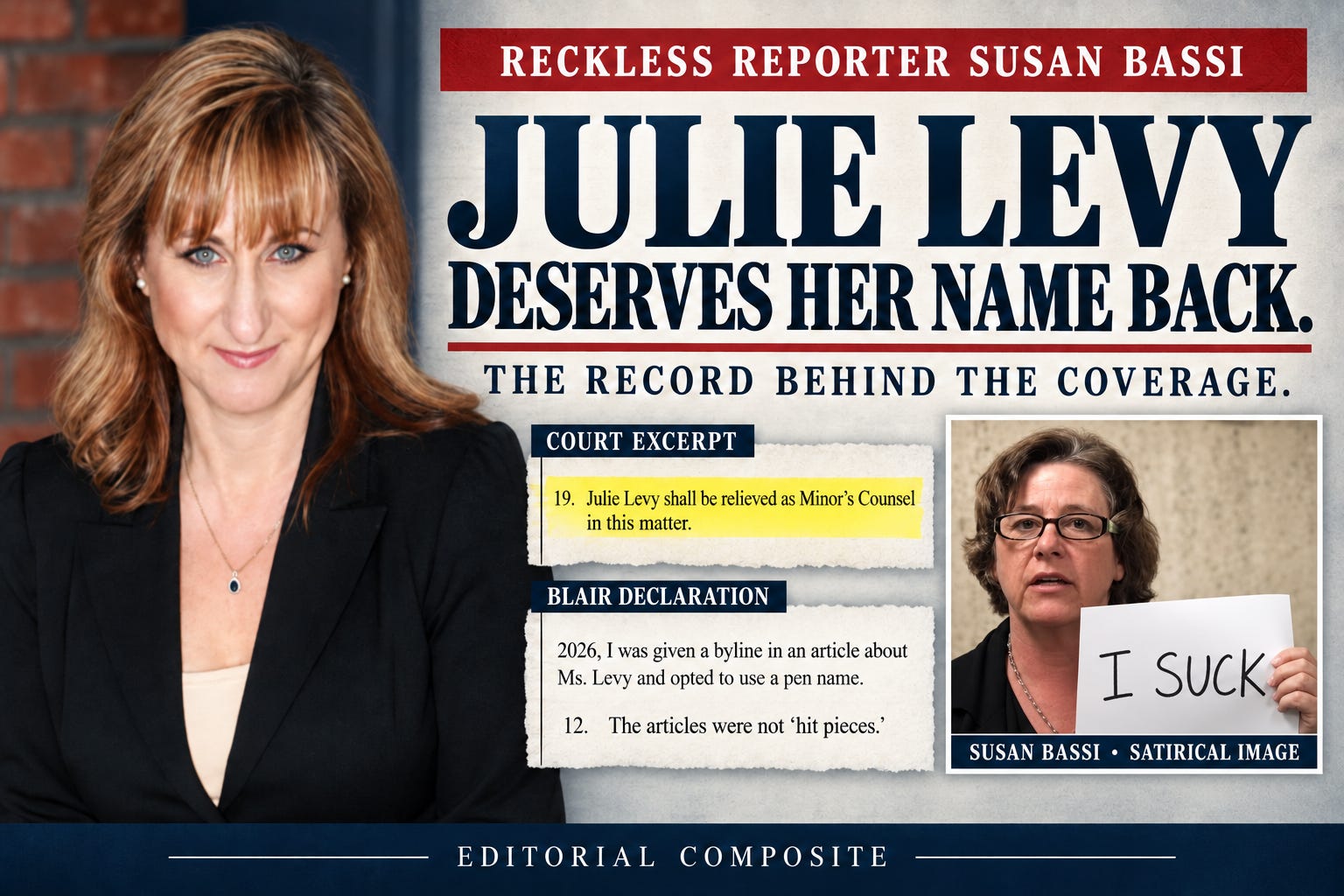
LUTHMANN NOTE: I want Julie Levy to get something the internet rarely gives back: a fair hearing after the pile-on. My criticism of Susan Bassi is no secret. Neither are the records reproduced here. An attorney’s court appointment ending cannot carry whatever accusation a reporter wants to hang on it. Asking for help with legal expenses deserves an honest account of why the request was made. Levy says she changed her professional life because she was afraid. That deserves more than another sneer from the cheap seats. In my view, this coverage failed her. Restoring the missing context is where repairing the damage begins. This piece is “Reckless Reporter Susan Bassi,” first available on The Family Court Circus.
Julie Levy was supposed to be teaching other California lawyers how to represent children. Instead, she says, she withdrew from the training because she was afraid for her safety. That is where this story begins: with a working attorney changing her professional life after becoming material for Susan Bassi’s brand of courthouse journalism.
“I did resign, and I’m not gonna be presenting this year due to my safety concerns,” Levy told me in a recent interview. Later, she described being frightened to look online. The California State Bar lists her as active, admitted in 2008, with no disciplinary action displayed. She says she began representing children in high-conflict custody cases after additional training in 2018.
Bassi’s coverage supplied a different identity: an attorney whose conduct deserved suspicion, whose departure from an appointment became disputed firing rhetoric, and whose request for assistance became an ethics story. Levy disputes those portrayals. The Davis Vanguard subsequently removed the challenged coverage and apologized. Its lawyer describes a settlement and broader concerns about defending Bassi’s work.
The records support a hard conclusion: ordinary procedural events and requests for protection were made to carry insinuations of professional wrongdoing they did not establish. Levy became collateral damage in a reporting operation that enlisted a former litigant with grievances against her. The damage she describes deserves more attention than the spectacle that generated it.
I have publicly criticized Bassi before. Readers deserve that disclosure. They also deserve the documents, Levy’s account, and a clear distinction between what the records say and what the coverage encouraged them to believe.
A court-appointed lawyer being relieved of an assignment is a procedural event. It does not, by itself, announce incompetence, corruption, or a disciplinary firing. California’s Family Code uses that precise term: appointed counsel continues representing the child unless the court relieves them through substitution or for cause. The reason is crucial.
Levy says Bassi transformed that distinction into “fired,” “pink slip,” and related characterizations. Her account is that a proposed decision contemplated ending her appointment, but she separately sought and obtained permission to withdraw before the final order because of the reporting and its effects. “So I was not fired,” she told me.
The preserved July 13 article actually says the court relieved Levy and acknowledges that the order does not explain why. Its reproduced court excerpt uses “relieved.” That article cannot be cited as containing every expression Levy attributes to Bassi’s wider output. The separate posts remain necessary to settle the exact language and context of those accusations.
But the central distinction already stands. A document ending an appointment supplies no automatic finding of professional disgrace. Readers who encountered firing rhetoric deserve the withdrawal papers, the operative order, and the court’s explanation, if any. A reporter cannot supply the missing judicial reasoning with a sneer.
This dispute concerns Levy’s appointment in the Espy/Reid matter. Her earlier representation in the Blair family case is a different proceeding. Combining the two into one seamless tale of professional failure compounded the distortion.
Levy’s position is specific and testable. She says she withdrew; anyone selling a disciplinary firing needs to produce the disciplinary finding. Susan Bassi failed to do so.
Levy’s request for public assistance was no secret, and she made that clear. She acknowledged asking for county representation and being turned down. She explained that she faced harassment arising from work the court appointed her to perform. Legal bills were accumulating. She asked whether the public institution connected to that work would help.
The July 19 article preserved in Blair’s exhibits quotes Levy explaining the connection between her official duties and the separate harassment proceeding. Readers should know that. The problem is what the article builds around that explanation: a heading announcing “RULES SHE MAY HAVE VIOLATED,” discussion of professional misconduct, and a description of her application as a “meritless emergency request.”
Those are judgments requiring their own foundation. Denying an application does not automatically establish that submitting it was dishonest, frivolous, or an ethical breach. Whether the county owed Levy representation is separate from whether she could properly ask. The published denial cannot do double duty as an unwritten disciplinary judgment.
Levy also explained why she thought assistance might be available: Nicole Ford had received county representation in her dispute with Bassi. The Ford order’s attachment identifies county counsel as Ford’s attorneys. Their situations need not be legally identical for Levy’s explanation to make sense. She was seeking a way to bear the cost of protection.
Bassi’s article instead presented the request as evidence that Levy placed personal financial interests ahead of a child. That conclusion needed more than a denied application and a list of ethical rules. The resulting insinuation was unmistakable: the lawyer seeking protection became the lawyer readers were invited to distrust.
One of the most useful documents for understanding Levy’s position comes from the opposing side. In a January 16, 2024 letter, Blair’s lawyer Brian Lanz urged the State Bar to reconsider a complaint involving Levy’s handling of subpoenaed records. He accused her of misconduct and argued that the court had reached the wrong result.
Then he acknowledged the result. According to Lanz, the Bar declined to proceed because the Sonoma County court declined to find misconduct and chose not to remove Levy. That is the account of an advocate trying to reverse the outcome, attached to Blair’s own declaration. It belongs beside the accusations whenever that dispute is retold.
The underlying ruling and Bar disposition would establish their exact scope. Lanz’s letter does not clear Levy of every criticism anyone might make. It does, however, puncture any presentation suggesting that the accusation itself was the official conclusion. The complaint had already encountered decisions its proponents did not like. Readers deserved to learn that history.
The trust-money accusation needs the same discipline. “I never took any money from the special needs trust,” Levy told me. Lanz’s letter describes Blair using refinancing proceeds to pay counsel and part of Levy’s bill, while challenging Levy’s accusations against Blair. A payment to an attorney and an attorney’s misappropriation of trust assets are different propositions.
Before branding Levy a thief, the reporting would need the transaction, the source of funds, the authority for payment, and evidence of her participation in wrongdoing. The financial records necessary to resolve that dispute were not supplied here. Repetition cannot fill the gap. Neither can outrage about the underlying custody outcome. Once again, Susan Bassi failed.
Heather Renee Blair was more than a person quoted about Levy. In her sworn declaration, she describes contributing to Vanguard articles as a volunteer court watcher and researcher, recording Levy outside the courthouse, and receiving a pen-name byline on July 13. A former litigant with an established grievance became part of the reporting operation covering the lawyer she opposed.
Blair also describes the route the footage took. Smith sent her a June 16 recording, which she forwarded to Bassi. Blair supplied her own June 18 recording and understood that Bassi used it in multiple posts. These are Blair’s descriptions of her participation, not an inference drawn from matching social-media accounts.
Blair denies producing hit pieces. She says the articles relied on public documents, court records, orders, and contemporaneous notes. That defense deserves to be stated. It also invites the obvious next question: who independently tested the contributor’s interpretation of those materials, given her personal stake in the subject? A file full of documents does not make every conclusion extracted from it accurate.
The later funding article identifies “Heather” as a mother, court watcher, and contributor. The relationship therefore was not wholly undisclosed. But meaningful disclosure requires readers to understand the conflict, including the prior litigation and unsuccessful effort to remove Levy. A pen name makes that work harder. Blair’s declaration does not identify which byline was hers.
Did Suan Bassi direct the courthouse encounter? The record establishes collaboration in producing coverage. The documented relationship is serious enough on its own: an interested participant helped shape reporting that invited the public to condemn her child’s former lawyer.
Jaclyn Smith’s account makes the courthouse activity harder to dismiss as ordinary observation. In her declaration and attached messages, Smith describes initially supporting the criticism of Levy, being recruited by Blair to record from another angle, and becoming uncomfortable after seeing Levy’s reaction and her effort to obtain an escort.
One exhibited exchange proposes that participants “flip off julie,” promotes Bassi’s channel, and invokes Nicole Ford’s experience seeking protection. Those messages belong to the participants identified in the exhibit. They are not Bassi’s explicit words. Their significance is the combination: a personal taunt, filming, promotion of the reporting platform, and a comparison with another attorney who sought protection.
Smith was not a pristine outsider who wandered into the story without connections. She initially participated in the hostility and later recognized that she worked with Blair’s former husband. Levy describes how that connection helped bring Smith forward. The preserved funding article also reproduces a custody-court minute excerpt stating that Smith invoked the Fifth Amendment when questioned about text messages. Those circumstances warrant scrutiny; they do not erase the exhibited conversation.
The sensible approach is to test the messages, recordings, chronology, and each witness’s personal observations. The texts supply something a generalized claim of press freedom cannot explain away: participants discussing how to provoke the person being covered. That is relevant to whether the activity was serving readers or feeding a grievance.
Levy says the pattern left her seeking escorts and afraid to read what appeared online. “I couldn’t look on the internet because I was too scared every day,” she told me. Her fear is her account. The messages help explain why she describes it.
The June 18 hallway contact is contested. Levy describes an intentional elbow or shoulder strike without physical injury. Morgan Vendrick’s declaration describes a bump that appeared intentional, while disclosing that Levy had already identified Blair as someone stalking her. Blair says she tried to avoid Levy, lightly brushed her bag, and apologized. Those are competing accounts, not interchangeable findings.
The sheriff’s informational summary calls the reported allegations “unfounded.” So does the release letter’s statement that the complete investigation and supporting material were withheld. Levy says the deputy failed to contact Vendrick and incorrectly included a restraining-order violation. Blair says the deputy told her the video supported her account.
The sheriff’s summary does not adjudicate Levy’s civil claim concerning a wider course of conduct. Under California’s civil-harassment statute, qualifying harassment can support protection without a criminal conviction or physical injury. The statute also excludes constitutionally protected activity and requires clear and convincing evidence for an order after hearing.
On June 22, the court issued a temporary order against Blair, including no-contact provisions, a 100-yard restriction, and limits on recording, monitoring, following, or documenting Levy directly or through others. It permitted required courtroom attendance as a party or witness. The temporary order was not a final merits judgment; Blair subsequently challenged the case through an anti-SLAPP motion.
Neither side gets to turn one preliminary document into the whole verdict. The police summary must be reported accurately. It cannot honestly be promoted into a finding that Levy invented every encounter, suffered no distress, or had no legitimate reason to seek protection.
Nicole Ford’s name entered this dispute through the participants’ own messages. The comparison deserves examination because it points to an actual judicial record. The certified 2025 order in Ford v. Bassi imposes contact and stay-away restrictions and prohibits repetition of specified statements the order identifies as defamatory. This was an order after hearing, not merely a request for protection.
Signed March 4 and filed March 5, the document lists a February 28, 2030 expiration. Its restrictions include 300-yard provisions and an attached list addressing accusations such as child abuse, theft, bribery, and billing fraud. The document concerns Ford, not Levy, and does not establish a violation arising from later reporting. Its specific terms should be read as written.
Ford’s 2019 sworn declaration describes courthouse encounters, escorts, changes to her routine, and a panic attack. Those are Ford’s assertions, not findings automatically imported into the later order. The parallels with Levy’s descriptions nevertheless warrant attention. Two attorneys described professional settings becoming places where they feared personal confrontation.
Bassi understands demands for protection and removal when she makes them herself. In her [June 27, 2023 email](https://drive.google.com/file/d/…