I worry when historians use the past to make a purely political point. Take this short video by historian Tad Stoermer from the Brandenburg Gate in Berlin. He offers the following take on the history of Reconstruction and its collapse before making a comparative point concerning postwar Germany and ultimately a point about the kind of “resistance” that he believes will most likely bring about meaningful change.
I found it to be incredibly confusing. Here is a short description that appeared below the video.
In the United States, reconciliation defeated Reconstruction. There is much to be said about how, and about how the two were seen by too many as mutually exclusive: to bring together again the people who mattered, the people who didn't matter to them could be sacrificed. Again. Reunion meant white people in the North and white people in the South, informed by the Lost Cause and pushed forward by the same forces of exclusion, exploitation and oppression the war had been fought against.That is why the Fourteenth Amendment collapsed so quickly and wasn't revived for another hundred years. We are back in that fight today.
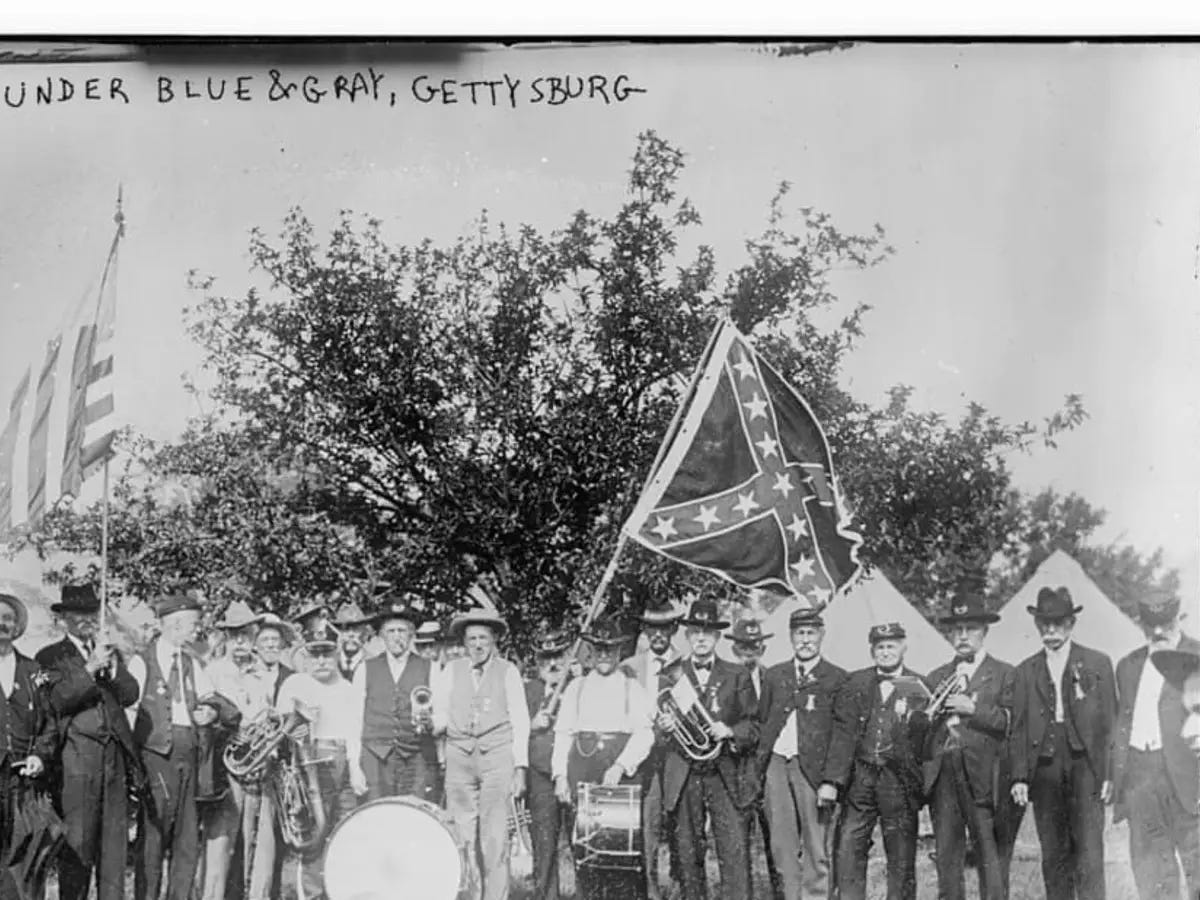
This simply is not true and I don’t know a reputable historian who has made this argument. While a few public examples could be found during Reconstruction, the sentimental culture of reunion that we typically associate with Blue-Gray encampments, battlefield commemorations, and the rhetoric of the Spanish-American War solidified by the end of the nineteenth century.
Historian Caroline Janney reminds us that reunion did not necessarily mean reconciliation. Reconciliation was never complete. Lingering bitterness between veterans on both sides and regional hatred was always present, even during public celebrations of reunion. This, of course, extended to the broader population as well.
But the more serious problem is Stoermer’s claim that: “People made a choice in the 1870s to value getting back with the enslavers’ and the enslaver mindset and the enslaver culture over reconstructing a country to make sure those things never were determining how people related one another in the first place.”
White Americans overwhelmingly rejected the “enslaver mindset.” It’s why the reference to a “Slaveholders Rebellion” was so popular throughout the postwar period. They celebrated the end of slavery for moral reasons and because they understood that it would strengthen the Union. This did not mean that they believed in racial equality—a distinction that is often overlooked.
My new biography of Colonel Robert Gould Shaw has been out for a couple weeks and the reviews are coming in.
“In the engrossing and highly readable A Glorious Fate, author Kevin M. Levin, a prolific writer on Civil War subjects, deftly unpacks Shaw’s legend to unveil the man beneath the myth.”—Fergus Bordewich
“What truly elevates A Glorious Fate, however, is the author’s revealing look at Shaw’s complex personality—including his surprising indifference about slavery.”—Harold Holzer
Subscribe as a Founding Member of Civil War Memory and I will send you a signed and personalized copy. You will also be helping me to research and write my next book about slavery and the battle of Gettysburg.
Most Americans believed that Reconstruction began and ended with the preservation of the Union and the end of slavery.
Reconstruction didn’t end because of reconciliation. It ended for a host of different reasons, including a fractured Republican Party, the Panic of 1873, westward expansion, a growing fatigue with the cost of military enforcement in the South, and, of course, sustained campaigns of paramilitary terror against African Americans.
Stoermer’s interpretation is premised on an implicit assumption that the Radical Republicans spoke for the majority of white Americans and that we should measure change solely through their legislative efforts.
They didn’t and we shouldn’t.
There were competing definitions of Reconstruction. Treating the Radicals as the standard makes it next to impossible to fully account for the change that came about during this period as well as its limits.
It also makes it difficult to appreciate the extent of the change that took place throughout this period.
As for his comparison with postwar Germany, I will leave it to the WWII scholars to respond.
It goes without saying that the history of Reconstruction is incredibly complicated. Trying to funnel it through a narrow wedge to make a political point does little to elucidate much of anything having to do with history.