My relationship with religion has unfolded across most of my life. I was raised Catholic, converted to evangelical Christianity in college, studied theology in seminary, and entered the ministry. I eventually became a pastor in one of the largest churches in North America. Christianity was more than a set of beliefs I held. It provided the interpretive structure through which I understood reality, morality, identity, purpose, and the meaning of my own life.
Leaving that world began a journey that has now spanned more than thirty years. Throughout that time, I have worked closely with people living through religious trauma, the collapse of inherited belief, the recovery of self-trust, and the difficult work of building a life after certainty. This work began long before “deconstruction” became a familiar cultural term. Over the years, it developed into my work in non-religious spirituality and, more recently, the establishment of existential health as a field concerned with the human relationship to meaning, identity, mortality, belonging, freedom, and self-authorship.
My understanding of religion has changed considerably along the way. I once regarded religion primarily as a system of supernatural beliefs, doctrines, institutions, and prescribed practices. I now understand that what we call religious grows from something more foundational in human architecture. Human beings seek orientation, construct meaning, create rituals, form communities, encounter mystery, face mortality, and organize their lives around what they consider sacred. Religion did not create these dimensions of existence. It gathered them into particular symbolic, institutional, and metaphysical forms.
For this reason, I am not categorically opposed to organized religion or religious practice. Religious communities can offer belonging, ethical formation, ritual, continuity, beauty, and meaningful ways of facing the conditions of human life. They can also centralize authority, sanctify harmful beliefs, suppress agency, and demand forms of self-betrayal in the name of faithfulness. The decisive issue is what a religion does with the human realities entrusted to it and what happens to people under its authority.
The following essay should be read within that larger context. My criticism of religion arises from sustained engagement rather than reflexive hostility. I remain interested in what religion reveals about the human search for meaning and transcendence, even as I challenge its claims to exclusive truth and unquestioned moral authority. Religion deserves neither automatic reverence nor automatic dismissal. It must answer for the forms of life it creates, the uses of power it legitimizes, and what it ultimately does to human beings.
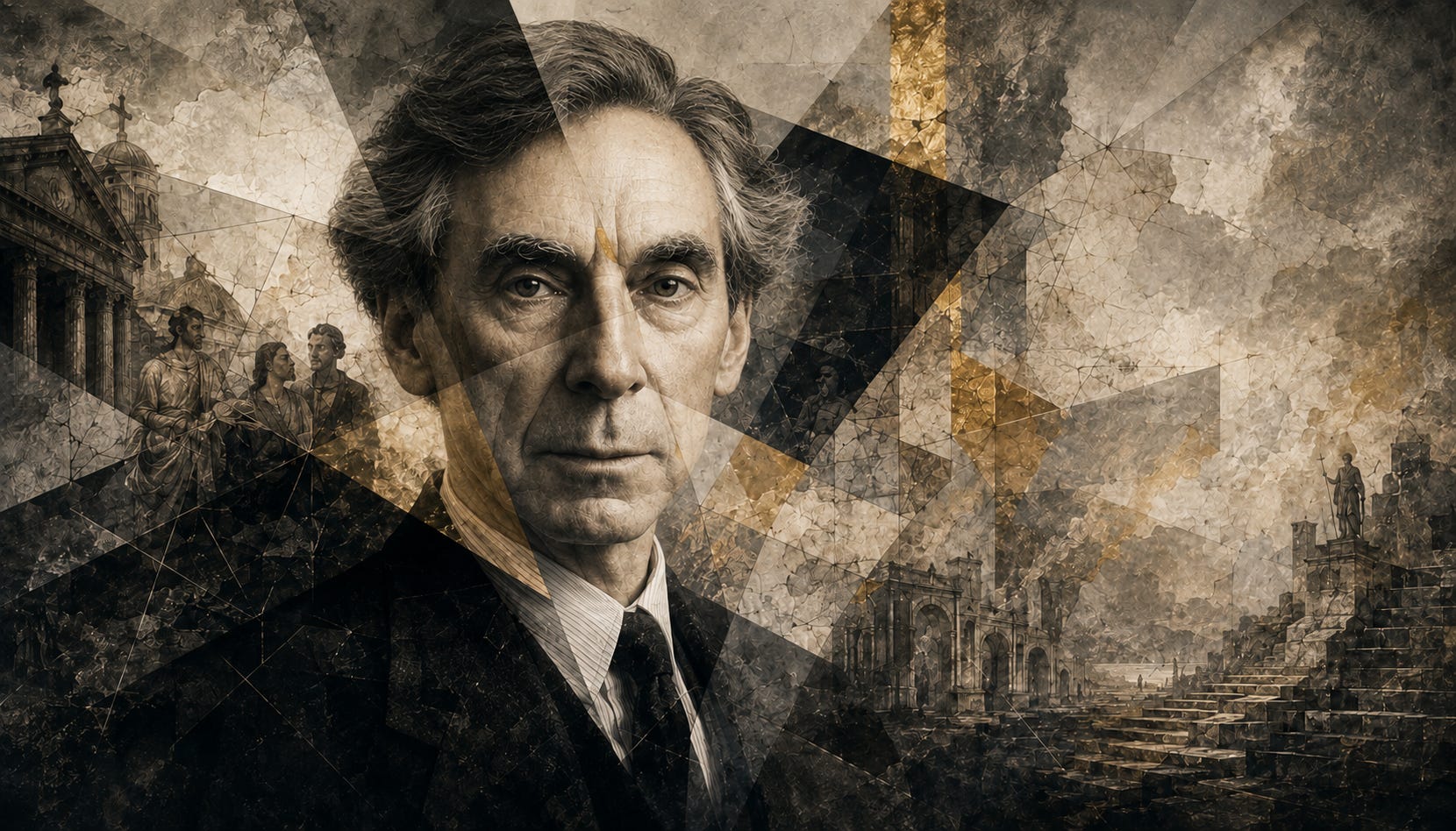
Bertrand Russell (1872–1970) was a British philosopher, mathematician, logician, and public intellectual whose work helped shape modern analytic philosophy. Awarded the Nobel Prize in Literature in 1950, he wrote widely on knowledge, language, morality, politics, war, and human freedom. Russell was also a prominent critic of organized religion whose essays, including ** “Why I Am Not a Christian,”** challenged Christianity’s claims to truth and moral authority.
Bertrand Russell entered my life as more than a philosopher whose arguments I found persuasive. He gave language to suspicions I had already begun to feel but had not yet learned to trust. After years inside Christianity, including theological education and ministry, I understood the internal logic of the faith. I knew how its claims were constructed, how its moral authority was defended, and how effectively it could explain away the evidence against itself. What I had not fully grasped was that Christianity’s moral credibility could be evaluated independently of Christianity’s account of its own divine origins.
Russell helped me see that a religion’s truth claims and its human consequences belong to different categories of judgment. A religious system may possess intellectual coherence, ancient texts, elaborate doctrines, moving rituals, and millions of devoted adherents. None of these establishes that the system is morally trustworthy. The moral question begins elsewhere. We have to examine what happens to human beings when its beliefs become institutions, its doctrines become laws, its leaders acquire power, and its account of reality becomes the authorized framework through which everyone must interpret their lives.
That shift changes the terms of the conversation. Religious traditions have long been permitted to serve as their own witnesses. Christianity claims divine authority and then uses that claimed authority to authenticate its moral teachings. It describes itself as the guardian of goodness, interprets resistance as rebellion against God, and treats obedience as evidence of virtue. The structure is self-sealing. The institution establishes the standard, judges itself by that standard, and declares its authority vindicated.
Russell broke open that enclosure. He insisted that religion answer to the world beyond its own explanations. Once that demand is made, a more difficult history comes into view.
In “Why I Am Not a Christian,” Russell confronts the familiar assertion that Christian belief is necessary for morality:
“That is the idea, that we should all be wicked if we did not hold to the Christian religion. It seems to me that the people who have held to it have been for the most part extremely wicked. You find this curious fact, that the more intense has been the religion of any period and the more profound has been the dogmatic belief, the greater has been the cruelty and the worse has been the state of affairs.”
Russell proceeds with characteristic severity, invoking the Inquisition, torture, witch executions, slavery, war, and the long resistance of organized churches to humane reform. His historical claims are sweeping, at points more polemical than precise. Christianity has never been a single moral actor, and Christians have participated in abolition, civil rights, peacemaking, prison reform, healthcare, education, and countless forms of human care. Any responsible account must include these realities.
The counterexamples do not dissolve Russell’s charge. They make it more exacting. Christian faith has inspired both liberation and domination, courageous resistance and institutional cruelty. The same Bible has been carried by the enslaver and the abolitionist, the segregationist and the civil rights marcher, the colonizer and the liberation theologian.
This moral variability raises a problem more serious than the simple accusation that religion makes people wicked. If the same revelation can authorize opposing moral worlds, revelation alone cannot settle which interpretation deserves our allegiance.
Religious communities often resolve this contradiction by dividing their history into true and false expressions of faith. The loving Christian represents authentic Christianity; the persecutor misunderstood it. The abolitionist followed Jesus; the slaveholder distorted scripture. Such distinctions can be theologically defensible, but they also protect the tradition from sustained moral scrutiny. Every humane outcome becomes evidence for the religion, while every atrocity is attributed to human failure. Christianity receives credit for its saints without accepting full responsibility for the systems its doctrines helped legitimate.
I call this sacred insulation: the capacity of a religious system to protect its moral identity from the consequences produced under its authority. Sacred insulation allows an institution to remain good in its own account regardless of the suffering woven through its history. Cruelty becomes an aberration, even when it recurs across centuries. Harm is blamed on defective believers, cultural contamination, or insufficient fidelity. The sacred framework itself remains untouched.
No human institution should possess that exemption. A political ideology would not be judged solely by its founding ideals while every destructive outcome was dismissed as a misuse. A medical system could not preserve its credibility by celebrating successful treatments and declaring its recurring injuries unrelated to its governing assumptions. Religious institutions deserve the same seriousness. Their ideals belong in the assessment, along with their structures of authority, patterns of formation, treatment of dissent, and effects upon vulnerable people.
Christianity has frequently grounded its moral authority in the character of God. If God is perfectly good, and Christian teaching reveals God’s will, obedience to that teaching becomes the proper foundation of morality. Within this framework, human judgment remains limited and unreliable. Divine command carries an authority that experience cannot overrule.
The difficulty emerges when obedience produces recognizable harm. A doctrine fractures a person’s relationship with their body, sexuality, mind, or deepest experience. Churches protect their reputations by silencing victims. Parents estrange themselves from a child because religious fidelity has been made more sacred than relationship. Entire communities oppose the dignity of others while interpreting their opposition as obedience to God.
At that point, believers are often told that divine goodness exceeds human comprehension. What appears cruel from a human perspective may belong to a higher moral order. The teaching must be trusted even when its consequences seem devastating. This move preserves theological consistency at the cost of moral perception. People learn to doubt their compassion whenever compassion conflicts with doctrine.
The result is a form of moral estrangement. Moral sensitivity remains, though trust in it has eroded. Someone feels the suffering in front of them and then consults an inherited system to determine whether that suffering deserves a response. Cruelty is recognized, yet naming it feels like rebellion. One’s own humanity becomes an unreliable witness in the presence of authorized belief.
Russell’s critique exposes the danger of confusing moral claims with moral performance. A tradition may speak beautifully about love, justice, mercy, and human worth while forming institutions that repeatedly violate those values. Moral language can even conceal the violation by renaming it. Rejection becomes faithfulness. Domination becomes spiritual leadership. Shame becomes conviction. The suppression of inquiry becomes trust. The abandonment of oneself becomes surrender to God.
A religion’s moral performance can be evaluated only when human consequences are allowed to count as evidence. Allowing those consequences to matter does not reduce morality to immediate comfort or personal preference. Loving action can be difficult, boundaries can be painful, and ethical responsibility may demand sacrifice. Human flourishing is more complex than the avoidance of discomfort.
Still, any system claiming moral authority must explain the patterns of fear, coercion, exclusion, self-division, and institutional protection it produces. Declaring those consequences spiritually necessary does not resolve the problem.
The central issue is answerability. Who has the right to question the system? What evidence can count against it? Which human experiences are permitted to challenge its conclusions? A moral framework becomes dangerous when it recognizes no authority beyond itself and offers no meaningful path by which those it harms can call it to account.
Russell’s criticism reaches beneath specific doctrines to a deeper moral architecture. Traditional Christianity has often equated goodness with submission to divine authority. Human beings are creatures, God is sovereign, and virtue consists in bringing the self into conformity with God’s will. The moral life begins with obedience.
Submission has an understandable appeal. Human beings are capable of self-deception, aggression, greed, and rationalization. No mature moral vision can treat personal desire as infallible. Religious traditions preserve hard-won wisdom, place individual life within a larger horizon, and remind us that we are accountable to realities beyond immediate appetite. The critique of submission should not collapse into the fantasy that each person can become morally sufficient unto themselves.
Even so, submission carries its own dangers, especially when the human interpreters of divine will become institutionally powerful. God does not issue church policies, write doctrinal statements, conduct disciplinary hearings, or decide which experiences count as legitimate. Human beings perform these tasks while claiming authorization from God. Submission to divine authority becomes inseparable from submission to those who define what divine authority requires.
This creates an authority transfer that is easily concealed. The believer experiences themselves as obeying God, while the actual content of obedience is supplied by a pastor, text, tradition, family, or community. Human authority acquires sacred force without having to acknowledge itself as human. Resistance can then be treated as spiritual failure rather than a legitimate response to interpretation, power, or harm.
A morality of submission forms a particular kind of self. It rewards compliance, distrusts inner conflict, and treats certainty as a sign of faithfulness. Moral discernment is gradually replaced by moral permission. People learn to ask whether an action is allowed, whether a belief is orthodox, whether a relationship has been approved, and whether their lives conform to the prescribed pattern. The capacity to evaluate, choose, revise, and take responsibility remains developmentally underused.
People formed by submission can possess considerable courage and intelligence, often exercising enormous discipline within the world they have been given. The deeper problem concerns agency. When goodness has been defined as obedience, self-authorship feels morally dangerous. Leaving the system can make freedom feel like guilt, uncertainty like failure, and independent judgment like an invitation to corruption. The authority structure survives internally even after its doctrines lose credibility.
Russell understood that a renewed religious life would require a different moral center. He called it “a morality of initiative.”
Russell writes:
“The first and greatest change that is required is to establish a morality of initiative, not a morality of submission, a morality of hope rather than fear, of things to be done rather than of things to be left undone.”
This is among the most generative formulations in his writing on religion. A morality of submission is organized around permission and prohibition. Its central achievement is negative sinlessness, the successful avoidance of forbidden acts. Russell imagines a moral life measured by what a person helps bring into existence.
The distinction reaches beyond the difference between passivity and action. Initiative requires a different relationship with uncertainty. Obedience offers a predetermined path. Initiative confronts circumstances for which no rule is sufficient. It asks us to perceive what is happening, recognize what the moment requires, and act without the guarantee that an authority will certify the decision in advance.
Such moral agency is demanding. Rules can spare us from direct encounter with complexity. They reduce the burden of judgment and protect us from responsibility for ambiguous outcomes. Initiative removes that shelter. The person must remain answerable for what they create, including the consequences they failed to anticipate. Freedom becomes a practice of responsible participation rather than release from all constraint.
Russell’s morality of initiative also changes the direction of moral attention. Sin-centered systems direct attention inward toward purity, guilt, temptation, and personal standing…