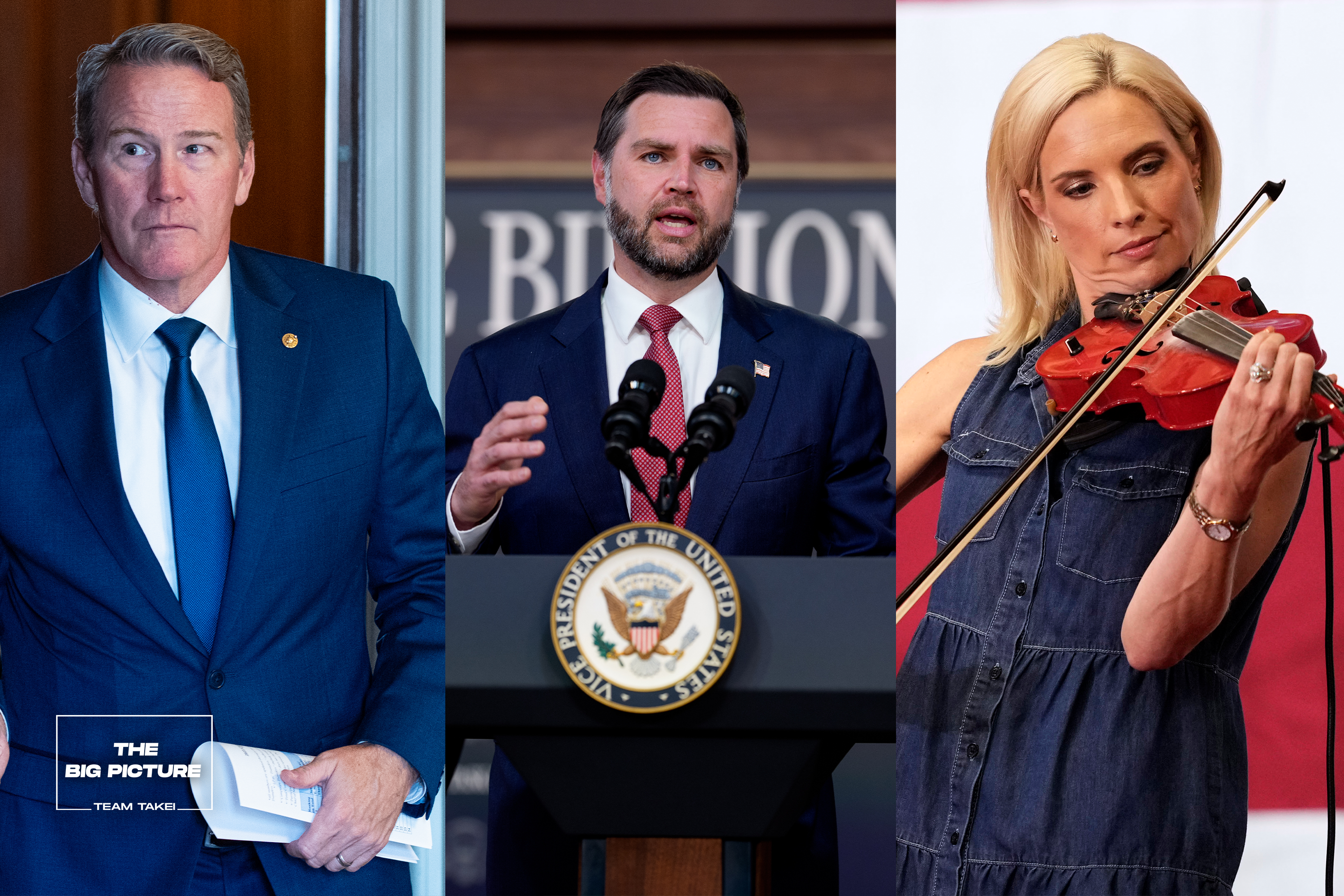
With 40 days until the midterm elections, candidates and parties are making their closing arguments to voters, offering final cases for why the American people should support them in November.
For instance, take Speaker Johnson, who spoke to the media last week after adjourning the House early until after Election Day, allegedly so his members could go back to their districts and campaign. He made the 𝕏following pitch to the American people for continued Republican rule. And somehow said it with a straight face:
“When we keep the majority in Congress, in the next two years, you’re gonna see a continued trend of working to bring down the cost of living, make affordability better for every American.”
Donald Trump echoed this message during his speech to the U.N. General Assembly this week:
“We inherited a dark age of America from the previous administration, and we turned it into the golden age of America. The entire world is being lifted by the wealth, strength, spirit, and momentum of a newly energized and a very powerful United States of America.”
These claims are quite the flex considering that, as a result of policies enacted by Trump and his pliant Congress in the current Republican Washington trifecta, the prices of gas and groceries are surging, housing and healthcare is increasingly out of reach for so many Americans, and every poll shows voters blame the Republicans for it.
But hey, at least it’s a message, right? They tried. That’s what a closing message is: a narrative on which voters can base their support.
The problem is, no one is buying it, not even Republicans. Increasingly, as Trump’s approval rating craters into the 20s and as Democrats are increasingly favored to win not just the House but possibly the Senate in November, Republicans are starting to say some quiet parts out loud in a desperate plea to save their jobs.
And it’s getting awkward.
MAGA aligned officials have always taken their cues from Donald Trump himself, whose shamelessly blatant lies remain unmatched in modern politics.
And why shouldn’t they? Throughout Trump’s time in politics, no matter what he said, his MAGA supporters and media allies would simply repeat it. And it worked beautifully in 2024.
But two years later, it’s clear that not even the White House can spin the reality of the electoral wave building against the Republican party this November. And so some have resorted to transparently desperate measures.
Take JD Vance, who debuted a new closing argument during a podcast interview last week, urging voters to
“Give us another chance — or, give us another couple of years to continue to work on the amazing things that we’ve been doing for the past two years.”
Quite the slip there, acknowledging that their first two years in office have been a failure, only to pivot quickly so that he sounds at least in some way positive.
And remember when Trump addressed his midterm convention in Texas earlier this month? He pledged to the American people:
“I will issue a dividend to every adult citizen in the United States of America for $5,000. If the Republicans win. You win with us and you get $5,000. It will be called the ‘Trump dividend.’”
Putting aside the bribey (and likely illegal) nature of the promise, it was quite the tell that he felt he had to dangle a monetary reward to the American people in exchange for votes. Also, it just simply made no sense. Republicans control every lever of power, so they can release the money now if Trump wanted to. Why wait until the election? It was a question even Laura Ingraham challenged Trump on during an awkward interview.
And as if that weren’t awkward enough, Trump went on to make yet another plea to the gathered convention:
“What I want you to do is pretend, please, that I’m on the ballot.”
He doubled down on this message later to Trey Gowdy on Fox, saying
“When [Trump’s] off the ballot, the people don’t go to vote, and I’m asking the people … to get out and vote. Pretend I’m on the ballot.”
On one level, the very fact that Trump made this argument betrayed a certain acceptance of the current dire political situation Republicans are in. It’s true that Trump has succeeded at turning out new voters whenever he has been on the ballot, even over-performing the polls. But when he’s not on the ballot, his connection with MAGA voters has not translated to strong Republican performance in midterms of the past.
Hence, the plea.
As PBS’s Matt Loffman put it, “The premise behind Trump’s ▶plea to pretend he’s on the ballot points to a potential turnout problem among his base.” Because,
the passion tilts toward Democrats. Seventy-six percent of Democrats say they care a great deal who wins Congress, while 67% of Republicans say the same. Additionally, 42% of Democrats are following the election very closely compared to 34% of Republicans.
But Trump’s ask was also hilariously tone deaf, oblivious to the fact that suggesting he is on the ballot this year is the very message Democrats want their own voters to hear. Tying a toxic Trump around the necks of Republican candidates is literally the Democrats’ closing argument.
The White House’s closing argument messaging ahead of the midterms isn’t all desperate begging and pleading. It’s also ill-advised press conferences.
In August, Kayleigh McEnany 𝕏made an incredible argument on The Five, pushing back on the notion that Republicans “don’t have a healthcare plan.”
“I’m tired of hearing the GOP doesn’t have a health care plan. Their plan is cutting the waste, fraud, and abuse.”
Turns out, she actually wasn’t joking. This week, the Trump administration adopted that message full-throatedly.
During a press conference touting $2.2 billion in savings to taxpayers supposedly “recovered” from “Obamacare fraud”, JD Vance and other officials announced that the Trump administration would be kicking 760,000 Americans off of their Affordable Care Act plans in the name of fighting “waste, fraud and abuse.”
Per The AP:
Vance said the cancellation of approximately 315,000 enrollments covering 760,000 people was done in part because the government was not checking whether people enrolled were eligible. Vance said another 419,000 enrollments will get additional verification to make sure they are eligible for the benefit.
Fox News 𝕏framed it as a “major crackdown” and Dr. Oz complained that these “phantom” enrollees were clearly fraudulent since they had never filed a claim. To him, this signaled fraud. To most healthy people, that’s simply how insurance works.
So, what were they thinking? Perhaps Republicans felt they needed to have an answer to what has traditionally been Democrats’ top issue. Except they did it exactly backward.
Usually, you want to turn your opponent’s strength into a weakness. In this instance, however, by highlighting the removal of 760,000 enrollees from their ACA plans, Republicans have instead reinforced another central Democratic midterm message, namely that Republicans are exacerbating the affordability crisis by kicking millions of Americans off healthcare.
Until Vance’s ill-advised press conference, that Democratic message was focused on the nearly $1 trillion in Medicaid cuts contained in the One Big Beautiful Bill Act. But with this announcement, the Republican closing message of saving American taxpayers billions by cracking down on “waste fraud and abuse” in healthcare once again only served to play into Democrats’ own closing message.
Republicans more concerned about maintaining their seats than hewing to an unpopular president’s policies are peeling away from Trump in pretty dramatic ways.
For the third time this year, last week the U.S. House voted to approve a war powers resolution to end the war in Iran. Of course, with Trump still in the White House, the vote is merely symbolic. But it is telling that, with each successive vote, more Republicans are joining Democrats in support of ending the war.
In the most recent vote last week, the number of Republicans seeking to end the war rose to seven, including U.S. Reps. Zach Nunn and Mariannette Miller-Meeks, two endangered Iowa Republicans, who see opposition to the war as a last ditch effort to shore up their campaigns.
In the aftermath of the vote, Speaker Johnson tried to downplay the vote by trying to claim the war in Iran is not even a war at all, 𝕏saying,
“Well look, the administration doesn’t consider this an ongoing war. It’s not. They’re trying to resolve an operation -- Operation Epic Fury, which was an epic success.”
Even adding a Bush-esque flourish,
“Mission accomplished there”
But Republicans in tough races aren’t on board with this, particularly in heartland districts where, as Nate Silver notes, the surging gas prices caused by Trump’s war are being felt most acutely.
But generally, Democratic polling overperformance has been strongest in the middle part of the country, in rural, agricultural states and in states that are big energy producers.
Could it be gas prices, which have recently
[spiked to almost $4.50 a gallon]amid Iran’s[effective shutdown of the Strait of Hormuz]? All but the[most obstinate Republicans]are plainly unhappy about the situation. In Michigan, Mike Rogers[called for]an end to the Iran War and a suspension of state and federal gas taxes. Turek’s opponent in Iowa, Ashley Hinson, likewise asked for an “immediate end” to the conflict on Monday — although she’s[voted against]numerous resolutions that would have directed Trump to end the war.
To put a fine point on it, Hinson then tweeted on Tuesday,
Along with Rogers and Hinson, we also saw Senator Jon Husted, who is polling behind Sherrod Brown in Ohio in one of the top swing races in the country, 𝕏declare in an interview, “The war needs to come to an end as quickly as possible so that we can lower gas prices.”
This comes as Brown hammers Husted for his support for Trump and the war in a brutal takedown:
No wonder for many endangered Republicans, their closing message is clear: end Donald Trump’s war.
Welcome to the resistance.
In recent speeches Trump has acknowledged how abhorrent Texas Republican Senate candidate Ken Paxton is. In his calls for his supporters to vote for Paxton, Trump has offered only a tepid endorsement, as in the speech he delivered during the midterm convention:
During his speech, Trump critiqued Paxton’s speaking style, saying people “may not like the way he talks.” He followed up on the comment the next day, saying to Paxton, “I don’t like the way you talk.”
In the same speech, Trump said that Paxton “may not be the best-looking guy I’ve ever seen” and reiterated his dislike of the way Paxton dresses, while still urging Texans to cast their ballots for him.
Somehow, that is not the coldest endorsement Paxton has received lately. Paxton’s estranged wife Angela Paxton, who announced she was divorcing Paxton shortly after he launched his Senate bid last year—reportedly “on biblical grounds”—has now weighed in on the 2026 midterms.
Speaking to a group of Texas Republican women on Friday, Angela Paxton didn’t even have to say her estranged husband’s name to issue perhaps the saddest endorsement of Republicans ever uttered:
“It’s not the people — it’s the seat. Because we have more control over that seat and the future when we control the seat — when it’s still in the family,
even if we’re mad at them.”
Cringe.
But that’s still more than George W. Bush or Senator John Cornyn is doing.
The two recently headlined a fundraiser for swing state Republican congressional candidates, where Paxton was conspicuously left off the list of recipients of their fundraising efforts.
Cornyn, whom Paxton famously defeated handily in the Senate primary earlier this year, has his reasons. As he put it last month
“Paxton’s a poor campaigner,” Cornyn told
[The Texas Tribune]in August. “He’s lazy and doesn’t raise money. And he basically is not offering a very compelling case for his election.”
Cornyn is proving prescient. A new top-rated independent poll finds Paxton’s opponent Democrat James Talarico with a 6-point lead in the race.
Talarico now has a 73% chance of winning the seat in November, according to Nate Silver’s forecast.
Republicans’ closing message in the Texas Senate race seems to be one of quiet resignation that Paxton is going to lose.
For ten years, we have watched in frustrated wonder as Donald Trump has kept his hold on the Republican Party through impeachments, insurrection, felonies, rape adjudications, a disastrous pandemic response and now a war in the Middle East and surging gas and grocery prices. Would the fever ever break?
As long as Trump’s MAGA base stuck by him, there was no incentive for elected Republicans to break with him publicly. There was far more downside than upside. But as Trump’s popularity plummets to new lows, and as core blocs within 2024 MAGA coalition—such as farmers, rural voters and hispanics who swung to him that year—show increasing skepticism of the president, and as Trump’s final midterm election fast approaches, there is less downside now to throwing Trump under the bus.
As Rolling Stone notes in its new piece on why Republicans are beginning to at long last turn on Trump,
A poll from CNN released this week, for instance, shows that Trump’s approval among independents is an anemic 25 percent. The network
that his net approval among independents has shifted 86 points in the wrong direction since before the 2024 election. Trump’s popularity is also cratering within his own party. A recent UMass/Amherst[highlighted]found that his approval among Republicans has dropped 14 points since March, and that one in six people who voted for him would not vote for him again.[poll]
And that’s just what some Republicans are doing.
As The Independent reported earlier this month, many Republican candidates who are in tight races in November “have dropped mentions of President Donald Trump from their campaign websites.”
[The Washi…