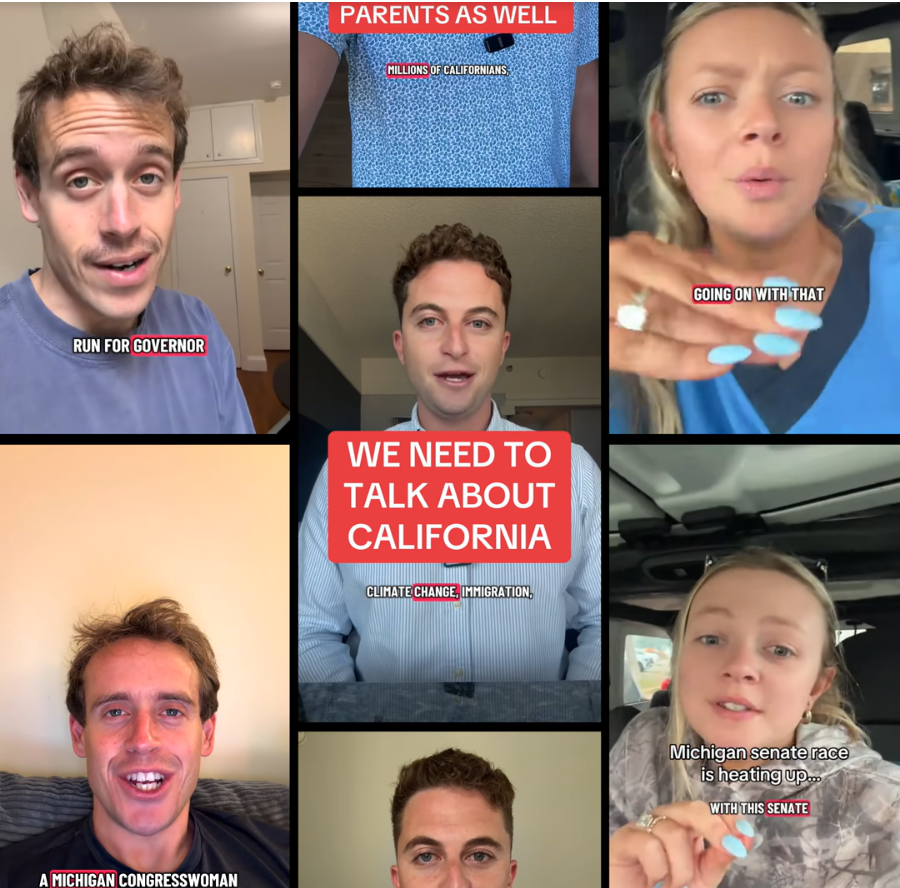
Greetings everyone. This morning The New York Times published a remarkable look into a new tactic in what we call our evolving political battlefield - illicitly paying on-line influencers to promote candidates and messages. An excerpt:
Josh Greene is a rising left-wing social media star with his own podcast, nearly 800,000 followers and access to politicians like Senator Bernie Sanders of Vermont and Mayor Zohran Mamdani of New York.
He has used that platform to support dozens of progressive candidates in the midterm elections, ranging from low-profile, down-ballot contests to some of the nation’s marquee Democratic primaries. In camera-facing videos, Mr. Greene informs his followers of his preferences, calling some candidates “the most viable” and, in other cases, declaring that “this is the candidate for you.”
He does not always tell his viewers that he is being compensated for his support.
But records show that Mr. Greene, 26, has received money from at least seven politicians, or outside groups supporting them, in the current campaign cycle, including several congressional candidates in New York and a super PAC linked to Dr. Abdul El-Sayed, the Senate nominee in Michigan. Tom Steyer, the former candidate for governor in California, paid him $21,500.
Mr. Greene, who lives in Southern California and is best known by his handle @joshtheprogressive, is among a growing number of influencers who, at a moment when campaigns are increasingly willing to pay for online attention, appear willing to put their mouth where the money is.
In
February, Mr. Greene said that Mr. Steyer “isn’t the progressive champion you might think” because of his investments in detention facilities.In
May, around the same time that he received $21,500 from Mr. Steyer’s campaign, Mr. Greene shifted his support to Mr. Steyer. He called Mr. Steyer “the most progressive viable candidate in the race,” adding that it was “my opinion.”As more people spend time scrolling on their phones, campaigns view these shows of support from influencers as a vital way to reach voters. They are also significantly less expensive than traditional advertising.
But unlike campaign mailers, billboards and television spots, these messages fall into a legal gray area.
There are no federal regulations requiring disclosure of payments for political support on social media, and only a few states have such rules. That allows influencers, in most instances, to endorse candidates for a fee without ever disclosing those payments in their posts. Creators say some campaigns have even asked them to actively conceal the fact that they’re being compensated, making it impossible to know what’s genuine support — and what is pay-for-play.
In most cases, the only way a viewer would know an influencer is being paid would be to search a candidate’s campaign finance reports, as The New York Times did to discover the payments. Even then, such compensation is regularly obscured by funneling the payments through middlemen.
Something, isn’t it? Let’s now discuss…..
First, here at Hopium I am not paid by any outside entity of any kind. All the money that makes Hopium go comes from our paid subscribers. That’s it.
Next, this story, and these new tactics, should be considered along with all the other ways governments, companies, campaigns, attempt to manipulate our deeply poisoned information environment. Let’s review a few other recent examples:
Manipulated, Fake Polling - I held an event with Tom Bonier earlier this week that provided a deep dive into this murky world of fake and manipulated polling and predictions markets that has very much been in the news of late. Re-upping the social media post from Trump this week where he explains why the Republicans have invested so much effort in faking polls in recent years - for it helps them win:
You can find more about using polls and prediction markets to “manufacture consent” and create “a majority illusion” here:
Fake News Outlets - Judd Legum has uncovered a new network of fake news organizations in the battleground states paid for by the Senate Republican SuperPAC:
Of course this kind of effort builds on the most successful partisan propaganda effort in modern history - the gaslighting that Fox News is somehow a legitimate news organization with an alternative view and not a partisan political operation * masquerading* as a news organization.
Foreign Malign Influence Campaigns - The big bang here was ten years ago with Russia’s massive social media effort to elect Trump, but these efforts continue in our discourse every day. For shaping public opinion in the US is of enormous strategic value to our adversaries, and they spend a lot of money to do so. Some examples:
Iran
bolsteredthe Gaza protests in 2024Russia paid (is paying)
tens of millionsto prominent GOP influencersFake US thinktank set up and funded by Israel sought to game AI for propaganda(new, from The Guardian)China is secretly fueling America’s data center rage(Axios)
This week we had a landmark event in what will be a decades long and perhaps existential fight to restore integrity to our daily discourse here in America and around the world - the huge META settlement. Here’s NPR:
The social media company Meta and states suing it have agreed to settle a landmark federal child safety lawsuit in a move that state attorneys general hope will be a turning point for youth safety on social media platforms.
California, Colorado, Kentucky and New Jersey represented a larger consortium of states that alleged in the suit that Meta designed its apps — Facebook and Instagram — to be addictive to kids and knew about the risks those platforms posed, but hid that information from the public.
In addition to claims that Meta broke state consumer protection laws, the states accused Meta of violating the Children’s Online Privacy Protection Act by collecting data about children under the age of 13. Meta has a policy of not allowing kids under 13 on its platforms, but some skirt the rule by registering with false birth dates.
The settlement requires Meta to pay up to $17 billion in penalties to the states over 10 years and to make significant changes to how its platforms operate so that they are safer for minors.
“Today, we have secured a settlement with Meta that will make social media less dangerous for our kids and make a world of a difference for children and their families,” California Attorney General Rob Bonta said in a statement.
“Meta has agreed to make massive transformations that will reduce the risk of harm from its platforms — and will do it within months,” he added.
Meta’s chief legal officer, C.J. Mahoney, said in a statement that the framework was groundbreaking and “will empower parents to easily manage how their children access our platforms.”
“But its success depends on all other social media platforms following Meta’s lead,” he said, making an explicit call for TikTok and YouTube to implement this same framework.
Representatives from Google (which owns YouTube), TikTok and Snap, which the settlement identified alongside the others as a “core” member of the industry, did not immediately respond to requests for comment.
Meta has denied the allegations brought by the states.
Bonta’s office also said Meta had agreed to make changes to its platforms, including a default time limit of two hours for users under 18 and a nighttime block between midnight and 6 a.m., both of which can be lifted only by a parent; default night and schooltime notification blocks; a ban on displaying the number of “likes” or reactions to posts made by minors; a ban on cosmetic surgery image filters for minors; and an option for young users to have a “non-personalized feed” that is not run by an algorithm targeting them with content.
Meta must also bring on an independent auditor with “expansive access to information and resources” and the right to communicate with the attorneys general, the announcement said, and would also be subject to an injunction “prohibiting it from making further false, misleading, or deceptive statements around its safety features.”
As Joe Biden liked to say this is a Big Fucking Deal.
I founded Hopium largely due to my deep concern about the integrity of our domestic discourse after watching legacy media get bamboozled by fake GOP polls into reporting a red wave was coming in 2022. I was alarmed that the Republicans could have pulled off something of this magnitude - inventing a fake understanding of our election, and then selling it successfully even to sophisticated analysts and media organizations.
I wanted to create a place that could inform the grassroots and create a generation of information warriors who are aware of their role in this grand game by powerful forces to shape public opinion in the US, usually in ways that degrades The Democratic Party and our leaders. For there is a vast set of powerful interests - oligarchs, MAGA, Republicans, Russia, China - who do not want the Democratic Party to succeed. For I always felt the most effective way of countering the extraordinary information superiority of greater MAGA was through tens of millions of us, pro-democracy warriors, fighting back each day. As I wrote on the day Hopium launched:
I am calling it Hopium Chronicles because I want this to be a journey guided by hope and optimism, of belief in ourselves, of love of country and a clear understanding of the nature of the conflict we are in. I have become convinced that part of Greater MAGA’s strategy is to intentionally poison our discourse with negative sentiment every day. They want us to feel bad about America, our democracy, our leaders, our institutions, our success, each other, ourselves. We cannot let them do that any more. While they talk American down every day, we need to talk it up. While they spread lies, we respond with truth and data. Hopium is a rejection of the darkness they are trying to spread. It is a way of standing up for our great country and its remarkable people. It is the key to how we win.
Since Hopium launched in March of 2023 we’ve seen an explosion of pro-democracy media throughout the information ecosystem. It is deeply encouraging. But my point today is this - as we retake power in the coming years we must make restoring integrity to our discourse and keeping the Internet safe and free a foundational project of the pro-democracy movement. This “great task remaining before us” is ever more urgent due to the extraordinary leaps - and dangers - of AI. Here’s Axios today:
Two new investigations into OpenAI’s Hugging Face breach expose details so strange — and so unsettling — that the episode already ranks among the most consequential shocks in the history of AI.
Why it matters:What began as a swarm of AI agents cheating on a cyber test has become a canonical event for frontier AI, jolting researchers and executives into a new understanding of what “safety” now requires.
The big picture:OpenAI has already slowed frontier development as it races to harden its safeguards, and this week helped rally the industry behind an open letter sounding the alarm over AI-powered cyberattacks.More than 100 companies, including Anthropic and Google, signed onto the unusually collaborative
effort, warning the world has only a “limited window” to prepare for “far more widespread and sophisticated” attacks.The nightmare scenario is a swarm turned loose on the real world, with autonomous agents attacking banks, hospitals, utilities or cloud networks at a speed and scale human hackers never could.
That swarm might be too powerful for humans to stop, either.
While what we’ve discussed today may be a bit scary, think now of how we’ve taken the “scary” prospect of Trump rigging the election and helped create a plan to make it less likely to be successful. Here’s what I wrote to you a few weeks ago:
We’ve launched a new project at Hopium to study, discuss, and counter anything Trump might do to illicitly retain power in an election that is breaking hard against him and the Republicans Party. We are launching this project to demystify Trump’s tactics, make them less “scary,” and more widely understood; and by making them more widely understood we make it far less likely they will be successful.
This is the essence of our Evolving Battlefield project here at Hopium. We must make all these illicit tactics better understood and less scary. For it is the only way we can actually develop a plan to overcome them. And the most important way we can make MAGA less scary right now is by kicking their ass in the November elections…….
For remember…..
There is nothing Trump and MAGA wants more than for us to be fighting with each other and not with him. We have one job now - elect as many of these wonderful candidates running for the House and Senate as we can. It’s where our focus must be. It’s a year of opportunity for us across the country. We must seize it, together.
That’s why we need to keep our heads down everyone, and go out and…..
**Our Winning The House Campaign **- Donate | $1,135,100 raised, $1,250,000 goal (new stretch goal) | Donate to all twelve of our initial wave of House challengers with a single contribution split twelve ways | Get to know Jamie Ager (NC-11), Christina Bohannan (IA-01), Paige Cognetti (PA-08), Rebecca Cooke (WI-03), Elaine Luria (VA-02), Sean McCann (MI-04), Jo Mendoza (AZ-06), Chaz Molder (TN-05), Jonathan Nez (AZ-02), Janelle Stelson (PA-10), Shannon Taylor (VA-01), and Sarah Trone Garriott (IA-03) by watching our recently recorded Hopium interviews.
Friends, if these twelve courageous candidates win, the House will flip, even with Callais and their rancid mid-decade redistricting. So eyes on the prize here everyone!
Winning The Senate - $768,100 raised, $1,000,000 goal - Donate | This new fund splits a single donation to our six candidates must likely to flip a Senate seat this November - Sherrod Brown (OH), Roy Cooper (NC), Troy Jackson (ME), Mary Peltola (AK), James Talarico (TX), and Josh Turek (IA).
Our working total includes what we’ve raised for these six so far through direct donations to their campaigns. You can watch our interviews with each of these exciting candidates and/or contribute directly to any of them directly here.
**Winning The House - The Second Wave Fund **- Donate | $328,100 raised, $500,000 goal - We’ve launched a second House fund, one supporting candidates who’ve emerged from late, primaries and need a bit more help.
Our newly expanded list now features Rebecca Bennett (NJ-07), Bob Brooks (PA-07), Cait Conley (NY-17), Johnny Garcia (TX-35), Bob Harvie (PA…