The removal of the last three Confederate monuments has received a great deal of media attention, as it should, but we also should acknowledge recent additions to the city’s monument landscape.
Together, both the removal of monuments and the dedication of new ones paint a much clearer picture of how one community has evolved in how it remembers its collective past.
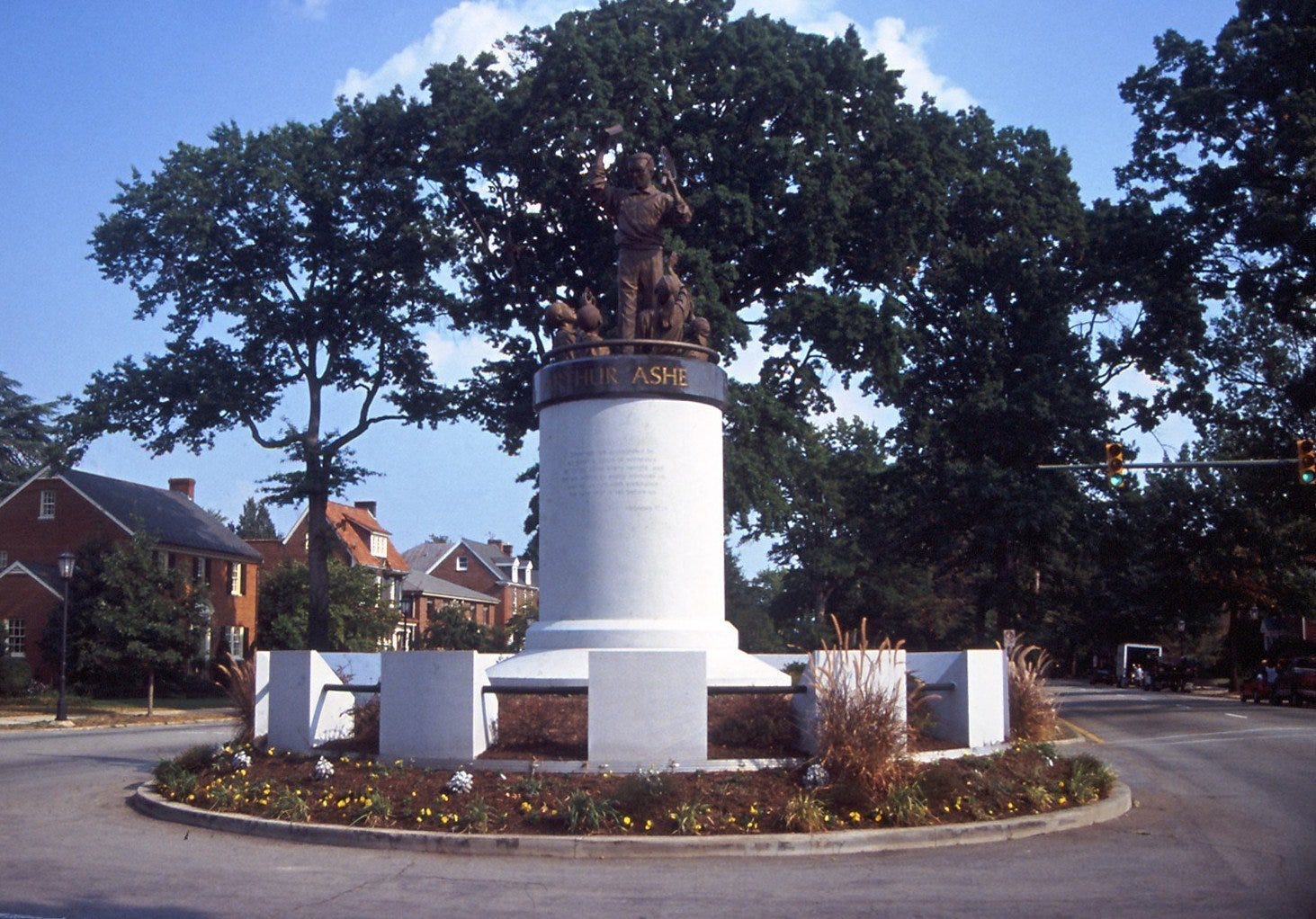
In the past few decades, Richmond has dedicated new monuments that have greatly expanded its commemorative landscape. A statue of homegrown tennis star Arthur Ashe joined Monument Avenue in 1996—arguably one of its most high-profile and controversial additions. While some Richmonders welcomed the statue, others argued that it would “disrupt the theme of the avenue,” and both its supporters and detractors mocked the statue itself.
It remains the only statue on Monument Avenue.
In 2003, the city dedicated a monument of Abraham Lincoln and his son Tad to mark the president’s April 1865 visit following the abandonment of Richmond by the Confederate government. The dedication helped re-interpret Lincoln’s visit as a symbol of slavery’s end as opposed to the entrance of a conquering tyrant.
While in Richmond just 11 days before his assassination, Lincoln famously corrected newly freed slaves who knelt at his feet: “Don’t kneel to me,” Lincoln responded. “That is not right. You must kneel to God only, and thank Him for the liberty you will afterward enjoy.”
Four years after the Lincoln statue was erected, the city installed the Richmond Slavery Reconciliation Statue, a 15-foot bronze sculpture depicting two enslaved individuals embracing not far from the center of Richmond’s former slave market.
The Virginia Civil Rights Memorial, located on the grounds of the capitol building and dedicated in 2008, celebrates the efforts of African-American students in rural Prince Edward County. Their decision to protest the condition of their school led to one of the lawsuits that comprised the 1954 landmark Supreme Court case, Brown v. Board of Education.
In 2017, the Maggie Lena Walker statue was dedicated at the intersection of Broad and Adams Streets. Designed by sculptor Toby Mendez, this 10-foot bronze statue honors the Richmond native who was a civil rights activist, entrepreneur, and the first African American woman to charter and serve as president of a bank in the United States.
The Virginia Women’s Monument, the nation's first monument focusing entirely to showcasing the historical contributions of women, was dedicated at the Virginia State Capitol in 2019. It was built without traditional martial pedestal and features life-sized bronze statues of influential figures from Virginia’s history standing directly on a granite plaza. They include:
Cockacoeske (Pamunkey chieftain)
Anne Burras Laydon (Jamestown colonist)
Mary Draper Ingles (pioneer frontierswoman)
Elizabeth Keckley (seamstress and civil rights activist)
Laura Copenhaver (entrepreneur)
Virginia Randolph (innovative educator)
Adele Goodman Clark (suffragist and artist)
Kehinde Wiley’s equestrian statue “Rumors of War” was also dedicated in 2019 on the front lawn of the Virginia Museum of Fine Arts (VMFA) on Arthur Ashe Boulevard. The massive 27-foot-tall bronze equestrian monument depicts a young African American man in contemporary streetwear (hoodie and Nikes) astride a rearing horse. It was specifically designed as a powerful counter-monument responding to the traditional Confederate equestrian monument honoring JEB Stuart that formerly stood a few blocks away.
The Emancipation and Freedom monument took its place on Brown's Island along the James River front in 2021. Designed by sculptor Thomas Jay Warren, this monument features two 12-foot bronze statues of a newly freed man and a woman holding an infant to commemorate the abolition of slavery. The base of the pedestal is etched with the names, faces, and biographical stories of 10 notable Virginia African American freedom fighters, including Nat Turner and Dred Scott.
Taken together, these monuments point to a city that in recent years has proven a willingness to acknowledge its dark past, using its public spaces to highlight history that reflects and inspires the entire community.
The city of Richmond didn’t have to remove its Confederate monuments to make room for these recent additions to the city’s commemorative landscape. Some have suggested that simply adding these new monuments would place them in conversation with some of the most potent symbols of the Lost Cause.
But we also need to acknowledge that the memory of emancipation and the long history of Black civil rights is exactly the history and progress that Confederate monuments were intended to suppress and prevent.
“Art is always about what people say ‘yes’ to.”—Kehinde Wiley