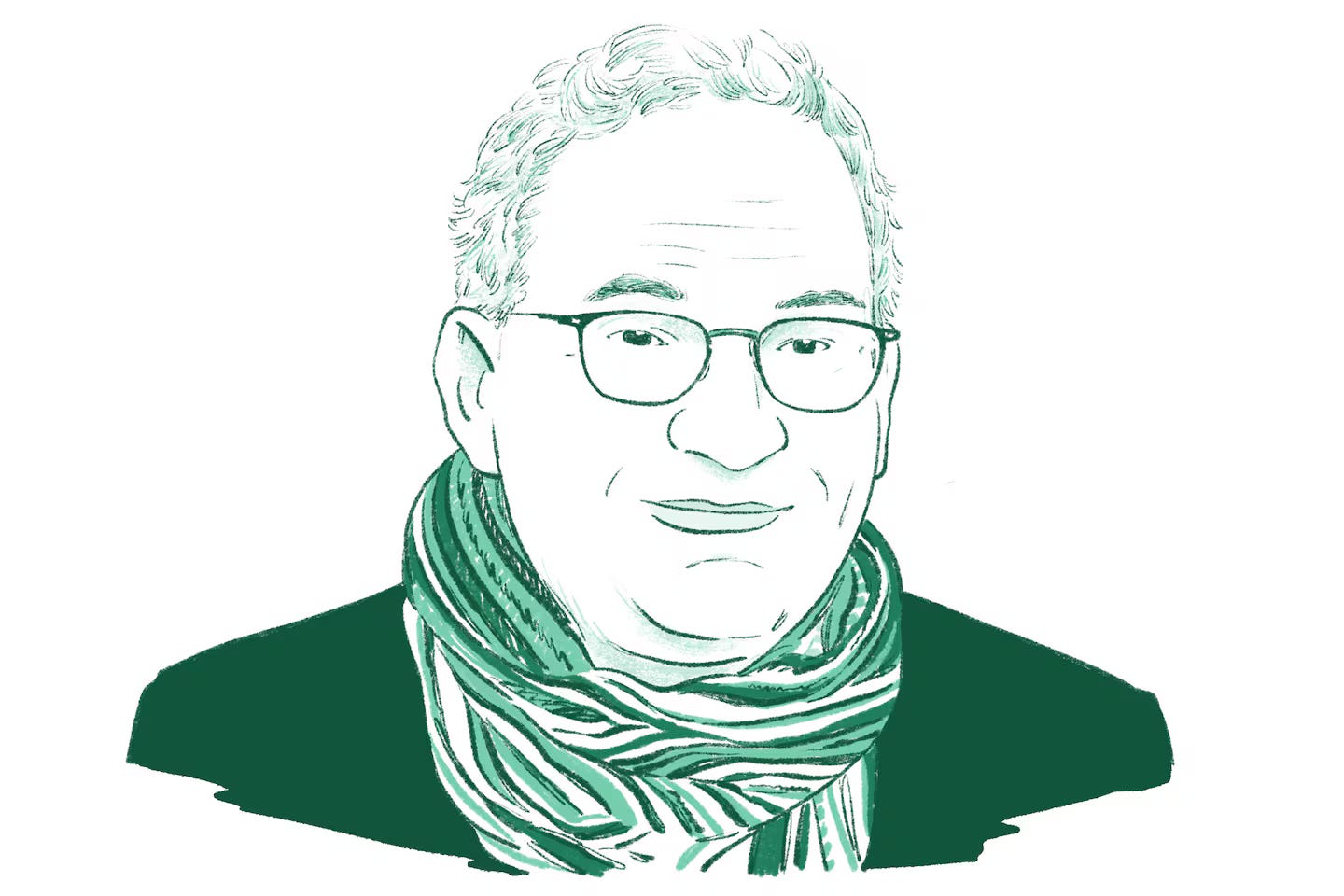
*I was hoping that The Boston Globe would review my new biography of Colonel Robert Gould Shaw, but this is even better. Thanks to Kate Tuttle, editor of the Globe's books section, for giving me the opportunity to talk about the book in anticipation of a local talk that I will deliver at the Theodore Parker Church in West Roxbury on December 2 at 7PM. The event is hosted by New Brook Farm. *
Most of you don’t subscribe to the Globe, so I am publishing the article below. I am not sure my face translates into a caricature all that well, but I appreciate the effort. LOL
Civil war historian Kevin M. Levin left Charlottesville, Va., for Boston in 2011. “A lot of my work had been focused on Virginia and the Confederacy,” he says, but the move north provided new inspiration. When seeking the subject of his next book, Levin turned to one of Boston’s fallen heroes from the war. In * A Glorious Fate: The Life and Legacy of Colonel Robert Gould Shaw* (University of North Carolina Press), Levin revisits Shaw, whose leadership of the all-Black 54th Massachusetts Regiment was memorialized in the iconic bas-relief sculpture across from the state house (and nearly a century later in the film “Glory”).
The real Shaw, born to abolitionist parents and raised in the bosom of elite Unitarian Boston, wasn’t the white savior portrayed in the movie, Levin says. Instead, he was a complicated figure — arrogant, self-centered in his youth, and perpetually at odds with his idealistic mother, focused more on the pragmatic arguments for enlisting African American soldiers than on moral arguments about equality or justice.
“You’ve got to draw a distinction between a story that’s going to bring people into the movie theater, and the complexity that you often find in the historical record,” Levin adds. Still, by book’s end the author found much to admire in his subject. “I think he really did struggle with some of the tougher questions about, you know, the purpose of the war, emancipation, slavery. But I think the way to understand Shaw in the end is not alone, but as part of a coalition of people” whose actions contributed to the Union victory and the eventual end of slavery.
It’s important to remember, Levin goes on, that despite Boston’s reputation as home to both Black and white abolitionists, from Frederick Douglass to William Lloyd Garrison, there were many local elites who supported the institution of slavery throughout the war. “Just economically speaking, they had a lot riding on this,” he says. For Shaw and his soldiers, marching through Boston before they shipped out to South Carolina, the streets were lined with supporters and more than a few opponents.
The Massachusetts 54th took massive losses in the battle of Fort Wagner, outside Charleston, in 1863, and Shaw, just 26, was among the dead. Almost immediately, his legend was proclaimed and burnished — mostly by his mother, Sarah Shaw, with whom he had argued so much in life. Still, in a sad example of things that emancipation didn’t change, when the Augustus Saint-Gaudens memorial was unveiled in 1897, the seating chart pushed Black attendees to the back rows.
“The Civil War was, in the end, a revolution,” Levin says. “Between 1861 and 1865, something fundamental changed about this country, namely the end of slavery. And there is no straight road that gets us there. I find that to be an important part of history — to remember that it’s always difficult to know where we’re going during incredibly divisive and complicated moments.”
Thanks to all of you who voted in UNC Press’s Reader’s Choice Award. Thanks to you my book has made it into the final round. I would really appreciate your support to help push the book over the edge. Please ** click this link** to vote.
I hope all of you have a safe and Happy Thanksgiving!