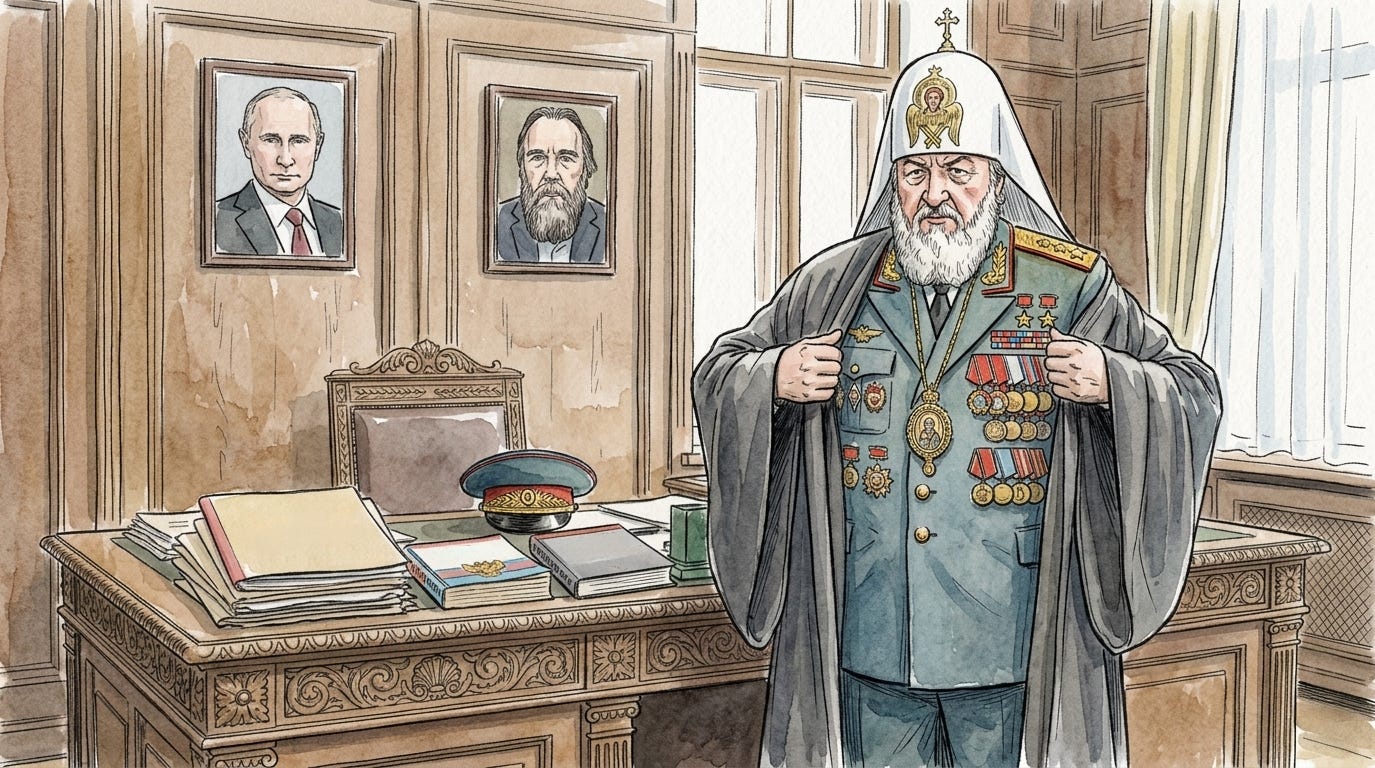
ZURICH—A claim has been circulating in certain right-wing circles in the West that Ukraine is “banning Christianity” by restricting the Ukrainian Orthodox Church of the Moscow Patriarchate (UOC-MP). This claim is not merely wrong—it is spectacularly, dangerously wrong. It reveals a profound ignorance of what the Russian Orthodox Church has become and what it truly represents.
We publish this newsletter every day at 9:05am NYC time / 4:05pm Kyiv.If you’re not already subscribing, why not do so now?
Ukraine has not banned Orthodox Christianity. The Orthodox Church of Ukraine (OCU), which received its Tomos of Autocephaly from the Ecumenical Patriarch Bartholomew I of Constantinople in 2019, continues to operate freely as an independent, self-governing Church in full communion with the broader Eastern Orthodox world.
An official document from Russia’s foreign intelligence agency branded Ecumenical Patriarch Bartholomew as the
“Antichrist in a cassock.”
What Ukraine has moved to restrict is not Orthodox Christianity in any meaningful spiritual sense, but an institution that has long functioned as a fifth column of Russian state power within Ukrainian society and representing a world outlook that is deeply inimical to European civilization as a whole—especially in the context of an ongoing invasion that Russian officials and clerics themselves openly call a “Holy War.”
What is emerging in Russia is not Orthodox Christianity as the world has known it, but a uniquely Russian religion, animated by apocalyptic hatred of the West.
To understand why restricting the Moscow Patriarchate’s branch in Ukraine is not banning Christianity, one must understand what Russian Orthodox Christianity is becoming.
Russian Orthodoxy is in the process of separating itself from the broader Eastern Orthodox realm—a separation as intense as the Great Schism of 1054 that divided Western Catholicism from Eastern Orthodoxy. What is emerging in Russia is not Orthodox Christianity as the world has known it, but a uniquely Russian religion: a world outlook animated by apocalyptic hatred of the West, one that merely wears the vestments of Orthodoxy while hollowing out its substance.
Thus, banning this Russian entity in Ukraine is not banning Christianity. It is defending Christianity—and European Civilization—from a force that seeks to destroy both.
While Russia may accuse Ukraine of schism, it is, in fact, Russia that is gradually separating itself from the broader Eastern Orthodox Christianity.
Constantinople’s 2019 granting of autocephaly to the Orthodox Church of Ukraine marked a pivotal moment not only in the ecclesiastical landscape but also in the broader historical and cultural trajectory of Eastern Orthodoxy.
The Russian Orthodox Church’s refusal to recognize this autocephaly has led to a schism with the Ecumenical Patriarchate. This rift is more than a mere ecclesiastical disagreement; it is yet another manifestation of a significant shift in Russia’s relationship with European culture—a process that can be understood through the lens of Oswald Spengler’s concept of Pseudomorphosis.
Pseudomorphosis, a term coined by Spengler, refers to the phenomenon in which an emerging culture is overlaid by the forms of an older, more dominant culture, stifling the young culture’s organic development. In the context of Russia, this process began with the Church reforms initiated by Patriarch Nikon in the 17th century.
These reforms aimed to align Russian-Muscovite Orthodox practices and canonical texts with those of Greek Orthodoxy, an effort that was met with significant resistance. Those who opposed the reforms, clinging to the original Muscovite practices, became known as the “Old Believers.” Significantly, Ukrainian clerics and theologians were at the forefront of these reforms, playing a crucial role in integrating Muscovite Orthodoxy with Greek traditions.
Ecumenical Patriarch Bartholomew I has emerged as the
most prominent ecclesiasticalvoice opposing Russia’s weaponization of Orthodoxy.
Nikon’s religious reforms, followed by Peter the Great’s more sweeping attempted social Westernization of Russian society, imposed a European veneer that never fully settled. This situation is reminiscent of the introduction of Greek-Byzantine Christianity into the Germanic world by the Carolingian rulers in the 8th and 9th centuries—most emphatically by Charlemagne, who can be viewed as the historical counterpart of Peter the Great.
Just as the newly introduced norms of Graeco-Roman Christianity sat uneasily upon the Germanic people, leading to continuous tension between Latin-Germanic Christianity and Byzantine Christianity, so too did Nikon’s and Peter the Great’s reforms create a persistent dissonance within Russian Orthodoxy and the Russian society as a whole.
The Gothic architecture and the development of Scholasticism that followed in the West were manifestations of this newly liberated Faustian spirit, reflecting a uniquely Western world-feeling with Germanized Christianity.
The Great Schism of 1054, which formally divided Eastern Orthodoxy and Western Catholicism, was more than a dispute over rituals or doctrinal differences. It was the culmination of a deeper cultural divide, a counterposition of two different world-feelings—what Spengler would describe as the emergence of the Faustian spirit in Western Europe, breaking free from the Pseudomorphosis imposed by Byzantine Christianity.
The Gothic architecture and the development of Scholasticism that followed in the West were manifestations of this newly liberated Faustian spirit, reflecting a uniquely Western world-feeling with Germanized Christianity.
[Editor's note: Spengler’s “Faustian spirit” names the defining impulse of Western Europe after 1000 AD—a restless striving toward infinite space, reflected in Gothic architecture. He contrasts it with the classical soul’s sculptural, bounded forms and the Byzantine soul’s world-cave, lit by divine light against surrounding darkness. Spengler (1880-1936) was a German philosopher of history.]
Similarly, the schism within Eastern Orthodoxy today, catalyzed by the autocephaly of the Ukrainian Church, could foreshadow a significant transformation within Russian Orthodoxy. While Russia may accuse Ukraine of schism, it is, in fact, Russia that is gradually separating itself from the broader Eastern Orthodox Christianity. As Ukraine moves closer to Europe, reaffirming its connection to the Greek Orthodox tradition, Russia is on the path to developing a distinct form of Christianity, one that is uniquely Russian and resonates more deeply with its cultural essence.
Russian leaders, Bartholomew said, should “
fear the Day of Judgment, if indeed they believe.
No figure has articulated the depth of this emerging schism more forcefully than Ecumenical Patriarch Bartholomew I of Constantinople, who since 1991 has held the position traditionally regarded as “first among equals” among the world's Orthodox patriarchs. Since the granting of Ukrainian autocephaly in 2019, Bartholomew has emerged as the most prominent ecclesiastical voice opposing Russia’s weaponization of Orthodoxy.
Moscow declared itself in schism with Constantinople in 2018 after Bartholomew recognized the independent Orthodox Church of Ukraine. As the events in the following years would manifest, this was not merely a jurisdictional quarrel.
Moscow’s Patriarch Kirill, who has always been closely allied with Vladimir Putin, provided a religious justification for the full-scale invasion of Ukraine, calling it a “holy war.” Bartholomew, for his part, has repeatedly denounced this characterization with unmistakable clarity: Russia’s war on Ukraine, he has insisted, is “not a holy and blessed war, as some claim. It’s an evil war, an unholy war.”
In early 2026, this conflict between Moscow and Constantinople escalated significantly.
The Russian intelligence service’s use of the language of
demonologyreveals the fusion between the Russian state and the Russian Orthodox Church.