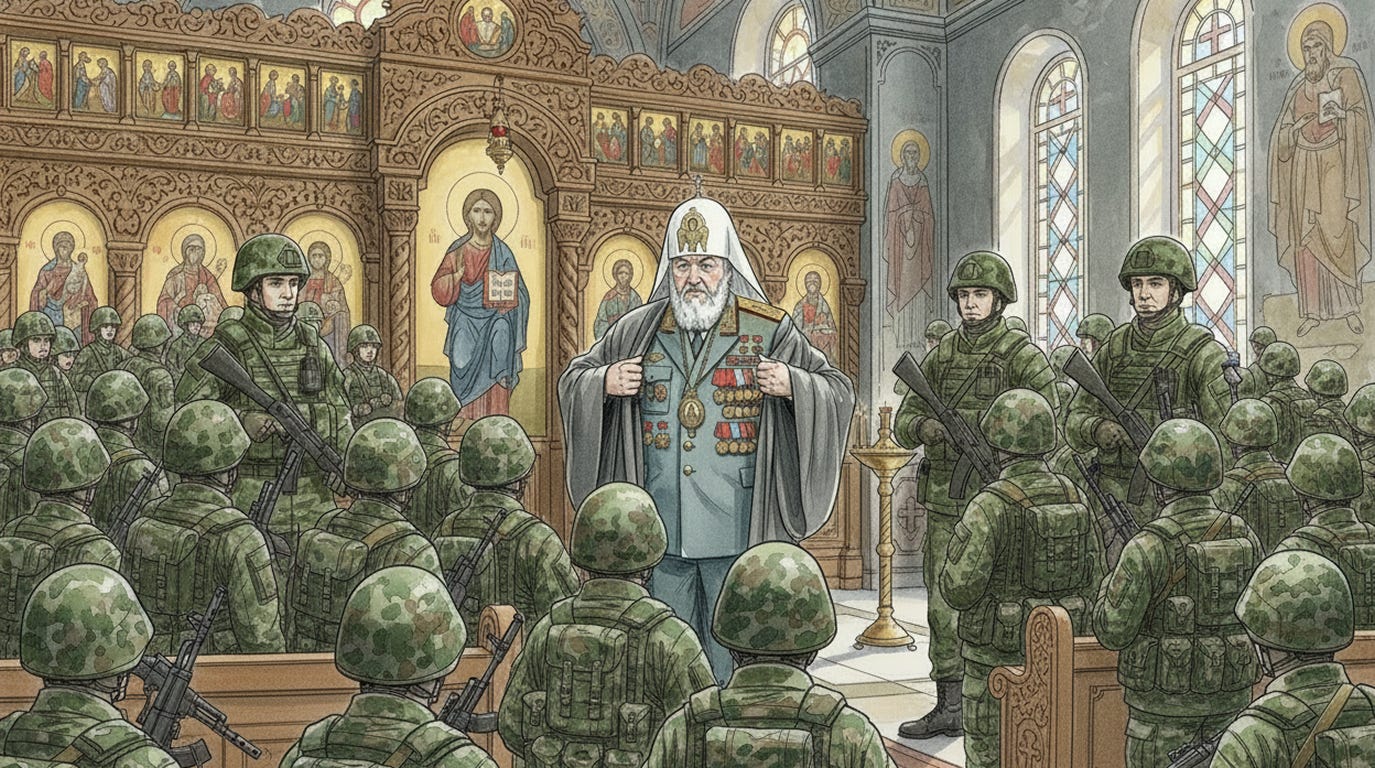
ZURICH—Western and Eastern Christians alike are often startled by the open militarism of the Russian Orthodox Church, which not only endorses the war but also goes so far as to bless soldiers and consecrate nuclear weapons. For many in Europe, such an attitude seems to contradict the spirit of Christianity itself—a faith widely associated with peace, humility, and compassion.
The animating forcebehind Russian society is not Orthodox Christianity per se, but the mythic idea of the “Russian World” (Russkiy Mir).
One might object: how can there be talk of a religious or quasi-religious fervor in Russia when church attendance is dismal and most Russians live secular lives? But this objection rests on a narrow, Abrahamic understanding of what religion is. Religion, in its deeper civilizational function, is not primarily about doctrine—it is about identity. It is a collective worldview, a metaphysical orientation, a sense of who we are and who we are not.
We publish this newsletter every day at 9:05am NYC time / 4:05pm Kyiv.If you’re not already subscribed, why not do so now?
The animating force behind Russian society is not Orthodox Christianity per se, but the mythic idea of the “Russian World” (Russkiy Mir). This idea, rooted in a deep civilizational self-image, is what defines the Russian sense of purpose, belonging, and enmity. Orthodox Christianity merely serves as an auxiliary.
This newly emerging “Russian Christianity” is as inimical to European civilization as, for instance, Islam.
Consider the parallel with Islamic jihadists of the 2010s. When ISIS surged across the Middle East, Western analysts **rushed to argue that the group did not represent “true Islam.” **Many recruits were buying books such as Islam for Dummies before flying off to Syria or Iraq. But for these individuals, Islam was not about mastering theology. It represented their identity. It defined their self-perception, offered meaning, direction, and—most importantly—a stance against the much-hated West.
Russia today functions in the same way. The doctrine of the Orthodox Church is irrelevant to most Russians. What matters is that the Church, like everything else in Russian public life, is being reshaped to reflect and reinforce the civilizational myth of the Russian World. This myth defines who Russians believe they are—and who they believe their enemies are. And this myth is religious in every meaningful sense. It sacralizes history. It sanctifies violence. It casts the West as a satanic and corrupting force. It turns political leaders into holy warriors and military invasions into sacred missions.
So yes, Russians are religious. Not in the way Westerners today understand religion, but in the only way that truly matters. The Russian World is their faith. It defines their cosmos. And it defines the enemy.
The Russian religion isanimated by an apocalyptic hatred against Europe, a religion inimical to both Western Christianity and Eastern Orthodoxy alike.
The accusation that Russia is creating something fundamentally alien to Orthodox Christianity has received formal theological articulation through the concept of ethnophyletism—a heresy first condemned at the Council of Constantinople in 1872. Ethnophyletism refers to the subordination of the Orthodox faith to ethnic identities and national interests, effectively turning a church into an instrument of nationalist ideology rather than a universal spiritual community. The 1872 Council declared this principle contrary to the Gospel and the canons of the Church fathers.
In March 2022, shortly after Russia’s full-scale invasion of Ukraine, more than 1600 Orthodox theologians and clergy from around the world signed the landmark “Declaration on the ‘Russian World’ Teaching,” issued by the Orthodox Christian Studies Center at Fordham University and the Volos Academy for Theological Studies. The Declaration condemned the “Russian World” (Russkiy Mir) ideology as “a form of Orthodox ethno-phyletist religious fundamentalism, totalitarian in character,” and denounced it as “a false teaching.” The Declaration explicitly identified Moscow’s ideology as a heresy that conflates Russian national identity, Russian state power, and Russian Orthodoxy into a single indivisible whole.
Ecumenical Patriarch Bartholomew himself has accused the Russian Orthodox Church of ethnophyletism. In a letter to Patriarch Theodoros II of Alexandria— whose canonical territory in Africa Moscow had invaded by establishing a rival exarchate—Bartholomew charged that the Russian Church was being instrumentalized for nationalist purposes. The Orthodox Church of Ukraine’s Holy Synod went further still, formally condemning the “Russian World” doctrine as rooted in “the heretical principles of ethnophyletism, Manichaeism and Gnosticism.”
The term ethnophyletism comes closest to describing the evolution of Orthodox Christianity in Russia but still misses the mark. The issue runs deeper and is more fundamental.
“Russian World” (Russkiy Mir) does not simply refer to a narrow ethnic identity but to a wider civilizational world outlook. It is the true religion of Russians in every meaningful sense that defines their cultural identity, their place in the world and their interactions with it. In Russia, Eastern Orthodox Christianity is being subordinated to this visceral impulse and is being molded by it. The historical outcome will be the emergence of a third major Christianity—a “Russian Christianity” that is as different from Eastern Orthodoxy as it is from Western Christianity (Catholicism/Protestantism). Currently, this process is unfolding within Russia.
Importantly, this newly emerging “Russian Christianity” is as inimical to European civilization as, for instance, Islam. And it is engaged in its own holy war (Jihad) against the West. Therefore, by banning the Russian Orthodox Church inside its borders, Ukraine did not ban Orthodox Christianity. It banned an entirely different religion—a religion animated by an apocalyptic hatred against Europe, a religion inimical to both Western Christianity and Eastern Orthodoxy alike.
Help us keep Under Fire News independent and daily.If you’d like to support our work with a one-time contribution, you can do so here
Putin’s “Peace Talks,” Odesa EditionRussia hit Odesa againovernight,killing a 75-year-old married couple,injuring at least 13 people, damaging residential buildings, and striking a foreign merchant vessel moving throughUkraine’s Black Sea corridor. Ukraine says Russia launched two ballistic missiles and 107 drones, with air defenses destroying or jamming 96 of the drones. An impressive defense, but not enough when even a handful get through. The attack is another summary ofMoscow’s actual negotiating position: terrorize civilians, threaten commercial shipping, then howl when Europe tightens sanctions on the shadow fleet keeping Russia’s war economy alive.
Trump Gets Talks—Hezbollah Gets a VetoIsrael and Lebanon haveagreedto extend the Israel-Hezbollah ceasefire by three weeks after direct talks in Washington—the second such meeting in a week and the first real diplomatic contact between the two countries in decades. That sounds historic, and in one sense it is.**But the fine print is ugly:**Hezbollah was not part of the talks, says it will not respect agreements made without it, and both sides have already violated the initial ceasefire. Israel still holds a buffer zone inside southern Lebanon, while Beirut hopes the process can stop a war that has killed around 2,300 people and displaced more than a million. The conservative read is simple: diplomacy can buy time, but not peace, as long as a state-within-a-state militia gets to decide whether Lebanon is at war.
EU Targets Russia’s Wallet—But Can It Close the Leaks?The EU hasrolledout its 20th sanctions package against Russia, arguably one of its most aggressive yet, targeting the real arteries of Moscow’s war economy: energy revenues, financial channels, and the military-industrial pipeline. The bloc is now going afterRussia’s “shadow fleet” of oil tankers, tightening restrictions on energy exports, and, crucially, moving to shut down sanctions evasion via third countries and crypto. For the first time, Brussels has imposed a blanket ban on all Russian crypto service providers and even preemptively outlawed the digital ruble, acknowledging that Moscow has been quietly rerouting transactions through digital assets. On the industrial side, dozens of companies linked to drone production and weapons manufacturing, along with facilitators inChina, the UAE, and Central Asia, have been blacklisted, while new trade restrictions aim to choke off high-tech inputs. The message is clear: Europe is finally trying to fight Russia’s war economy systemically, not symbolically. The open question, as always, is whether enforcement will match ambition.
€90 Billion for Ukraine … and a Hangover for EuropeEU leadersgatheredin Cyprus to celebrate unlocking a massive €90 billion loan for Ukraine,hailed as a show of unity after Hungary dropped its veto, but the morning after looked far less triumphant. Behind the applause, divisions quickly resurfaced over how Europe will fund its own defense, manage rising costs from the Iran conflict, and sustain long-term support for Kyiv. The loan may cover roughly two-thirds of Ukraine’s near-term needs, but it also underscores an uncomfortable truth: Europe is still reacting to crises rather than preparing for them. With defense budgets under pressure and energy markets rattled by Middle East instability, the summit revealed a bloc that can still agree on symbolic big moves, yet struggles when the conversation turns to sustained military readiness and economic sacrifice.
€161 Million for Drones, EW, and RealityThe European Commission and Ukraine’s Defense Ministry arelaunchinga €161 million programme fordual-use technologies, with €140 million in EU guarantees and €21 million in investment grants aimed at unlocking up to €400 million in bank lending. The money will target the sectors Ukraine has been forced to master under fire: aerial, ground, and naval drones, electronic warfare, space tools, communications, navigation, and critical components. Politically, this is more than another funding line. It is Europe slowly admitting that Ukraine is not just a recipient of aid, but a defense-tech testbed the continent badly needs to plug into, assuming Brussels can move fast enough to matter.
Prince Harry Arrives to Remind the West It Has an Attention Span ProblemPrince Harry made a surprisevisitto Kyiv on Thursday, arriving by overnight train from Poland and using the trip to deliver a message that is, for once, harder to mock than to ignore: the world must not lose sight of Ukraine simply because attention has shifted to Iran. He is set to address theKyiv Security Forum, describe Ukraine as bravely defending Europe’s eastern flank, warn against becoming “numb” to the war, and argue that this is a fight about values, not just territory. He also plans to reconnect with the Invictus community and visit demining efforts tied to Halo Trust, whose Ukraine operation now employs around 1,300 people.
From Battlefield Proof to French Production Linesnew
Tencore’stie-upwith France’sShark Roboticsis more than another memorandum dressed up as progress: it is a glimpse of what serious European defense cooperation is supposed to look like when war strips away the vanity. Under the “Build with Ukraine” initiative, the two companies plan to create two joint ventures: One in France to develop and manufacture defense robots for logistics and medical evacuation using Ukrainian battlefield feedback, and another in Ukraine to serve as an industrial and service hub for maintenance, training, and gradual component localization tied into a European supply chain. The military logic is clear enough, but so is the political one. Tencore brings combat-tested experience from thousands of TerMIT ground robots already used for logistics, evacuation, and engineering tasks, while Shark Robotics contributes mature robotics expertise from extreme-environment and emergency-response platforms deployed in more than 25 countries.
You might also find this interesting:
underfire.news | PayPal | X | Instagram | LinkedIn | Youtube | Facebook