BERLIN—Russia could live like Norway. It has the resources, the land, the educated population, and the historical proof that it is capable of technological and scientific excellence. But it does not. And that is not a coincidence.
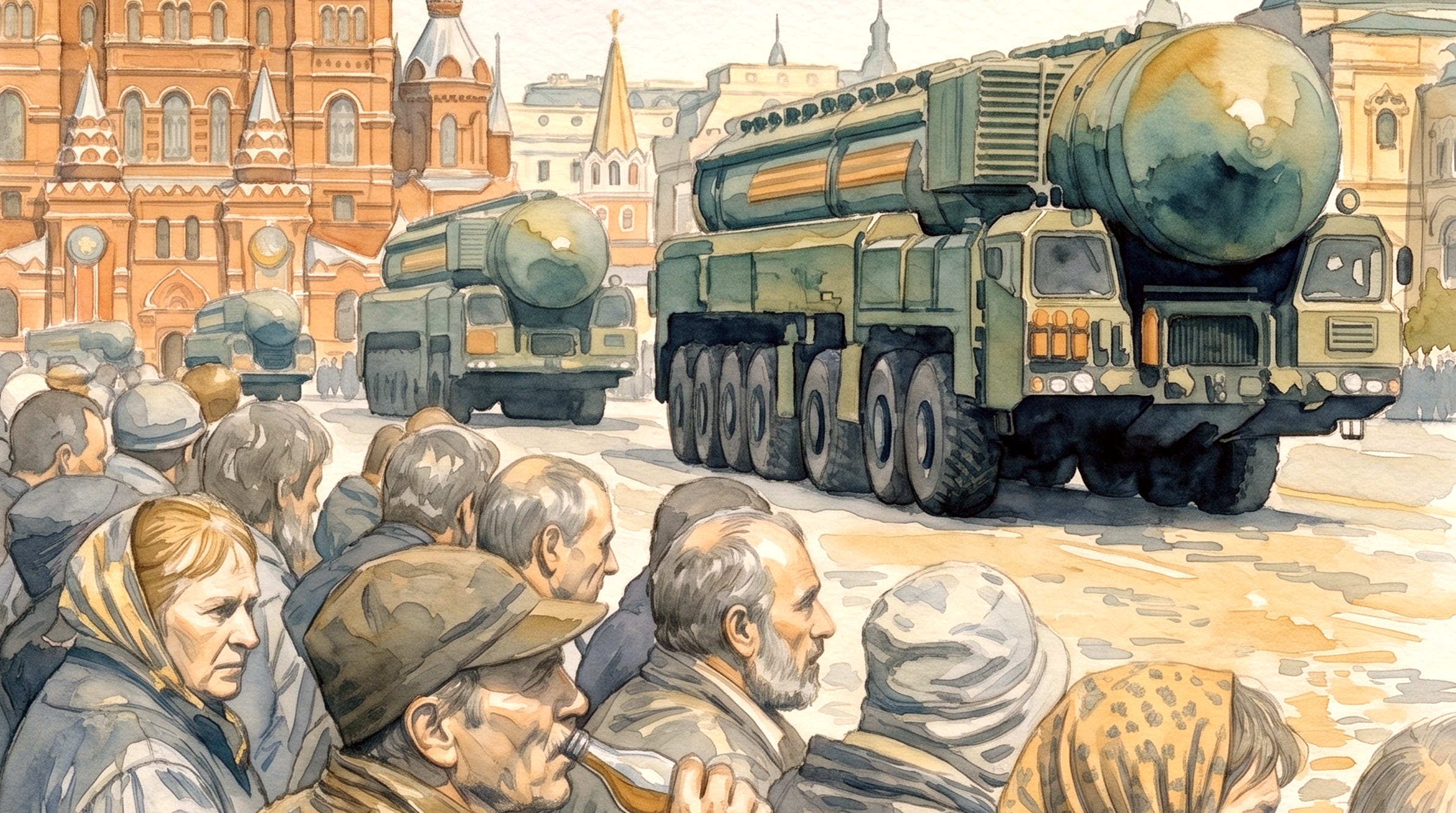
Russia’s failure to prosperous and pleasant like Norway is the result of a political choice. Modern Russia has chosen militarization over prosperity, war over development, and control over transformation. The consequence is a country that operates far below its potential, while its population pays the price for a system that prioritizes power projection over living standards.
We publish this newsletter every day at 9:05am NYC time / 4:05pm Kyiv.If you’re not already subscribed, why not do so now?
What is missing is … a model of life that people would actually want to live in and others might even want to emulate.
Back in Soviet times people knew the saying: “We are poor, but at least we are powerful.” Projection of international power and fear was more important for the Kremlin and even for a lot of people, who accepted being poorer than the West in exchange for the illusion of power over huge parts of the world.
The economic gap illustrates this failure with brutal clarity. Russia, with roughly 140 million people, produces around 2.1 trillion dollars in GDP, which translates into approximately 14,000 to 15,000 dollars per capita. Norway, a country of just 5.5 million people, reaches between 85,000 and 95,000 dollars per capita. This is not a small difference, nor is it an inevitable one. It reflects a divergence in how two resource-rich countries chose to organize their economies and societies. One built long-term wealth and stability, while the other extracted enormous value and failed to translate it into broad prosperity. Because in terms of raw potential, Russia is not behind, it is ahead.
Russia is one of the most resource-rich nations on earth, with vast reserves of oil, gas, coal, metals, timber, and freshwater. Entire regions, especially east of the Urals, remain underdeveloped, not because they are unusable, but because their development would require long-term planning, infrastructure investment, and a willingness to think beyond immediate control.
Norway, by contrast, has a far smaller and more concentrated resource base, largely limited to North Sea hydrocarbons. Yet it transformed that limited advantage into a sovereign wealth fund exceeding 1.5 trillion dollars, effectively securing prosperity for future generations.
And the explanation does not lie in a lack of human capital. This is a country that sent the first human into space, Yuri Gagarin, and conducted complex interplanetary missions, including multiple probes to Venus. These achievements required a highly capable scientific and engineering base, and that base did not simply vanish, although much of that base was indeed Ukrainian.
Even today, Russia maintains a solid educational system, particularly in mathematics, physics, and engineering, capable of producing skilled specialists. The idea that Russia lacks the intellectual capacity to build a high-income society is simply wrong. The limitation lies in how that capacity is used.
The scale of Russia’s unrealized prosperity is enormous. It is not a theoretical scenario, but a plausible alternative path that was never taken.
A system built around centralized control of resource revenues has little incentive to distribute wealth broadly or to encourage independent economic development. Diversification remains limited, innovation is constrained by political structures, and long-term growth is subordinated to stability and control. The result is a form of managed underperformance: strong enough to sustain itself, but structurally incapable of reaching its full potential. This becomes even more evident when considering what Russia could realistically achieve. Even a partial convergence with countries like Norway, say, reaching half of its per capita income, would imply 40,000 to 50,000 dollars per capita across a population of over 140 million people. That would represent one of the largest affluent societies in the world. The scale of Russia’s unrealized prosperity is enormous. It is not a theoretical scenario, but a plausible alternative path that was never taken.
What is missing, ultimately, is not capability but direction and more precisely, the absence of a civilizational vision that translates material wealth into a model of life that people would actually want to live in and others might even want to emulate. Norway offers such a model: high living standards, social security, institutional trust, a functioning balance between state and individual. Russia, despite having the raw means to construct something comparable, does not present a similarly coherent or attractive vision. Instead of expanding opportunity, it narrows it, instead of projecting stability, it projects power, and instead of building a future, it manages the present.
What might once have been a question of missed opportunities becomes, over time, a pattern that is difficult to reverse.
Russia’s war on Ukraine just further locks-in managed decline. A system that directs increasing shares of its resources into sustained war, into military production, into strategic confrontation, is structurally moving further away from any path that would lead toward broad prosperity and long-term development. War compresses time horizons, absorbs talent, and hardens political structures. It reduces flexibility precisely where flexibility would be required to change course.
What might once have been a question of missed opportunities becomes, over time, a pattern that is difficult to reverse. The result is a country that continues to carry within itself the potential for a different future, yet simultaneously moves in the opposite direction. Russia could offer its population a high standard of living, a stable economic outlook, and a forward-looking societal model grounded in its immense resources and its still considerable human capital. Instead, it offers endurance, mobilization, and authoritarian control. That is the real cost of this trajectory, not just for Ukraine or Europe, but for Russia itself: a prosperous, livable future remains possible in theory, but will never become reality in practice.
What further weakens this already fragile trajectory is that the alternative Russia claims to offer on a civilizational level does not withstand closer scrutiny either. The narrative of a more traditional, more rooted, more “authentic” society, a society built around Orthodoxy, cultural continuity, and supposedly stronger social cohesion, sounds, at least on the surface, like a countermodel to what is often described as a fragmented and overstretched West.
But in practice, this promise remains largely unfulfilled. Russia faces many of the same structural problems it criticizes elsewhere: demographic decline, high divorce rates, social dislocation, alcoholism, regional inequality, and a noticeable lack of long-term orientation among parts of its population. Migration pressures exist, integration challenges persist, and the idea of a socially cohesive, internally stable, value-driven society begins to fade the closer one looks.
If Russia were offering a genuinely functioning alternative, a society perhaps less wealthy, but more stable, more meaningful, more grounded, one could at least argue that it has chosen a different, coherent path. But even that claim does not hold.
What remains instead is a gap on both levels: economically, the country underperforms relative to its immense potential, and civilizationally, it falls short of the very standards it sets for itself. The promise of being a more traditional, more coherent, even spiritually renewed version of Europe does not materialize in reality. On the contrary, it remains rhetoric without a corresponding societal outcome.
The Kremlin Elite has chosen war and has closed the doors on a brighter future.
If you’re not already subscribed, why not do so now?