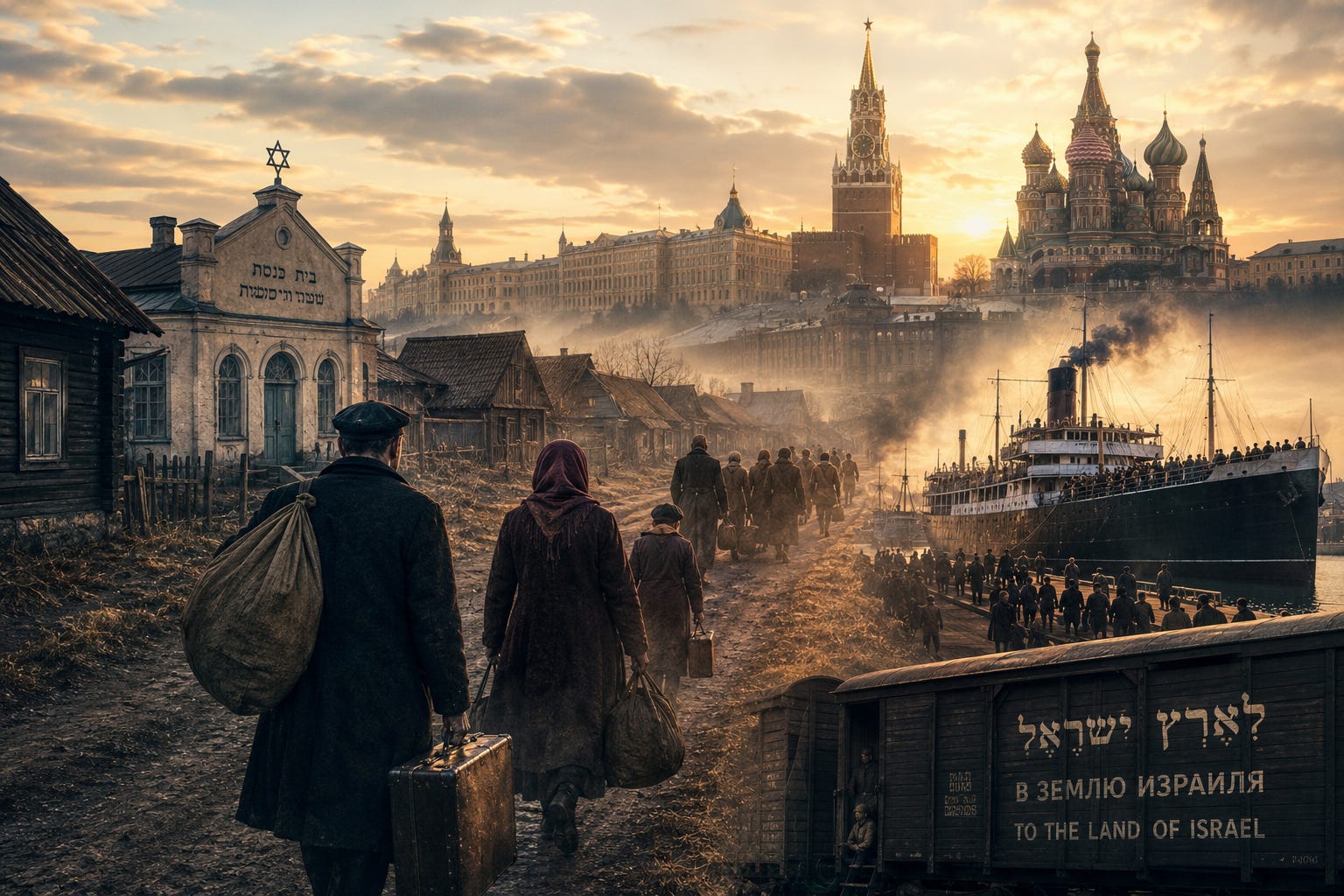
This is another chapter in The People Who Carried Their World , my ongoing series tracing the Jewish diaspora across countries, centuries and migrations. If you’re new to the series—or want to explore the chapters already published—you can find them all in The Map They Couldn't Erase, the living index to the project.
For most of its history, Russia had relatively few Jews. Then, in 1772, the Russian Empire joined Prussia and Austria in carving up the Polish-Lithuanian Commonwealth and suddenly found itself ruling hundreds of thousands of them. Two more partitions followed in 1793 and 1795. By the time Poland-Lithuania had disappeared from the map, Russia had absorbed close to a million Jews, along with towns, synagogues, schools, cemeteries, businesses and communal institutions that had already been there for generations.
The Jews hadn’t migrated into Russia looking for a home. Russia expanded into the places where they were already living, more than a thousand years after the larger Jewish diaspora had begun spreading out of ancient Israel and Judea.
Jewish communities existed throughout the Mediterranean long before Rome destroyed Jerusalem and the Second Temple in 70 CE, and Roman conquest dispersed still more Judeans through the empire. Captives were taken to Italy, where Jewish communities were already established, and Jewish life grew throughout the Roman and post-Roman world. Over the centuries, communities developed in Italy and what is now France and Germany. By the early Middle Ages, important Jewish centers had emerged along the Rhine in Mainz, Worms and Speyer.
These communities became the heart of Ashkenaz, the Hebrew name medieval Jews used for the German lands. Jewish migration gradually moved farther east into Bohemia, Poland and Lithuania, accelerated by expulsions, Crusader massacres, economic restrictions and the search for places where rulers were willing to let Jews settle and work. Polish rulers issued charters protecting Jewish commerce and communal life, and the Jewish population grew dramatically over the following centuries.
The route wasn’t genetically or historically sealed. Jews married converts and absorbed some European ancestry along the way, while retaining substantial ancestry shared with other Jewish and Middle Eastern populations. The community that emerged in Central and Eastern Europe was unmistakably European in some of what it had acquired and unmistakably Jewish in the peoplehood, religion, historical memory and ties to the ancient Jewish homeland that it carried forward.
By the eighteenth century, the Polish-Lithuanian Commonwealth had become the demographic center of the Jewish world. Jews there spoke Yiddish, maintained extensive networks of yeshivas and synagogues, printed books, traded across borders and developed communal institutions that governed much of Jewish daily life. Hasidism emerged in this world during the eighteenth century, along with the fierce rabbinic opposition to it. When Catherine the Great acquired these Jews during the partitions, she was absorbing a civilization that had developed long before Russian officials arrived.
There were also Jewish communities that reached Russian rule by different roads. Jews had lived for centuries around Crimea, the Black Sea and the Caucasus, with connections to older Jewish populations in Byzantium, Persia and the Near East. The expanding empire eventually ruled Mountain Jews, Georgian Jews, Krymchaks, Karaites and, after Russian expansion into Central Asia, Bukharan Jews. By the nineteenth century, several branches of the Jewish diaspora had been brought under the same tsar.
Russia now had to decide what to do with them.
Russia had repeatedly restricted Jewish settlement in its interior before the partitions. Once Catherine ruled hundreds of thousands of Jews, the issue became impossible to avoid. In 1791, following complaints from Moscow merchants about Jewish competitors, her government restricted where Jews could permanently settle. A series of decrees expanded and formalized those boundaries into what became known as the Pale of Settlement.
The Pale eventually covered about 472,000 square miles, including much of present-day Lithuania, Belarus, Ukraine and Moldova, large portions of Poland and smaller areas of western Russia. Most Jews were prohibited from permanently settling in Moscow, St. Petersburg and much of the Russian interior unless they fell into an approved category tied to profession, education, wealth, military service or another exemption. Even inside the Pale, additional regulations could exclude Jews from certain villages, border regions and other areas.
Millions of people lived inside those boundaries. Towns throughout the former Polish-Lithuanian lands developed substantial Jewish populations, sometimes Jewish majorities. The Yiddish word shtetl simply meant town, and the places later reduced in popular memory to tiny villages could be busy commercial centers filled with synagogues, schools, markets, workshops, charities, burial societies, libraries and religious courts.
The first empire-wide census in 1897 counted 5,198,401 Jews in the Russian Empire, including Congress Poland. By then Russia ruled the largest Jewish population in the world.
Residential restrictions were only part of the system. Beginning in the 1880s, quotas limited Jewish admission to secondary schools and universities, with tighter limits outside the Pale. Occupational restrictions closed other doors. A young Jew could meet the academic standards for a university and still be rejected because the permitted Jewish percentage had already been filled.
Under Tsar Nicholas I, state policy reached directly into Jewish families.