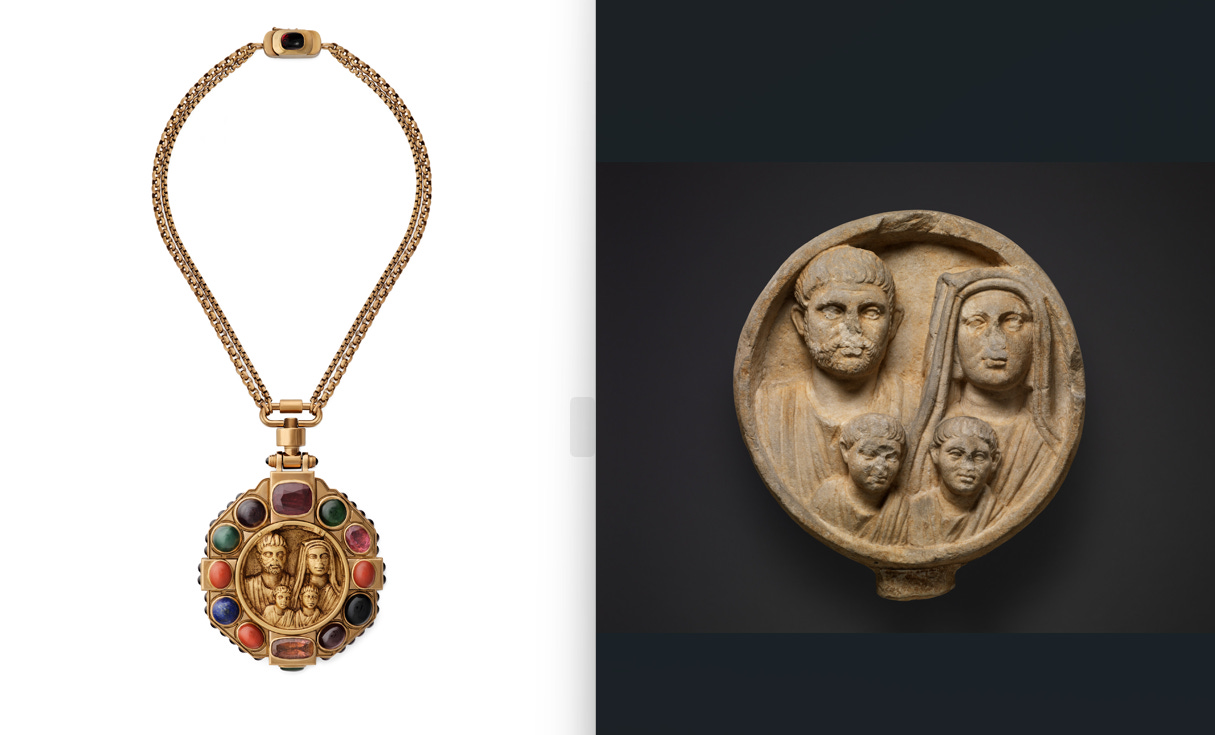
On September 15, the New York Fashion Week (NYFW) will see the launch of a new Sabyasachi Mukherjee collection. And I’m not just speaking of couture — which he will showcase at the Spring-Summer 2027 lineup — but jewellery that will also be shown on September 15, the last of the six-day event. Sabyasachi’s accessories and jewellery collection have been part of the quintessential look that he has created over the past 26 years of operations. So why am I talking about this new collection that launches at his second outing in the NYFW?
I recently sat down with Sabyasachi and the head of Global Licensing and Partnerships at the Metropolitan Museum of Art (also called the Met), Josh Romm, to discuss their unique partnership that has resulted in a range of jewellery pieces inspired by the museum’s Byzantine Empire collection that dates back over two millennia and comprises a number of artefacts from sarcophages to caskets to book cover plaques to coins. The partnership is a multi-year deal — Sabyasachi did not clarify the precise number of years when asked — and will launch with a 100-piece collection of 18k and 22k gold ornaments made with precious stones like diamonds, garnets, tourmaline, jade, jasper, onyx and turquoise.
The idea, Sabyasachi said, was to take objects of importance from the museum’s collection, “which had nothing to do with jewellery” and convert them into modern pieces.
“I was always also very clear that I do not want the jewellery to become too archaic, and fussy but to have a certain sense of modernity. So, what we created was what we in our heads called Industrial Baroque. There is the object inspired from the Met’s collection, which is hand-made, made in 22-carat gold. Then there are surrounding peripherals like the chain or the bail, which are machine-made, industrial modern, 18-carat gold,” Sabyasachi said.
Getting this amalgamation right took multiple attempts — somebody flew down to Italy to get the right alloy to mix with the gold to ensure that the colour difference was just right; the stone cutters and engravers in Jaipur had to train their ‘karigars’ in tools that had gone out of use after mechanisation set in — and, though prized as luxury products, Sabyasachi said that the products would have multiple iterations because the intention was not to make it a collector’s item but for “more people to have access to it”.
Counter-intuitive though it sounds, Sabyasachi is onto an important shift in the luxury market that has become more pronounced since the Covid-19 pandemic, as wealth pockets among the existing rich and the global luxury market has seen a steady rise. The band of luxury buyers has expanded, and brands need to redefine the stories they’re selling to remain relevant. If Sabya’s maximalist nonchalance formed the core of his brand in the past, today, he recognises the need to include the karigar’s story, the journey of the precious stone from quarry to jewellery, the provenance of his design. The new buyer wants emotional connection and authenticity, and for Sabyasachi, nothing can offer a bigger stamp of it than a museum, because, as he puts it, “in this age of misinformation, an object cannot lie.”
But what is this truth that brand collaborations bring out?
For Romm, whose previous roles include an executive position at the Smithsonian and who has also consulted with artist estates, it boils down to revenue and footfall. The proceeds that come from the Met’s brand collaborations support the collection, including its study and conservation. “As a licensed category, art continues to grow in market share around the globe, and the impact to institutions has a meaningful impact on revenue and visitation,” he said. The collaborations are “across the spectrum,” he said. Recently, Australian fashion brand Camilla created a series of prints that compiled hundreds of works in the department of European Sculpture and Decorative Arts, while American apparel brand Pacsun developed more than a dozen fashion collections over the last three years targeting Gen Z consumers. In jewelry, Munnu The Gem Palace, Silvia Furmanovich, Hanut Singh, J. Hannah, and Pamela Love “have created collections directly inspired by works in The Met collection”.
The bid to remain relevant to an audience that consumes everything digitally points to the centrality of their role in the art and luxury ecosystem. Their engagement is their currency; if it dips, the market loses out on an essential component: attention.
And what underlies attention? In my opinion, genuine human interest in the stories we tell each other. For instance, notice the figures in the wrist cuff of Sabya’s collection. Greek god Dionysus is seated on a panther surrounded by larger standing figures who represent the four seasons: Winter, Spring, Summer, and Fall. The imagery itself isn’t new. What is unusual, however, is that the seasons are usually portrayed as women, whereas in this image, they are shown as sturdy youth, a strange and interesting departure seen even in the source image, a Marble sarcophagus dating back to the third century. So strong is the myth of Dionysus that two centuries later, an epic would be written by a poet in which Dionysus, the god of wine, vegetation, abundance and ecstasy, would march his troops all the way to India to defeat a fictional king here and cement his place in the pantheon of Greek gods. (Dionysiaca by Nonnus)
On Tuesday, a wrist cuff will grace a New York runway, which invokes a 2000-year old mythology, retold multiple times across centuries and geographies, memorialised in epic poetry, sarcophagi and now, high jewellery. It is this engagement with stories — central to being human — that remains our most valuable currency.
Dhamini Ratnam is culture editor at Hindustan Times. Ways of Seeing is her fortnightly newsletter that takes you through only the most important cultural happenings you need to know of. You can write to her at dhamini.ratnam@htlive.com or comment on this newsletter below.