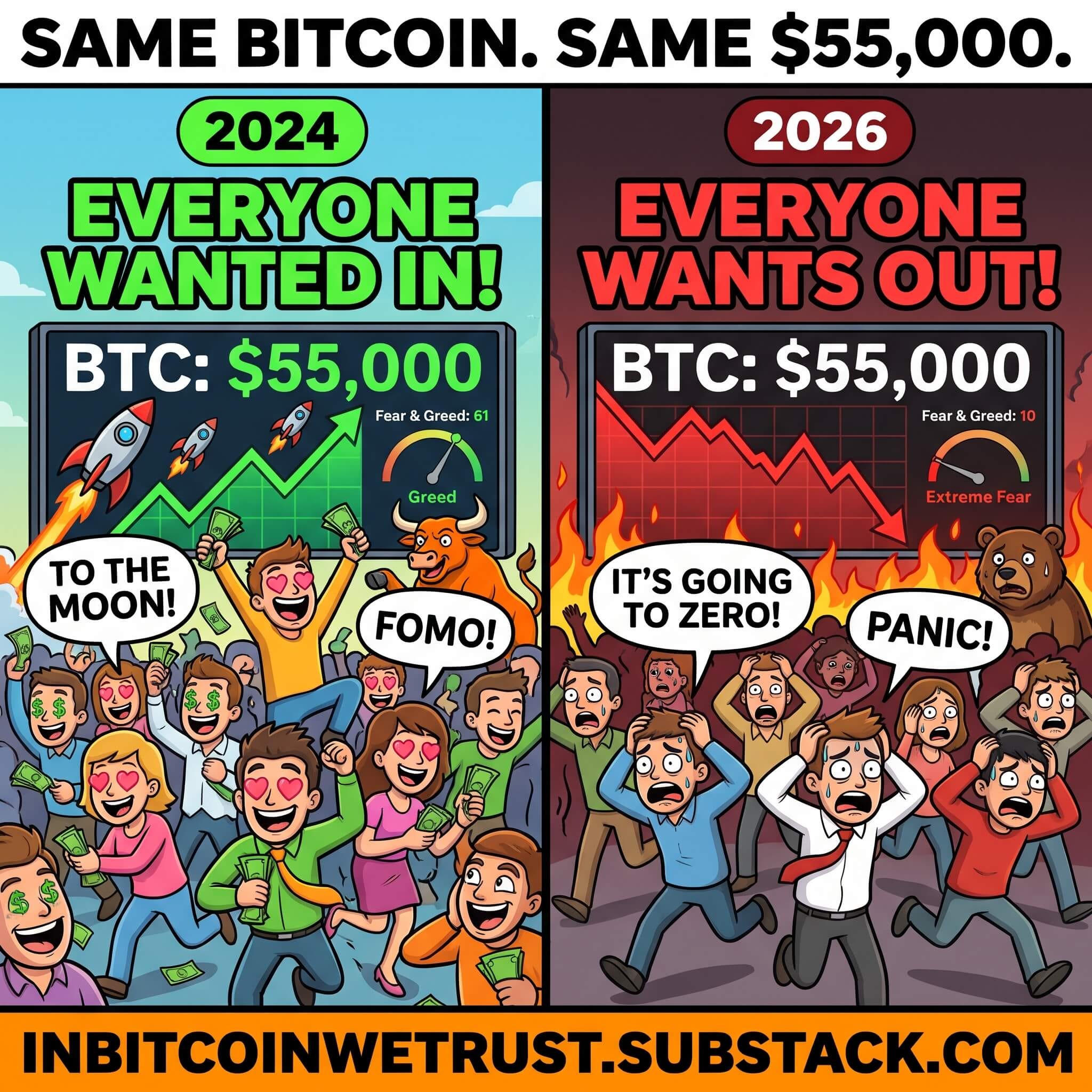
In 2024, $55,000 felt like a once-in-a-lifetime launchpad to the moon. In 2026, it feels like a trapdoor straight to zero. Inside the psychological illusion that keeps 95% of investors permanently broke.
Bitcoin at $55,000 in 2024: EVERYONE WANTED IN.
Bitcoin at $55,000 in 2026: EVERYONE WANTS OUT.
Stop scrolling for ten seconds and stare at those two lines.
Don’t stare at the bleeding candlestick chart on your phone. Don’t stare at the liquidation feed scrolling like a ticker tape at a funeral. Don’t stare at whatever frantic thumbnail YouTube just pushed onto your screen featuring a wide-eyed influencer, glowing red lasers, and a giant arrow crashing through the floor. Just sit quietly with the pure, unfiltered absurdity of human psychology captured in twelve words.
Same Bitcoin. Same immutable 21 million hard cap. Same global, decentralized network of independent nodes verifying transactions roughly every ten minutes without asking a single president, central banker, regulator, or Wall Street executive for permission. Same open-source code humming along with zero CEO, zero marketing department, zero quarterly earnings calls, and zero concern for how your stomach feels this morning.
Same price: $55,000.
Yet look at the emotional thermometer of the market:
2024:Crypto Fear & Greed Index at61. 🟢*(Greed)2026:Crypto Fear & Greed Index at10. 🔴(Extreme Fear)*
Even more remarkable is the speed at which human conviction dissolves when the screen turns red.
Literally yesterday, people were nervously sweating over $63,000 and $61,000. Overnight, the floor gave way again, dragging Bitcoin straight down to $55,000. And just like that, the last thin layer of bravado evaporated from the room.
Close your eyes and think back to what $55,000 felt like in 2024.
Remember the electricity crackling in the air? Your cousin who hadn’t texted you since the holidays suddenly wanted to grab coffee to ask which app he should download before Monday. The financial television anchors who had spent two straight years smirking at digital assets were suddenly breathless over spot ETF inflows and institutional adoption. Group chats lit up past midnight with screenshots, laser-eyed memes, and back-of-the-napkin early retirement spreadsheets. At $55,000 in 2024, people felt painfully, urgently late. They felt a sharp sting of regret that they hadn’t backed up the truck at $35,000. They were practically tripping over one another to wire cash onto exchanges before the rocket cleared the atmosphere without them.
Now look around at $55,000 in 2026.
The group chats are tombstones. The loudest evangelists from last year have quietly stripped the orange emojis out of their bios and pivoted to posting about AI startups, marathon training, or sourdough bread. The same financial commentators who couldn’t stop celebrating Bitcoin’s “digital gold supercycle” twelve months ago are back on air smirking about speculative bubbles. People aren’t asking how to buy; they’re staring at their phones in the dark, silently calculating how much money they’ll have left if they hit sell before the whole thing supposedly goes to zero.
What changed?
Nothing inside the Bitcoin protocol changed. Not a single line of its monetary policy was edited. No emergency committee voted to print another ten million coins. The scarcity didn’t soften. The block clock didn’t skip a beat.
The difference wasn’t in the code. The difference was in the movie playing inside people’s heads.
In 2024, people were dreaming about $100,000.
In 2026, they’re having nightmares about crashing straight through $50,000—and tumbling into the $40,000s or $30,000s.
And right there—inside that chasm between a dream and a nightmare bolted onto the same asset at the same price—lives the single biggest reason most people never build serious, lasting wealth in financial markets.
Jensen left after 33 years. Musk called hiring him “an honor.” Inside Terafab, they could build the titan that swallows NVIDIA whole.
Most of us love to flatter ourselves into believing we are cold, rational evaluators of value. We read the lengthy macro essays. We track sovereign debt trajectories and global liquidity charts. We nod seriously at debates over fiscal deficits and currency debasement. We tell ourselves our financial decisions are anchored in objective logic and first principles.
Most of the time, we are lying to ourselves.
The human brain is catastrophically bad at evaluating absolute numbers. Evolution never asked our ancestors to price scarce global monetary networks; it asked them to detect sudden movement in the tall grass and stay with the herd. As a result, our minds are wired almost exclusively to process direction and contrast. Plunge your hand into a bowl of lukewarm water after gripping an ice cube, and the water feels startlingly hot. Plunge the same hand into the same bowl after holding a steaming mug of coffee, and the water feels cold.
The temperature of the water did not move by a fraction of a degree. Your reference point did.
In behavioral economics, Nobel laureate Daniel Kahneman and Amos Tversky spent decades demonstrating that human beings do not experience wealth in absolute terms—we experience it relative to an emotional anchor. Worse still, their landmark research on loss aversion proved that the psychological agony of losing a dollar hurts roughly twice as much as the pleasure of gaining a dollar feels good.
In 2024, $55,000 was lukewarm water after two long years of clutching an ice cube. Investors were crawling out of the frostbitten crypto winter of 2022 and 2023, when Bitcoin had scraped the bottom near $15,500 and mentioning Bitcoin at a dinner table earned you the same polite silence as bringing up an MLM scheme. Watching $55,000 flash across the screen felt like stepping out of a bunker into warm spring sunlight. Every tick higher validated your intelligence. If you had bought at $20,000 or $30,000, you felt like a prophet. Even if you bought right at $55,000, the slope of the line pointed aggressively up and to the right—and our ancient tribal wiring interprets upward momentum as safety. Everyone is running this way, so there must be shelter ahead.
Now fast forward to 2026.
In 2025, Bitcoin climbed all the way to approximately $126,000. For a dizzying, intoxicating stretch of months, $126,000 burned itself into the collective psyche as the new permanent baseline. People didn’t merely look at $126,000—they moved in and furnished the place. They mentally spent that paper wealth. They recalculated their net worth at $126,000. They browsed lakefront real estate at $126,000. They silently drafted resignation letters in the shower at $126,000.
And then the market did what Bitcoin has always done to anyone who gets too comfortable: it ripped more than half the price away.
So when you look at $55,000 today, your brain does not actually register $55,000. It registers minus $71,000. It sees a vicious 56% amputation. It sees the mortgage you didn’t pay off, the profits you didn’t lock in, and the humiliating suspicion whispering in the back of your skull that you were the naive exit liquidity left holding the bag while smarter insiders quietly cashed out near the peak.
The market doesn’t just reprice your portfolio. It hijacks your identity.
When the price is climbing, you feel like a visionary who understood the future before the rest of the world woke up. When the price is falling—especially when it drops from $63,000 to $61,000 to $55,000 in a single nauseating blur—you feel like an idiot who got seduced by a fairy tale. And because human beings will pay almost any financial penalty to escape the sting of feeling foolish—even in the privacy of their own thoughts—they immediately start hunting for narratives that validate their pain.
Suddenly, every bearish headline sounds remarkably sophisticated. Suddenly, the same career skeptics you laughed at during the bull run sound like the only sober adults in the room. Suddenly, you are no longer evaluating Bitcoin’s fixed supply, censorship resistance, portability, or long-term adoption curve. You are simply searching for an intellectual permission slip to end the emotional torture.
That isn’t an analysis of Bitcoin’s value. That is an emotional reaction to its recent price.
Right now, the panic feels uniquely unbearable because of how fast it happened.
One moment Bitcoin is fighting to hold the low $60,000s. The next moment it slices cleanly through $60,000 and lands at $55,000. When a drop happens that violently, the human mind instinctively assumes something catastrophic must have broken underneath the hood.
Look at the actual catalysts rattling markets this week: Wall Street anxiety over hawkish Federal Reserve minutes hinting at higher rates, a sharp tech-stock sell-off dragging global risk sentiment into Extreme Fear, consecutive days of heavy outflows from spot Bitcoin ETFs, and massive waves of leveraged futures liquidations wiping out nearly $2 billion in overextended positions in a single 24-hour sweep.
Read that list again carefully.
Notice what is not on that list?
Bitcoin wasn’t hacked. Its cryptographic security wasn’t cracked. Its 21 million supply cap wasn’t breached. Its network didn’t go offline for five minutes, let alone five days.
What you are watching at $55,000 is not a protocol failure. It is a mechanical liquidity purge.
When leverage piles up across derivatives exchanges and short-term Wall Street capital rushes for the exit simultaneously over macroeconomic jitters, selling feeds on itself. A 4% dip triggers forced margin calls. Forced margin calls dump spot supply onto thin order books. That extra selling pushes price down another 5%, tripping stop-losses and spooking ETF holders into redeeming shares the next morning. Within 48 hours, a routine macro scare snowballs into a full-blown cascade—and the Fear & Greed Index plunges all the way down to 10.
Here is the crucial distinction that separates generational investors from perpetual victims of market cycles:
Forced sellers do not sell because an asset is worthless. They sell because they have to.
A leveraged trader getting liquidated at 3:00 AM doesn’t have a view on Bitcoin’s value in 2029. A hedge fund de-risking across tech and crypto before a Federal Reserve meeting doesn’t care whether Bitcoin’s monetary properties are intact. They are reacting to margin requirements, quarterly benchmarks, and short-term panic.
Yet when retail investors watch the resulting red candle slam from $63,000 down to $55,000, they mistake a forced liquidation cascade for a verdict on Bitcoin’s long-term survival. They watch someone else’s margin call—and respond by voluntarily liquidating their own unleveraged spot holdings at the same fire-sale price.
Whenever the Fear & Greed Index hits 10, the four most expensive words in financial history start echoing from every corner of the internet: “This time is different.”