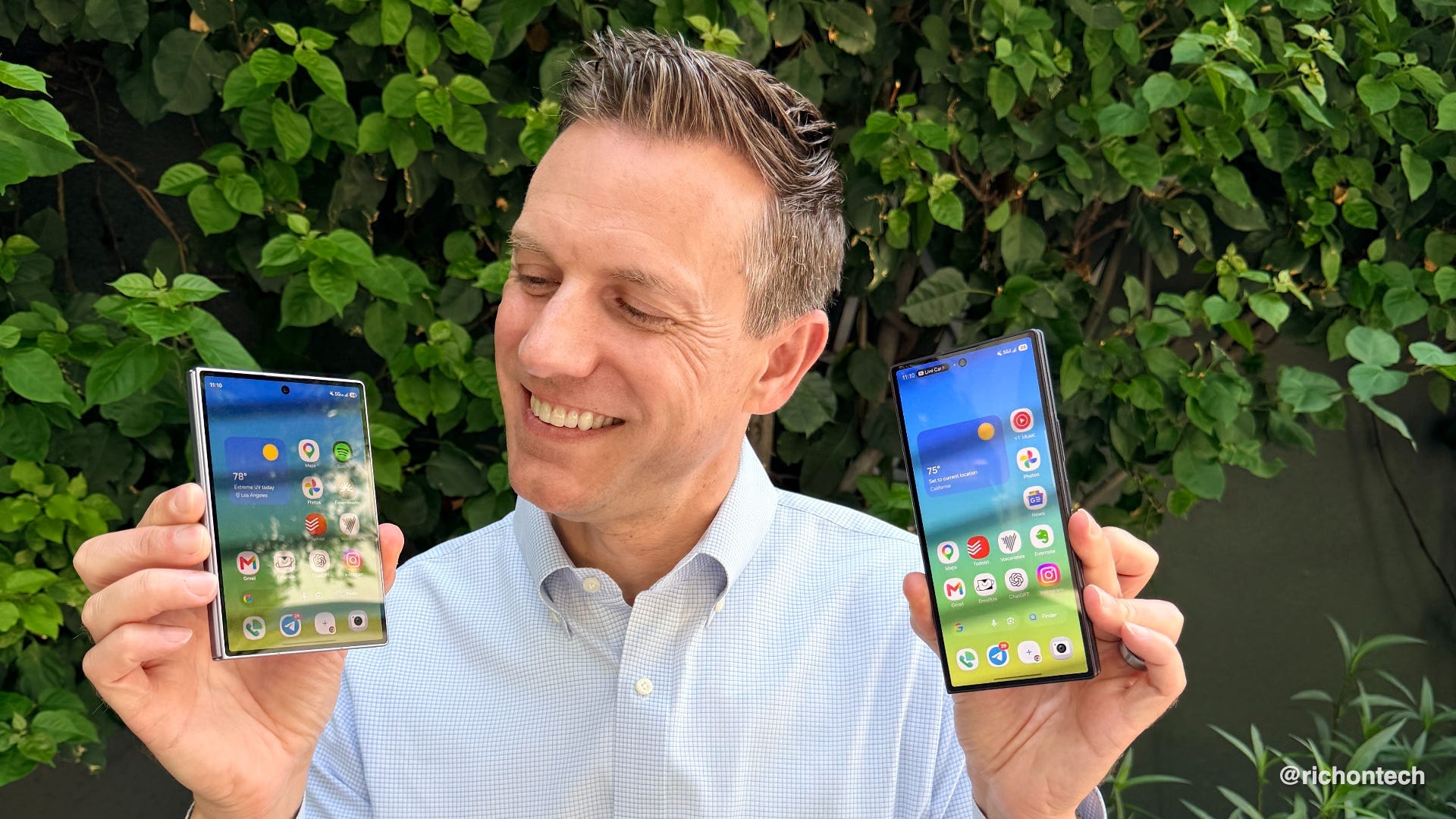
After spending time with Samsung’s new Galaxy Z Fold 8 and Galaxy Z Fold 8 Ultra, I now think something I haven’t said about previous foldables: these finally feel ready for everyday use.
Samsung brought me to London for their launch, where I spent a day sightseeing with both phones in my pocket. While the company is offering two versions this year, it’s the standard Fold 8 that really surprised me.
It’s lighter, easier to hold, and the wider front display makes everyday tasks much more comfortable than previous Samsung foldables. I could quickly check email, send messages, and browse the web without immediately feeling like I needed to unfold the phone. The only downside is that some apps, especially social media, don’t always scale perfectly to the unusual aspect ratio. I also found when they keyboard is on screen it can get a little cramped.
Open it up, though, and that’s where the experience really shines. The large inside display is fantastic for reading, watching videos, and multitasking. I found myself running multiple apps side by side far more often than I expected because it was so convenient.
Performance was excellent throughout my testing. Everything felt fast and polished, and battery life got me through the day. Samsung also made the phones easier to open, and the side mounted fingerprint reader is exactly where your thumb expects it to be.
The cameras are solid, even if they aren’t Samsung’s absolute best. The dual 50 megapixel system on the Fold 8 is more than capable for everyday photos. One feature I especially enjoyed is My FanCam, which can automatically create a video that follows a single person in a group. I immediately thought about parents using it to make highlight clips of their kids playing sports.
Samsung also improved the durability of the inside display with a new Flex Titanium layer and better anti reflective coatings. The crease is still there, but it’s not a big deal during daily use.
The Ultra model offers more advanced cameras and a hinge that stays open at virtually any angle, but it’s also taller, heavier, and its narrow outside screen still isn’t my favorite.
Neither phone has built in magnets for magnetic accessories, so you’ll need a case if that’s important to you. This, in turn, adds extra bulk, which is a disappointing on devices this thin.
These phones are expensive, starting around $1,900 for the Fold 8 and $2,100 for the Ultra. But if you’ve been waiting for foldables to feel less like an experiment and more like a phone you could actually live with every day, Samsung has made its strongest case yet.
Disclosure: I may earn a commission from purchases made through links in this post, at no additional cost to you.