Saylor RT'd a DeFi Protocol 4 Times in One Week. I Had to Look Into It.
Saylor RT’d @apyxfi 4 times in 7 days. 22%↑ Strategy’s preferred stock into on-chain yield. $277M TVL in 3 months. 13% APY from real corporate dividends plus an airdrop on top. Here’s everything. How it works, where the yield comes from, the Saylor connection, the risks nobody’s mentioning, and whether the farming math actually works.
Per-article narration is paused while we focus on the 9 daily compilation episodes. Listen to today's Finance daily brief — the story below is covered there alongside the rest of the day's reads. The full article text is below — read along while we ramp narration back up.
Saylor RT’d @apyx_fi 4 times in 7 days. A protocol wrapping STRC 0.22%↑ Strategy’s preferred stock into on-chain yield. $277M TVL in 3 months. 13% APY from real corporate dividends plus an airdrop on top.
Here’s everything. How it works, where the yield comes from, the Saylor connection, the risks nobody’s mentioning, and whether the farming math actually works.
You can also watch this on Youtube as I break it down on a video format.
You can’t understand Apyx without understanding what it’s built on.
Strategy Inc (formerly MicroStrategy) is a Nasdaq-listed company that pivoted from enterprise software to becoming a Bitcoin treasury company. Their playbook: raise money through capital markets, buy Bitcoin, hold it forever.
The problem: how do you keep raising money to buy more Bitcoin without diluting your common shareholders (MSTR holders)?
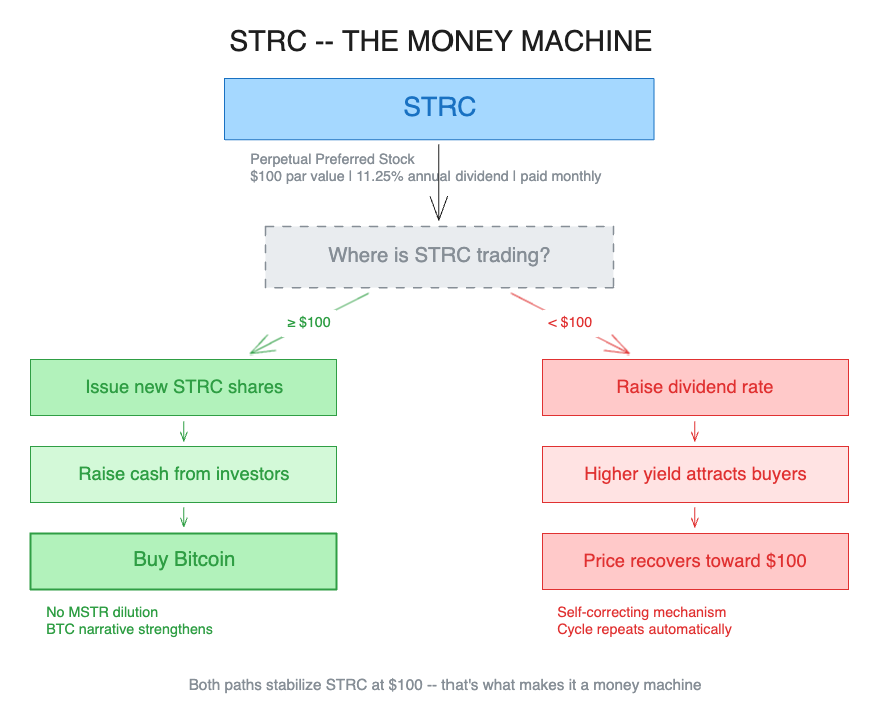
$STRC is Strategy’s Variable Rate Series A Perpetual Preferred Stock. Think of it like a bond that never matures but pays dividends forever.
Par value: $100/share.Strategy wants STRC to trade near $100Dividend: 11.25% annually, paid monthly in cash. 100 shares ($10K) = ~$1,125/year, ~$94/month**Variable rate mechanism:Strategy adjusts the dividend rate monthly to pull STRC toward $100. Below par = raise rate to attract buyers. Above par = can lower itCapital raise mechanic:**When STRC trades at/above $100, Strategy issues NEW shares and uses proceeds to buy Bitcoin. No MSTR dilution
When STRC trades at or above $100, Strategy issues new shares, raises cash from investors, and buys Bitcoin. When STRC drops below $100, Strategy raises the dividend rate to attract buyers. Price recovers back toward par.
Self-correcting. In 2026 alone, STRC-funded purchases bought ~77,000 BTC -- 10x more than all US spot Bitcoin ETFs combined. Strategy is on track to hold 1M+ BTC by late 2026 at this pace.
STRC trades at/above $100 → Strategy issues new STRC shares → Raises cash → Buys Bitcoin → BTC goes up → MSTR common stock goes up → Market confidence grows → STRC stays at/above $100 → Issue more STRC → repeat.
BTC crashes hard → MSTR drops → Market confidence falls → STRC drops below $100 → Can’t issue new STRC (nobody buys below par) → Can’t buy more BTC → BTC narrative weakens further → Possible dividend cut if capital dries up.
STRC has traded as low as $85-$95 during stress periods. The dividend is “an economic tool, not a legal guarantee” -- Strategy can reduce, suspend, or delay it. STRC holders rank junior to all debt.
Bottom line on STRC: High-yield preferred share (~11.25%) from a company that is essentially a leveraged Bitcoin bet. Yield is real and paid monthly, but only flows as long as Strategy’s BTC-fueled capital machine keeps working.
Apyx takes STRC (and SATA from Strive Inc at 12.25% dividend) and wraps them into DeFi-native tokens. The protocol buys the shares, holds them off-chain via custodians, and issues on-chain tokens representing that value.
Two tokens. Two layers. Different purposes.
A synthetic dollar representing a claim on the underlying collateral (STRC + SATA + cash/Treasuries).
Backed by preferred shares + cash buffer. Protocol holds ~$130M+ in STRC alone (1M+ shares)
Designed to trade near $1, but explicitly not a hard peg -- docs say it “may trade modestly above or below $1”
**Earns zero yield.**apxUSD by itself does nothingRight now, almost entirely held for points farming. Without points, there’s no reason to hold apxUSD over USDC
Retail buys on secondary (Curve, Aerodrome, PancakeSwap). Whitelisted institutions mint/redeem directly
The ERC-4626 vault token where actual yield lives.
Deposit apxUSD, get apyUSD. Yield comes from the dividends the underlying STRC and SATA shares actually pay
Current APY: ~12.95% (May 5 snapshot). 30-day average: 11.1%
Yield accrues by exchange rate rising (like wstETH). No rebasing
Yield rate recalculated monthly based on prior month’s collateral earnings
Protocol retains ~50% of yield to build overcollateralization buffer
**20-day cooldown to withdraw (ERC-7540).**During cooldown: zero yield, exchange rate frozen. One pending request per user -- modifying resets the clock
Let me trace the full chain.
You deposit USD. Apyx mints apxUSD. Protocol buys STRC (11.25%) and SATA (12.25%). Monthly dividends flow in. apyUSD exchange rate rises. You earn ~13%.
Not emissions. Not funding rates. Not a ponzi loop. Corporate dividends from a Nasdaq-listed company.
Four mechanisms working together:
1. Overcollateralization. Total apxUSD minted is constrained by collateral market value. Collateral pool exceeds outstanding apxUSD supply. Exact ratio isn’t disclosed but visible on their transparency dashboard.
2. Whitelisted arbitrage. Only whitelisted institutional participants can mint/redeem directly.
apxUSD above $1: mint from protocol at $1, sell on secondary. Increases supply, pushes price down
apxUSD below $1: buy cheap on secondary, redeem with protocol for $1 of USDC. Decreases supply, pushes price up
Regular users can’t do this -- they trade on Curve/Aerodrome/PancakeSwap
3. Cash & Treasury buffer. Part of the reserve is in short-term US Treasuries and cash, reducing collateral pool volatility and ensuring redemption liquidity.
4. STRC’s own peg mechanism. Strategy adjusts the dividend rate monthly to pull STRC toward $100/share. The underlying collateral has its own price stabilizer.
What breaks the peg:
STRC drops significantly below par (happened at $90.52 in Nov 2025). Overcollateralization buffer absorbs, but a big enough drop threatens it
Mass redemptions + illiquid STRC markets = protocol can’t sell shares fast enough. Docs acknowledge “liquidity may be more limited outside of traditional trading hours and on weekends”
Redemptions settle in USDC, not underlying shares. Protocol must sell STRC → USDC to process. In a crisis, everyone wants to sell STRC simultaneously
Saylor RT’d @apyx_fi 4x in 7 days (Apr 30 - May 4):
$25M STRC tokenization to STRCx
Voted FOR semi-monthly STRC dividends
PancakeSwap/Base launch
$125M STRC purchase milestone
Not a direct endorsement. But context matters.
Apyx is the largest on-chain STRC holder at ~$130M+ (over 1M shares). They voted in favor of semi-monthly dividends -- which would double yield frequency. They’re positioning as a strategic ally in Strategy’s capital structure.
Saylor benefits because Apyx is a consistent buyer of new STRC issuances. The interest is mutual
100M APYX tokens, fixed supply. 5% goes to S1 farmers (ends May 22), 4% to S2. No VC allocation. Team vests over 4 years. Protocol TVL: ~$277M.
The question is simple: at what APYX price does farming actually beat just holding apyUSD at 13%?
Breakeven vs apyUSD yield (13%): ~$1.10 at 10x hold, ~$0.55 at 20x commit. Below that, you’re better off just taking the yield.
For context: FDV/TVL at $1 = 0.36x. Ethena launched at ~$2B FDV with 10x the brand awareness.
Assumptions: ~151B total S1 points (est. $150M points-earning TVL at avg 12x multiplier over 84 days), S1 pool = 5M APYX.
$0.30 ($30M FDV) -- S1 pool = $1.5M, S2 pool = $1.2M. Disappointing for farmers.
$0.50 ($50M FDV) -- S1 pool = $2.5M, S2 pool = $2.0M. $10K committed at 20x earns ~$1,000. That’s 10% in 12 weeks -- decent but nothing vs holding apyUSD at 13% APY.
$1.00 ($100M FDV) -- S1 pool = $5.0M, S2 pool = $4.0M. Solid. 20x commit = ~$2,000 (20% in 12 weeks). Combined with apyUSD yield, attractive.
$3.00 ($300M FDV) -- S1 pool = $15.0M, S2 pool = $12.0M. Points game clearly outperforms raw yield. 20x commit = $6,000 (60% in 12 weeks).
$5.00 ($500M FDV) -- S1 pool = $25.0M, S2 pool = $20.0M. Home run. $10K commit at 20x = $10,000 airdrop (100% return). Question: does a 3-month-old protocol with no organic demand for its base token deserve $500M FDV?
Hold apxUSD (10x) -- Sitting in a 0% yield token for points. No lock.
Commit apxUSD (20x) -- Same but locked for 14 days. Best risk/reward for most people.
apyUSD base (1x) -- Earning 13% real yield, minimal airdrop. For yield purists.
Pendle LP apxUSD (24x) -- LP fees + high points. IL risk.
Pendle LP apyUSD (11x) -- Lower multiplier, still LP risk.
Pendle YT-apyUSD (13x) -- Leveraged yield speculation, principal decays.
Pendle YT-apxUSD (32x) -- Maximum points, maximum principal risk. Principal decays to zero at maturity by design.
Curve LP + Commit (12x) -- Stablecoin pair, limited IL.
Morpho borrow (5x) -- Borrow apxUSD, earn points on borrowed amount.
$277M TVL. The breakdown matters more than the headline number.
The dominant venue. $252M in STRC-powered assets on Pendle overall (includes Apyx + Saturn’s USDat).
PT-apxUSD (3 markets)-- ~$107M liquidity, $206M TVL. 15.7% fixed yield. ~41 days to maturity. Buy at discount, redeem 1:1 at maturity.PT-apyUSD-- 18.0% fixed yield. ~41 days to maturity. Higher rate because native yield is baked in.LP apxUSD-- 8.55% APY + 24x points. Provide liquidity, earn fees + points.LP apyUSD-- 14.44% APY + 11x points. Lower multiplier, higher base APY.YT-apxUSD-- Variable yield + 32x points. Max leverage. Principal decays to zero at maturity.YT-apyUSD-- Variable yield + 13x points. Lower leverage, same decay mechanic.
Why 67% of TVL is on Pendle: PT tokens let you lock in fixed yield (18%) while avoiding the 20-day apyUSD cooldown. PTs are tradeable -- you can exit anytime at market price. Points multipliers (24x on LP, 32x on YT) make Pendle the most capital-efficient points venue.
Morpho total TVL is $7.2B. apxUSD/apyUSD vault TVL not publicly broken out.
PT-apyUSD as collateral-- Supply PT, borrow USDC/apxUSD at ~1.3-6%. Loop 3-5x for 70-90% APY.PT-apxUSD as collateral-- Same mechanic. Borrow at ~5%. Loop for up to 87% APY.srRoyAPYUSD as collateral-- Supply senior tranche, borrow, loop at ~1.3%. Leveraged covered yield, ~20-30%.Raw apxUSD supply-- Earn base + 5x points. Low effort, points focused.
Why Morpho matters: It’s the leverage layer. The PT looping strategy (buy PT at 18% fixed → deposit on Morpho → borrow at 1.3% → buy more PT → repeat 3-5x) is the highest-yield play at 70-90% APY. Carries liquidation risk if PT prices drop due to apxUSD depeg concerns.
Senior (srRoyAPYUSD)-- ~8-10% APY. Protected by 15% drawdown buffer. Can be looped on Morpho.Junior (jrRoyAPYUSD)-- ~30-40% APY (record 40.05%). First-loss. Gets wiped first if STRC depegs. Now tokenized on Pendle for secondary trading.
Open access just launched.
apxUSD/USDC-- Main retail trading pair. 12x points (LP + commit).apxUSD/apyUSD-- Internal routing pair. 6x points.
Aave-- apxUSD as lending collateral. Live, low usage.PancakeSwap (ETH)-- apxUSD-USDC, apyUSD-apxUSD pools. Launched May 7.Aerodrome (Base)-- LP venue for Base chain expansion.
Apyx is custodial at its core. The protocol holds off-chain preferred equity (STRC, SATA) through custodians. apxUSD is a claim on assets in a brokerage account, not in a smart contract.
What does that actually mean?
Smart contract hack -- A hacker drains the apxUSD/apyUSD contract, but underlying STRC sits off-chain in custody. Can’t steal the collateral. CAN steal: LP pool assets on Curve/Pendle/Morpho, exploit vault logic to mint unbacked apxUSD, drain user deposits mid-transaction.
Custodian failure -- Custodian holding STRC goes bankrupt, gets seized, or gets hacked. apxUSD exists on-chain but has nothing backing it. Bigger risk than pure DeFi protocols.
Protocol team risk -- Apyx team controls minting, collateral allocation, redemption logic. If team disappears or acts maliciously, you can’t self-custody the underlying STRC.
Regulatory seizure -- Government decides wrapping securities on-chain is illegal. Freezes custodian accounts. apxUSD becomes unbacked overnight.
Smart contract exploit worst case: (1) LP positions on Curve/Pendle/Morpho get drained (your DeFi exposure), (2) someone mints unbacked apxUSD, dumps it, breaks the peg, (3) legitimate holders can still redeem through protocol IF collateral is intact off-chain. The real risks are off-chain: custodian failure, regulatory action, team malfeasance, or STRC itself cratering.
1. apxUSD demand collapse post-airdrop. apxUSD earns 0% yield. Only demand driver is points. After TGE, if APYX disappoints, no reason to hold apxUSD over USDC. If supply contracts from $277M to $50M, protocol survives but exit liquidity is terrible.
2. STRC depeg / Strategy stress. STRC floor is soft -- hit $90.52 before. In a BTC crash, could go lower. Strategy has never cut the dividend, but explicitly CAN. If BTC drops 50%+, Strategy may not be able to issue new STRC, cutting off the capital-raise engine. That’s when dividend risk becomes real.
3. Custodial / counterparty risk. Can’t verify holdings in real-time. Monthly PCAOB attestations by Wolf & Company -- between attestations, you trust the protocol. Custodian insolvency, brokerage failure, or regulatory freeze = on-chain tokens become claims on nothing. This risk CANNOT be hedged in DeFi.
4. 20-day cooldown trap. If STRC drops, you’re locked for 20 days earning nothing. Exit queue fills. Protocol needs to sell STRC to USDC but everyone else is selling too. Mitigation: use Pendle PT instead -- PTs are tradeable on secondary.
5. Morpho loop liquidation. 3-5x PT loop + PT price drop (from apxUSD depeg concerns) = Morpho liquidates you. PTs converge at maturity, but only if underlying apxUSD holds. 70-90% APY comes with real liquidation risk.
6. Pendle YT decay. YT tokens decay toward zero at maturity by design. Need yield + airdrop to exceed principal loss. 32x multiplier doesn’t help if APYX = $0.30.
7. Death spiral. BTC crash → STRC below $85 → Strategy suspends dividends → apyUSD yield goes to zero → apxUSD undercollateralized → mass redemptions → protocol can’t liquidate STRC fast enough → apxUSD depegs hard. Requires multiple simultaneous failures.
8. Regulatory action. STRC is a security. Wrapping it on-chain adds legal surface area. “Eligible participants in permitted jurisdictions” language signals awareness.
Worth calling out what looks scary but isn’t:
Smart contract hack draining STRC reserves-- STRC is off-chain. Contract exploit drains LPs and manipulates tokens, but can’t touch brokerage accounts. Risk is contained to DeFi-layer exposureProtocol running out of money-- Keeps 50% of yield as reserves. Also earns from mint/redeem fees and IPO participationAirdrop dilution-- Fixed supply (100M), no new emissions
Genuinely interesting RWA-DeFi bridge. The yield is real -- corporate dividends from a Nasdaq-listed company, not emissions or funding rates. The Saylor alignment is a signal worth noting. The team is ex-Kraken and DeFi Development Corp (Nasdaq-listed). $277M TVL in 3 months
But:
3 months old, custodial, untested in a drawdown
apxUSD has no organic demand outside points -- this is the structural question nobody’s answering
20-day cooldown is a structural problem in a crisis
FDV expectations need to be realistic -- this isn’t Ethena
If you’re farming: PT-apyUSD at 18% fixed is the safest play. If you want points exposure, 20x commit gives you the best multiplier-to-risk ratio. Don’t oversize.
If you’re watching: this is the first serious attempt to bridge TradFi preferred stock dividends into DeFi composability. Whether it works through a cycle is the real question.
Not financial advice. DYOR.