*(This is an important post, so I’d really appreciate if you shared it and restacked it—thanks!) *
Friend of the blog writes about the Schmotte and Bailey fallacy. You tell people to do one relatively uncontroversial thing. They claim that you are telling them to do some other far more controversial thing. So, for example, you tell them to make doing good a major life project. They think you’re telling them to be a utilitariany utilitarian who harvests the organs of innocent humans to give them to shrimp.
A common claim is that EA is either utilitarianism or a tautology. Either EA says: maximize welfare all the time at all costs no matter what, or it’s just the trivial claim that you should do good. , after summarizing EA, says:
Who could argue with that! But this summary also invites perhaps the most powerful critique: who could argue with that? That is to say, this sounds like so obvious and general a project that it can hardly denote a specific philosophy or project at all. The immediate response to such a definition, if you’re not particularly impressionable or invested in your status within certain obscure internet communities, should be to point out that this is an utterly banal set of goals that are shared by literally everyone who sincerely tries to act charitably.
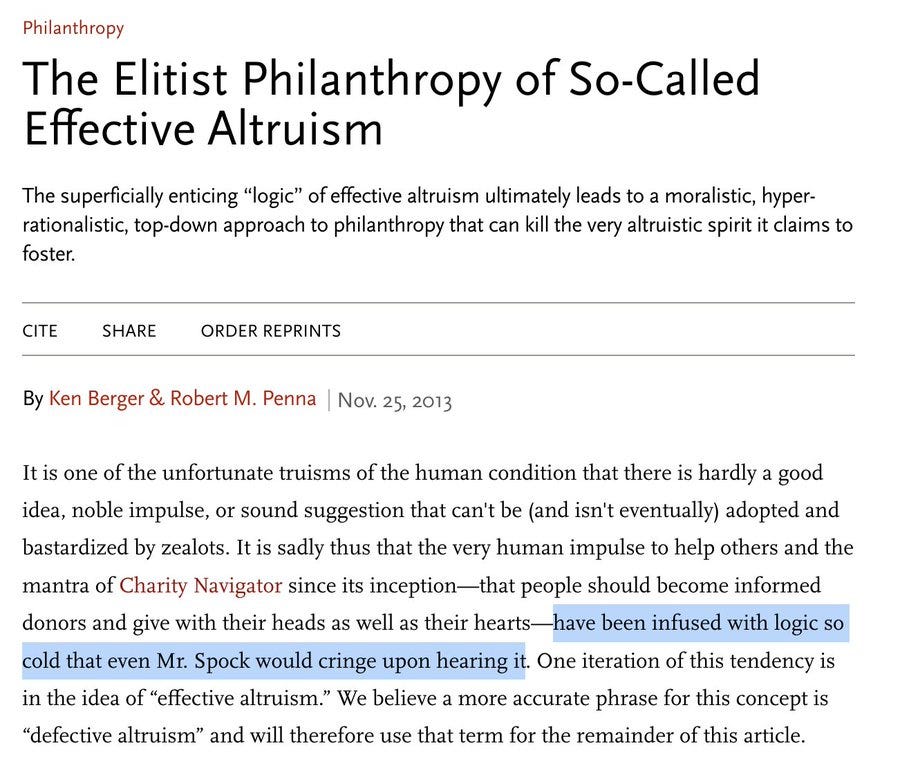
The reply is, of course, that EA is a neglected truism. The core EA idea is that you should make doing good as effectively as you can a major life project. It sounds really obvious when you think about it. But almost nobody acts on the idea. Prior to the dawn of EA, almost nobody looked hard into charitable effectiveness. Other organizations that were focused on 𝕏tallying overhead even mocked us for this!
Most people don’t give much to charity, and if they do, they give to charities that resonate with them rather than ones that are most effective. If you ask most people who give to charity why they think the charity they gave to is the most effective one, they will give you a vaguely confused look.
So here, I will make very clear that I am not Motte and Baileying you. There is a specific thing I think you should do that you probably do not do. That thing is taking the Giving What We Can pledge and giving 10% of your income to effective charities. I think the case for taking the pledge is extremely strong, but almost nobody does it. In this respect, it’s a neglected truism.
You cannot say that EA claims are all trivial when EAs are saying that you should give 10% of your income to effective charities and almost nobody does that. It can’t be that a claim is too obvious and trivial to need stating if almost nobody acts on it, including you.
The pledge is a pledge to give 10% of your income to effective charities. I have taken the pledge (though I give significantly more than 10%). It is very streamlined and efficient. It allows you to keep all your donations in one place, and see whether you’ve donated 10% of your income to effective charities. Taking the pledge also helps convince others to do so. Thus, if you’re going to give 10%, I think you ought to take the pledge.
Why should you give 10%? Well, here is a very plausible moral premise: intense suffering and death are bad. It is bad when a child dies. If you can prevent something very bad from happening without giving up anything of comparable value, then you should do so. This is why you should pull a child from a pond if doing so would ruin your shoes or pull a child from a car-wreck, even if doing so would ruin your fancy watch.
Giving up 10% of your income would likely save at least a life a year. The best charities save lives for about $4,000. So if you give away 10% of your income, depending on your income, you’ll maybe save one life a year and maybe multiple. Think about some child you know. Imagine that child dying. Then imagine that a stranger could prevent them from dying by sacrificing a small portion of their salary.
Shouldn’t the stranger give a small fraction of their salary, so that the child you know can live? If the far away child dying of malaria was your brother, your child, or your cousin, wouldn’t you want a stranger to save them at the cost of just a few thousand dollars? If someone could have saved my life when I was a child, but didn’t do so because it would have been slightly personally costly, that would have seemed bad. So similarly when some far away child is dying, I should help if I can.
Why should you give to effective charities rather than ineffective ones? The answer is that there is strong moral reason to do more good instead of less good. Almost everyone recognizes this in other contexts. If you can either save five people or two from an oncoming train, everybody (save John Taurek) thinks you should save five. If we apply this logic to the charity sector, we end up with the conclusion that you should donate where you can do the most good. This matters a great deal, because the best charities do hundreds or thousands of times more good than the median charity.
Does the fact that some charities appeal to you emotionally mean that you should give to them even if they don’t do the most good? No. Imagine there were five people dying of typhoid and three of lupus. You could either save the five or the three. Would it be reasonable to save the three on grounds that treating lupus resonates with you more emotionally? No, obviously not. Similarly, when deciding which charity you give to, you should give where you think will do the most good, rather than to the place that resonates with you. Preventing death is more important than feeling happy about the particular way you prevented death.
Is this too demanding? Is this like asking you to give up your life to save ten others—which morality could never command? No, because the cost is not extremely large. Remember, I am not saying you should give away all of your money. Maybe you should do that, but that’s not the ask, and that depends on more controversial ethical assumptions. I am saying that you should give away 10% of it. That still leaves you with 90% which is likely much more than average members of your parent’s generation had, and certainly much more than average members of your grandparent’s generation had.
The correlation between money and happiness is real but pretty small. In contrast, the correlation between charitable giving and happiness is pretty large. The best study on the association between money and happiness found “donating to charity had a similar impact on happiness to household income doubling!”
By giving regularly, you can know that you are making a meaningful difference. There are children who would be dead if you’d never lived, but who instead get to live. This makes your life more meaningful. So my guess is that giving is not a cost. Instead, even if you were selfish you should give. I’m very happy generally, and a big part of that is thinking that I’m making a difference with my life.
But even if it did make you a bit less happy, this would be a small price to pay to save lives regularly. Even if you have a 10% reduction in your happiness, you’ll still be one of the wealthiest 1% of people who ever lived, if you’re in the west. You’ll be one of the richest few percent of people in the world. Going from super duper affluent by historical standards to *merely *super affluent and saving a bunch of extra lives is worth it!
If you’ll still be able to live well and still be richer than almost everyone who has ever lived after making some sacrifice, then it is hardly the kind of debilitating sacrifice that is too demanding for morality to ever demand. If paying a small price is the only way to prevent many children from dying, then you should do that.
Now, there are some other controversial things I think. So, for example, I think that it’s good to donate to help shrimp, because one dollar can spare thousands of shrimp from a horrible fate. But that is a *separate *view from the view that you should give to effective charities and most people who give to effective charities don’t believe it. Do not say, then, “I am not on board with giving to effective charities because I don’t care about shrimp, and otherwise EA is a tautology.” It’s not a tautology. It says you should do something that you probably don’t do!
So please, you, whoever is reading this, think hard about whether to give 10% of your income to effective charities. Think hard about whether you want to be the kind of person who sacrifices a small fraction of your income to save a bunch of lives. If you take the pledge, standard offer goes: I’ll give you a free paid subscription to this blog.
My guess is that if you take the pledge, you will be happier and more fulfilled. More importantly, many additional children won’t die unnecessarily. If you could see the children suffering from their diseases, you would see how vital this kind of action is and feel empathy for them.
But the fact that you can’t see them doesn’t make any difference to your reasons to help them. It is a betrayal of the principle *behind *empathy to only help those who we can see vividly enough to feel for. It is wrong to let children die because they’re too far away away to see.